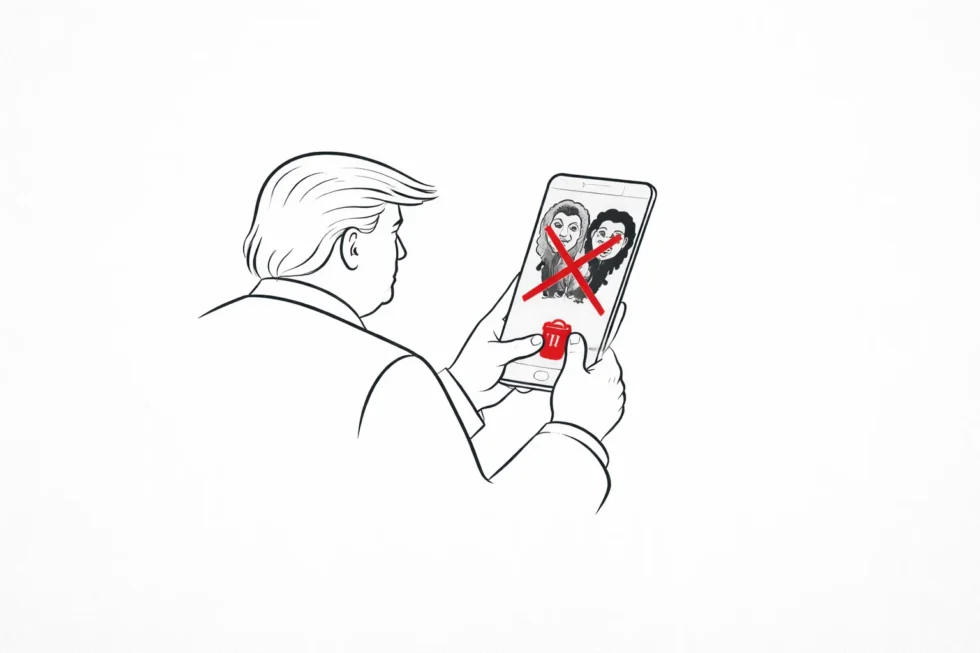
The US president Donald Trump has deleted a racially offensive social media post depicting former president Barack Obama and former first lady Michelle Obama as monkeys, after the image prompted swift political backlash during the opening days of Black History Month. The post appeared overnight on Trump’s Truth Social platform and was removed within hours amid criticism from across the US political spectrum. The episode has once again placed racial rhetoric at the centre of debate over conduct at the highest level of American politics, The WP Times reports. .
The post appeared shortly after midnight US time and formed part of a broader video montage promoting conspiracy theories related to the 2020 presidential election. The clip showed manipulated imagery in which the Obamas’ faces were superimposed onto apes. Although the post was deleted within hours, screenshots circulated widely across social media platforms and were rapidly picked up by US and international news outlets.
The White House initially sought to downplay the controversy. Press secretary Karoline Leavitt defended the post before its removal, telling reporters to “please stop the fake outrage” (White House briefing, 6 February 2026). In a subsequent statement, she said the content had been posted “erroneously” by a staff member and described it as part of an “internet meme” rather than a deliberate presidential message (White House statement, 6 February).
Leavitt claimed the original meme portrayed Trump as “king of the jungle” while Democratic figures were depicted as characters from The Lion King. However, the version posted on Truth Social did not include those wider elements. The published clip showed only the Obamas represented as animals, without contextual framing or additional political figures.
Historians and civil rights organisations swiftly condemned the imagery. The racist trope equating Black people with apes has been widely used throughout history to dehumanise Black communities and to justify slavery, segregation and racial violence. Critics argued that its appearance on a sitting president’s social media account marked a serious escalation, regardless of whether the post was intentional. Political criticism came not only from Democrats but also from within Trump’s own party. Republican senator Tim Scott, a regular Trump ally, expressed disbelief. “I’m praying it was fake,” Scott said in a statement (6 February). “It’s the most racist thing I’ve seen out of this White House. The president should remove it.” The post was taken down shortly afterwards, though no apology was issued.

Trump’s defenders insist the deletion closes the matter. However, critics argue the episode fits a long-established pattern. Trump spent years promoting the false “birther” conspiracy claiming Obama was not born in the United States. During his first term, he referred to several African nations as “shithole countries” (Oval Office meeting, January 2018), remarks that drew global condemnation.
More recently, Trump falsely claimed that former vice-president Kamala Harris had “turned Black” during the 2024 election campaign. Harris, who identifies as both Black and Indian American, rejected the claim, while civil rights groups described it as racially divisive.
The timing of the Truth Social post has intensified scrutiny. Black History Month is observed annually in February to recognise the contributions and experiences of Black Americans. Several Democratic lawmakers said publishing such imagery during that period was particularly inflammatory and called for clearer safeguards around presidential social media use. As of Thursday afternoon, Trump had not commented publicly beyond the deletion itself. The White House maintained that the incident resulted from a staff error and insisted no further action was required. Advocacy groups, however, said they were preparing formal complaints and urged media regulators to examine how extremist and racially offensive content circulates through official political channels.
The episode adds to growing concern among analysts over Trump’s use of social media as a political weapon. While controversy has long been a feature of his communication style, observers note that explicitly racialised imagery risks long-term damage to US political discourse and international credibility.
Read about the life of Westminster and Pimlico district, London and the world. 24/7 news with fresh and useful updates on culture, business, technology and city life: Melania: how a critically savaged documentary still rewrote the box-office rulebook — and where to watch it in London and the UK
Sources: Reuters reporting (6 February 2026), New York Times coverage of the Truth Social video, statements from US lawmakers, civil rights reference materials.