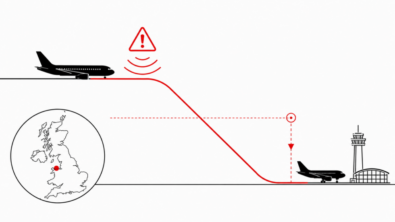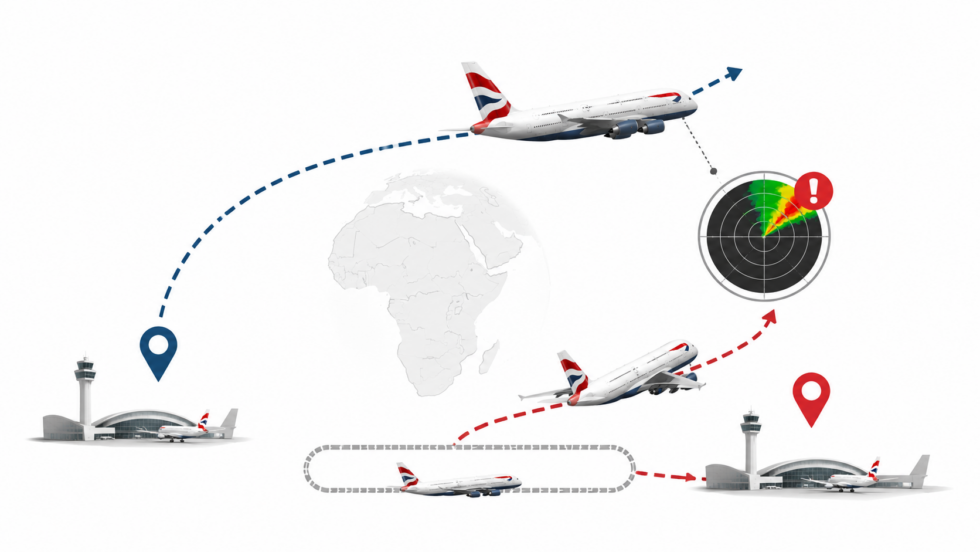
11 August 2026. An Airbus A380 7-hour return flight left British Airways passengers back at the same airport from which they had departed after flight BA54 from Johannesburg to London Heathrow developed a reported weather-radar problem over Central Africa. The aircraft, British Airways A380-841 G-XLEJ, had already suffered a delay of more than five hours on the ground before eventually leaving O.R. Tambo International Airport at 02:36 local time on 8 August. It climbed to about 34,000ft and continued north through Botswana and Zambia towards the Democratic Republic of Congo, but the London-bound journey was abandoned after the crew detected the reported radar malfunction. Instead of continuing across Africa and towards Europe, the A380 reversed course for Johannesburg, turning what should have been an overnight intercontinental service into an almost seven-hour flight that ended where it began. The WP Times reports that the aircraft then spent roughly two hours in a holding pattern north of Johannesburg as its weight was reduced before landing safely back at O.R. Tambo.
For passengers, the sequence was unusually long even by the standards of a technical return. BA54 was scheduled to leave Johannesburg at 21:15 on 7 August for a journey of roughly 11 hours and 15 minutes to Heathrow, but did not become airborne until the early hours of the following morning. More than two hours into the northbound sector, the A380 reached the DRC region before turning south. The decision did not lead to an immediate landing: the aircraft had departed Johannesburg carrying fuel for the long journey to Britain, and after returning towards South Africa it entered a racetrack-style holding pattern at around 25,000ft. It eventually landed at Johannesburg almost seven hours after take-off. The aircraft underwent maintenance and was subsequently returned to service; G-XLEJ departed Johannesburg again as BA54 at 22:48 on 8 August and this time completed the journey to London Heathrow. The available reports do not indicate injuries or an accident during the incident.
Airbus A380 7-hour return flight: the timeline of British Airways BA54
The scale of the disruption becomes clearer when the journey is reconstructed chronologically. BA54 is British Airways’ Johannesburg-to-London Heathrow service, with a scheduled journey of approximately 11 hours and 15 minutes. Published schedule data lists the service as departing Johannesburg at 21:15 local time and being operated by an Airbus A380-800.
On this occasion, however, the disruption began before passengers left South Africa.
| Stage | What happened |
|---|---|
| Scheduled departure | 21:15 SAST, 7 August |
| Actual departure reported | 02:36 SAST, 8 August |
| Aircraft | Airbus A380-841 |
| Registration | G-XLEJ |
| Route | Johannesburg to London Heathrow |
| Initial altitude | Around 34,000ft |
| Route before turnback | Botswana, Zambia and towards the DRC |
| Reported problem | Weather-radar malfunction |
| Crew decision | Return to Johannesburg |
| Return phase | Holding north of Johannesburg |
| Holding altitude reported | Around 25,000ft |
| Holding duration | Approximately two hours |
| Result | Landed back at Johannesburg |
| Next departure | 22:48 SAST on 8 August |
| Final outcome | Subsequent BA54 reached Heathrow |
The supplied aviation report says the aircraft had travelled for more than two hours through Botswana and Zambia before reaching the Democratic Republic of Congo, where the reported weather-radar problem was identified. The crew then discontinued the planned northbound journey and turned south. That distinction matters. The aircraft did not fly for seven hours towards London and then suddenly turn around close to Britain. A substantial part of the total airborne time was accumulated on the outward leg, the return south and the subsequent holding near Johannesburg.
Why did BA54 turn back instead of continuing to London
The reported fault involved the aircraft's weather radar. An airborne weather-radar system gives pilots information that helps them identify significant precipitation and convective weather ahead and plan an appropriate route around it. That capability is particularly relevant when an aircraft is crossing regions where significant convective weather may be encountered. The supplied account states that the problem became a concern because BA54's route was taking it through the equatorial region. Rather than continue the long-haul sector with the reported radar malfunction, the crew turned the aircraft back.
It is important not to go further than the evidence. The available reporting identifies a reported weather-radar malfunction; it does not establish that the aircraft itself was in immediate danger, that it had encountered a severe storm, or that passengers were facing an emergency landing. What is known is simpler: a technical problem was identified, the London sector was discontinued and the crew returned to the departure airport.
Why return all the way to Johannesburg?
A turnback can appear counter-intuitive once an aircraft has already travelled hundreds of miles from its departure airport, but distance alone does not determine where a crew lands after a technical problem.
The operating airline must consider the nature of the fault, airport suitability, maintenance support, operational resources and the aircraft's subsequent handling. Johannesburg was the departure point for the service and a station from which British Airways was operating the A380.
The available reporting does not provide the crew's detailed operational decision-making or a British Airways technical statement explaining why Johannesburg was selected rather than another airport. It would therefore be speculation to attribute the decision to one particular operational factor.
What can be stated is that the crew elected to reverse course and the aircraft ultimately returned safely to O.R. Tambo.
Why the British Airways A380 spent about two hours circling Johannesburg
Returning towards Johannesburg did not mean BA54 could simply descend and land immediately.
A long-haul aircraft departing for an 11-hour journey can be considerably heavier shortly after take-off than it would normally be on arrival because much of the fuel intended for the flight remains aboard.
That is where the difference between maximum take-off weight and maximum landing weight becomes relevant.
Airbus documentation for different A380-800 weight variants lists maximum take-off weights substantially above their corresponding maximum landing weights. Depending on the weight variant, Airbus documentation gives maximum take-off weights reaching 575,000kg, while maximum landing weights are around 386,000kg to 395,000kg.
This does not mean BA54 was necessarily at either of those limits. The precise take-off weight, fuel load and target landing weight for G-XLEJ on this particular flight have not been made public in the material reviewed.
It does explain, however, why aircraft weight becomes an important consideration when a heavily fuelled long-haul aircraft returns.
The supplied account says that as BA54 approached northern South Africa, the A380 descended to approximately 25,000ft and entered a racetrack holding pattern north of Johannesburg. It remained there for about two hours, burning fuel before continuing to O.R. Tambo.
Did the Airbus A380 dump fuel before landing?
The material supplied for this report specifically describes the aircraft burning fuel while holding. It does not establish that G-XLEJ conducted a fuel jettison.
That distinction should be retained.
Flight-tracking patterns showing an aircraft circling do not, by themselves, prove that fuel is being dumped. In this case, the reporting describes a prolonged holding pattern used to reduce aircraft weight through fuel consumption.
The sequence therefore appears to have been:
- BA54 turned south after the reported radar problem.
- The A380 returned towards the Johannesburg area.
- It descended to approximately 25,000ft.
- The crew entered a racetrack holding pattern.
- The aircraft remained in the hold for about two hours.
- Fuel consumption reduced the aircraft's weight.
- BA54 then returned to O.R. Tambo.
The source account says the aircraft subsequently landed without incident.
How unusual was the seven-hour “flight to nowhere”?
The striking element was not simply the turnback but its duration.
Passengers had first experienced more than five hours of delay before departure. They then spent almost seven hours airborne only to return to Johannesburg. In practical terms, somebody who had arrived at the airport expecting an overnight journey to Britain could have spent well over half a day travelling without reaching another city. But the seven-hour figure should not be confused with seven hours spent attempting to resolve the technical fault in flight.
It encompasses several separate phases: the northbound journey from Johannesburg into Central Africa, the reversal and flight back towards South Africa, and approximately two hours of holding before landing. The planned Johannesburg–Heathrow journey itself is a substantial sector. Current schedule information puts BA54 at approximately 11 hours and 15 minutes and the direct distance between the two cities at roughly 5,639 miles, or 9,075km.
What happened to A380 G-XLEJ after it returned to Johannesburg
The return did not end the aircraft's involvement in BA54.
After landing, G-XLEJ was taken for maintenance checks and repairs associated with the reported weather-radar problem. According to the supplied material, engineers subsequently cleared the aircraft to return to service.
The same A380 departed Johannesburg again later on 8 August.
Its second departure was recorded at 22:48 SAST, against a normal scheduled departure time of 21:15 for that evening's BA54. This time the aircraft continued north and completed the journey to London Heathrow without a further reported disruption. G-XLEJ is a British Airways Airbus A380-841 delivered to the airline in November 2015. Aircraft fleet records identify it as manufacturer serial number 192 and list it as active. The aircraft's return to commercial service on the same route is significant because it shows that the initial turnback did not result in G-XLEJ being removed from operation for a prolonged period.
What passengers need to know about the BA54 incident
The essential facts can be separated from some of the more dramatic descriptions of the journey.
The aircraft did turn back. BA54 departed Johannesburg for Heathrow but reversed course after a reported technical problem involving its weather radar.
The journey lasted almost seven hours. That time included the initial northbound flight, the return towards South Africa and the holding period before landing.
The aircraft circled before landing. Reporting indicates approximately two hours in a racetrack holding pattern north of Johannesburg while fuel was consumed and aircraft weight reduced.
There is no evidence in the material reviewed of injuries. The A380 returned to O.R. Tambo and passengers and crew were reported to have returned to the gate without incident.
The aircraft flew again. After maintenance work, G-XLEJ was cleared for service and operated BA54 again later on 8 August, successfully reaching Heathrow.
For British passengers following the story, that final point puts the incident in context. The unusual feature was the extraordinary length of the aborted journey rather than an accident involving the aircraft.
Why the BA54 Airbus A380 return attracted attention
A commercial flight returning to its departure airport after a technical problem is not in itself unprecedented. What made BA54 particularly conspicuous was the combination of the aircraft involved, the distance already travelled and the amount of time passengers spent airborne before arriving back at their starting point. The Airbus A380 remains the world's largest passenger airliner by capacity in its full-density potential configuration, and its size makes an extended holding pattern visually striking on flight-tracking services. G-XLEJ itself is one of British Airways' A380-841 aircraft and is powered by four Rolls-Royce Trent 970 engines, according to aircraft records. There was also an obvious passenger dimension. The service had already suffered a ground delay exceeding five hours. The aircraft then departed in the early morning, travelled north across southern and Central Africa, reversed course and eventually returned to Johannesburg.
For those on board, the destination after almost seven hours of flying was therefore exactly the same airport they had left.
Yet the operational outcome was straightforward: the aircraft landed safely, underwent maintenance and subsequently returned to service. The most accurate description of the event is therefore less dramatic than some of the “flight to nowhere” headlines surrounding it. BA54 was a long-haul service that developed a reported technical problem after departure; the crew discontinued the London journey, returned to Johannesburg and spent additional time holding before landing as the aircraft's weight was reduced.For passengers, however, the result was undeniably exceptional: more than five hours of delay on the ground followed by almost seven hours aboard an Airbus A380, only to arrive back at O.R. Tambo International Airport.
Materials used in preparing this report: Aviation A2Z, Airlive, Airbus Aircraft Characteristics documentation, BA54 published flight schedule data, aircraft registration and fleet records.
Read about the life of Westminster and Pimlico district, London and the world. 24/7 news with fresh and useful updates on culture,
business, technology and city life: What is known about the August England bus pass change and who will have to wait longer to qualify