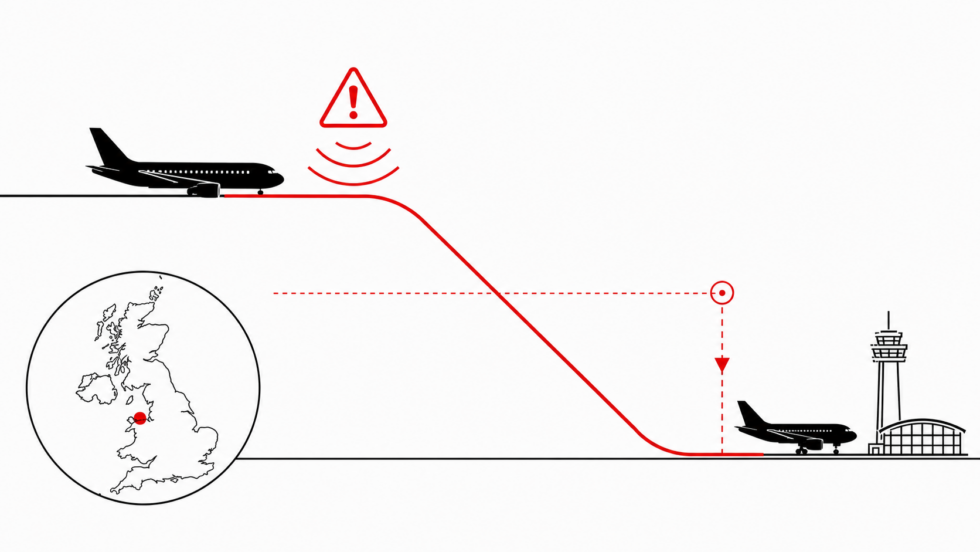
British Airways BA825 emergency descent began after the Dublin-to-London service declared a general in-flight emergency over north-west England on Tuesday, 1 September 2026. Flight BA825, operated by an Airbus A321neo registered G-TNEI, transmitted transponder code 7700 near Liverpool before making a controlled descent to 8,000ft and continuing towards London Heathrow rather than diverting to another airport. Emergency arrangements were made for its arrival, while the aircraft remained under air traffic control at the lower altitude. British Airways later described the cause only as a “minor technical issue”, without identifying the affected system or giving further technical detail. The aircraft landed safely at Heathrow at about 9.49am BST, according to flight-tracking data cited in reports published after the incident. The WP Times reports that no injuries or subsequent operational disruption linked to BA825 have been reported.
The sequence matters more than the emergency label alone. A 7700 code tells controllers that an aircraft requires emergency handling, but it does not identify whether pilots are dealing with a technical fault, medical problem or another situation on board. In BA825’s case, the most significant observable change was the descent from cruising altitude to 8,000ft, followed by continued flight towards the airline’s Heathrow destination. The crew did not divert to Liverpool, Manchester or another nearer airport, and the aircraft subsequently reached London safely. British Airways has not publicly attributed the event to pressurisation, an engine problem or any other specific failure, so those possibilities should not be presented as the cause.
The confirmed facts are the 7700 declaration, the descent to 8,000ft, the continuation to Heathrow and a safe landing after what British Airways called a minor technical issue.
What happened during the British Airways BA825 emergency descent?
Flight BA825 Dublin to Heathrow was operating the short morning link between the Irish and British capitals when its routine journey changed over north-west England. Tracking reports identify the aircraft as G-TNEI, an Airbus A321-251NX, commonly described as an A321neo. AIRLIVE reported that the crew selected squawk 7700 near Liverpool shortly after reaching cruising altitude, while independent flight-tracking records also logged the aircraft as a 7700 emergency on 1 September. The jet then descended sharply but in a controlled manner until it reached approximately 8,000ft. It remained at the lower level while proceeding towards Heathrow, with reports describing a holding phase as the crew assessed the situation with air traffic control.
There is a small difference between published departure times because flight trackers and news reports can use different operational markers. The Independent, citing FlightAware, reported an 8.30am departure and a 9.49am arrival, while AIRLIVE placed departure at about 8.45am; AirNav Radar records BA825 from Dublin and confirms a 9.49am BST arrival at Heathrow. That discrepancy does not alter the central chronology of the emergency. The aircraft was airborne on its normal Dublin-London sector, declared the emergency near Liverpool, descended to 8,000ft and then continued south.
The sequence can be reduced to five confirmed operational points:
- BA825 departed Dublin Airport on the morning of 1 September for London Heathrow.
- The Airbus A321neo G-TNEI transmitted emergency code 7700 while over north-west England.
- Flight-tracking data showed a controlled descent to approximately 8,000ft.
- The aircraft remained on course for Heathrow instead of diverting to another airport.
- BA825 landed safely at Heathrow at about 9.49am BST.
The uploaded reporting supplied for this article also records that Heathrow ground crews were placed on standby and that British Airways attributed the declaration to a “minor technical issue”.
Why BA825 descended to 8,000ft has not been disclosed
The altitude change is the most visible technical feature of the flight, but it does not establish the cause. A rapid or precautionary descent may be appropriate in several abnormal situations, and the track alone cannot determine which checklist or system prompted the crew’s decision. British Airways has not released engineering findings, a detailed crew account or a description of the component involved.
“The aircraft landed safely at Heathrow following a minor technical issue.” (British Airways spokesperson, 1 September 2026, statement reported after BA825 landed.)
That wording is deliberately limited. It confirms a technical issue and the safe outcome but does not say what failed, when the problem was first detected or whether maintenance action was required after arrival. Reports that speculated about cabin pressure, an engine issue or an onboard medical event preceded the airline’s confirmation and should not be treated as established explanations. AIRLIVE itself initially said the nature of the anomaly had not been formally confirmed.
No public evidence released on Tuesday establishes that BA825 suffered a depressurisation, engine failure or other specific malfunction.
What the flight path shows before the Heathrow landing
The British Airways flight emergency Heathrow operation differs from a diversion because BA825 ultimately kept Heathrow as its destination. Once stabilised at the lower altitude, the crew continued towards London rather than turning into a nearer airport. Reports placed Heathrow emergency services on standby, a normal precaution when an inbound aircraft has declared an emergency and may require priority handling on arrival.
Published tracking information indicates that the aircraft approached Heathrow and landed without a further reported airborne escalation. Some reporting placed touchdown at about 9.40am, while tracker-derived arrival or gate times show approximately 9.49am; those times can describe different stages between runway touchdown and completion of the flight. AIRLIVE subsequently reported the aircraft taxiing to a remote stand at Terminal 5.
| BA825 event | Confirmed information |
|---|---|
| Route | Dublin Airport to London Heathrow |
| Date | 1 September 2026 |
| Aircraft | Airbus A321neo |
| Registration | G-TNEI |
| Emergency code | Squawk 7700 |
| Location of declaration | North-west England, near Liverpool |
| Lower altitude | Approximately 8,000ft |
| Airline explanation | Minor technical issue |
| Destination after declaration | London Heathrow |
| Recorded arrival | About 9.49am BST |
| Outcome | Landed safely |
What does BA825 squawk 7700 mean for an aircraft in flight
The BA825 squawk 7700 signal is important because it changes how air traffic control handles an aircraft, but it is not a diagnosis of the emergency. Aircraft transponders transmit identifying and operational information that controllers use to monitor traffic. Code 7700 is internationally reserved for an aircraft in a state of emergency and alerts controllers that the flight may require priority, assistance or additional coordination. ICAO procedures state that a pilot in an emergency should normally select Mode A code 7700 unless air traffic control has already instructed the aircraft to maintain another specified code. ICAO procedures therefore explain what the code communicates, not what caused the event aboard an individual aircraft.
“The pilot of an aircraft in a state of emergency shall set the transponder to Mode A Code 7700.” (International Civil Aviation Organization, transponder emergency procedures.)
A 7700 alert can accompany very different situations. The code gives controllers a common signal that something requires emergency handling even before all details have been exchanged by radio. It may also lead to coordination with the destination airport and emergency services while pilots work through procedures in the cockpit.
For BA825, the code should therefore be read alongside what happened next:
- the crew descended significantly from cruising altitude;
- the aircraft stabilised at approximately 8,000ft;
- the flight remained under control and continued towards London;
- Heathrow prepared for the arrival;
- the aircraft landed safely;
- British Airways subsequently identified a minor technical issue as the reason for the emergency declaration.
Those facts do not mean the 7700 call was unnecessary or that a “minor” fault could be ignored in flight. Aviation crews may declare an emergency because they need immediate operational flexibility while dealing with a problem whose severity is still being established. The airline’s later description reflects what was known after the aircraft had landed safely, not necessarily the information available to the pilots when they selected 7700.
An emergency declaration describes the operational status of the flight at that moment; it does not by itself measure the eventual severity of the fault.
What is known about the Airbus A321neo G-TNEI
The aircraft identified in the incident, Airbus A321neo G-TNEI, belongs to the newer-engine generation of Airbus’s A320 single-aisle family. Airbus lists the A321neo as the longest-fuselage member of that family, with typical two-class capacity of 180 to 220 passengers and a maximum certified seating figure of 244 depending on configuration. The manufacturer gives the standard A321neo family a maximum range of up to 4,000 nautical miles for relevant variants, far beyond the requirements of the Dublin-Heathrow sector. Airbus’s official A321neo specifications also list an overall length of 44.51 metres and a wingspan of 35.8 metres. Those specifications provide context for the aircraft type, not evidence about the cause of Tuesday’s technical issue. No public statement reviewed on 1 September tied the event to an A321neo-wide safety problem. There is also no basis in the available information to infer a fleet-level issue from a single emergency declaration.
Why the aircraft could continue to Heathrow
Continuing to the planned destination after an emergency declaration can appear counter-intuitive, particularly when the aircraft has already made a substantial descent. In practice, the crew’s decision depends on the nature of the problem, aircraft condition, airport suitability, weather, available technical support and instructions or coordination with air traffic control. The public record in this case does not disclose the crew’s decision-making or the technical checklist involved.
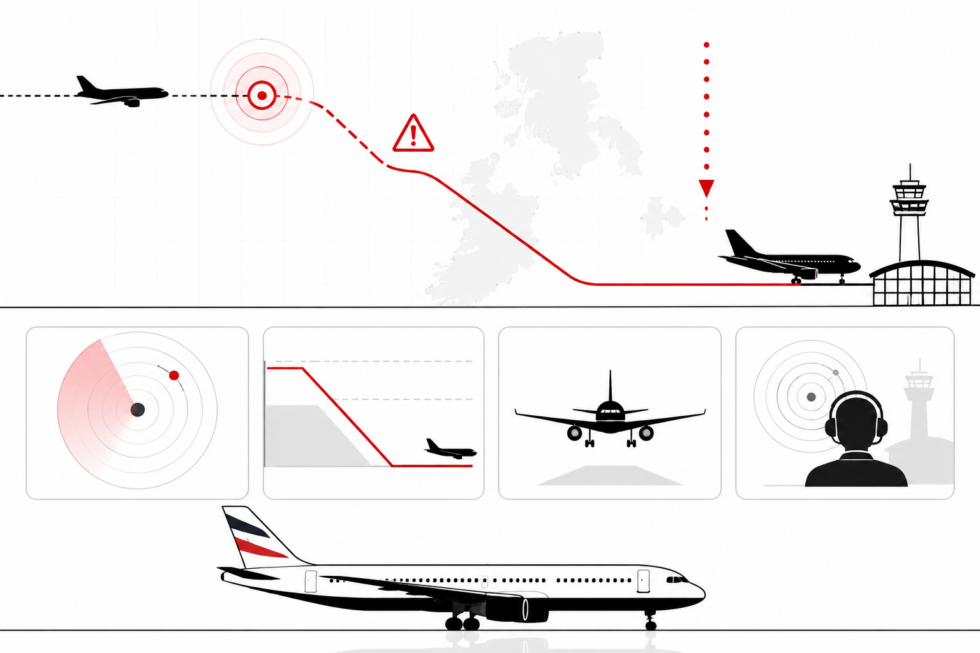
What can be established is that BA825 did not make an unscheduled landing elsewhere. Heathrow is British Airways’ principal London hub and was already the planned destination. The aircraft remained airborne long enough to continue there at lower altitude, while emergency support was prepared for its arrival. That operational sequence is consistent with a problem the crew was able to manage through to landing, although British Airways has not provided enough information to define the fault more precisely.
How did the BA825 emergency end at London Heathrow
The final phase of the British Airways BA825 emergency was comparatively straightforward in public flight records: the aircraft reached Heathrow, landed safely and left the active runway. No evacuation, passenger injuries or damage to the aircraft were reported in the material available on Tuesday evening. British Airways’ statement confirmed the safe landing and characterised the trigger as a minor technical issue. The airline did not announce a diversion, rejected landing, return to Dublin or second emergency during the approach.
The outcome also separates BA825 from incidents in which a 7700 declaration leads to an immediate diversion. Two days earlier, Jet2 flight LS1473 from London Stansted to Ibiza transmitted the same general emergency code and diverted to Paris Charles de Gaulle before later continuing to Spain, according to reports published on Tuesday. BA825 followed a different operational path: lower altitude, continued progress to its intended airport and a safe Heathrow arrival.
The comparison illustrates why the transponder code alone cannot tell passengers what will happen next.
| Flight | Emergency action | Immediate destination | Outcome reported |
|---|---|---|---|
| BA825, Dublin-Heathrow | 7700, descent to 8,000ft | Heathrow remained destination | Landed safely |
| LS1473, Stansted-Ibiza | 7700, diversion | Paris Charles de Gaulle | Landed, later continued to Ibiza |
British Airways has not publicly released the number of passengers aboard BA825, the exact cockpit warning received by the crew, the maintenance findings after landing or whether G-TNEI required repairs before returning to service. Without those details, any more specific description of the failure would go beyond the confirmed evidence.
What is known about BA825 after the safe landing
By Tuesday evening, the essential safety outcome was clear. BA825 had completed the Dublin-Heathrow sector, everyone aboard had reached the destination safely according to the available reporting, and no continuing airport disruption had been attributed to the incident. Flight-tracking databases recorded the aircraft’s arrival, while the airline gave no indication that the event had affected wider Heathrow operations.
The remaining unanswered question is technical rather than operational: precisely what generated the problem that led the crew to declare 7700 and descend to 8,000ft. British Airways’ “minor technical issue” description is currently the most specific confirmed explanation. Unless the airline, a regulator or an investigation subsequently publishes more detail, attributing the descent to a particular aircraft system would be speculation.
BA825’s emergency ended with a normal destination reached safely, but the exact technical fault behind the 7700 declaration has not been publicly identified.
Materials used: British Airways, International Civil Aviation Organization, Airbus, FlightAware flight data, AirNav Radar, AIRLIVE, The Independent, Daily Mirror.
Read about the life of Westminster and Pimlico district, London and the world. 24/7 news with fresh and useful updates on culture, business, technology and city life: Why was Heritage Live cancelled and what is known about the Sandringham concerts, line-ups and refunds