The global technology landscape is on the precipice of its most significant transformation since the launch of the original iPhone. On June 8, 2026, the world’s attention will fixate on Apple Park as the annual Worldwide Developers Conference (WWDC) kicks off. This is no ordinary software update; it is a seismic shift for millions of users across the United Kingdom. This year's keynote is set to unveil iOS 27, introducing the radical "Liquid Glass" design—the first major aesthetic overhaul in over a decade—alongside a groundbreaking integration of Google Gemini algorithms directly into the heart of Apple Intelligence.
For the British consumer—from the fintech innovators in London’s Silicon Roundabout to the creative agencies of Manchester and the growing biotech clusters in Cambridge—this represents the birth of a Siri that finally transcends basic voice commands to become a proactive, neural assistant. In 2026, Siri becomes a cognitive partner capable of managing complex, localized tasks with an understanding of British nuance that was previously the stuff of science fiction.
This event represents a fundamental pivot from a static app-based interface to a fluid, context-aware ecosystem. As reported by The WP Times , via apple.
iOS 27 and Liquid Glass: Aesthetic Precision for the UK Market
With the release of iOS 27, Apple officially matures "Liquid Glass," a design language that first appeared in 2025 but reaches its technical zenith in 2026. This system moves away from the "flat" layers of the past decade toward a UI rooted in hyper-realistic refractions, adaptive glass textures, and complex fluid physics. This philosophy mirrors the British appreciation for premium craftsmanship and understated elegance.
In 2026, your iPhone is no longer a static pane of light. Through the "Visual Intelligence" engine, the interface behaves like a physical material. Under the damp, grey skies of a typical London drizzle, your lock screen might subtly "mist" over, increasing contrast for better legibility in low light. Conversely, during a rare high-summer heatwave in the Cotswolds, the glass textures turn krystal-clear, utilizing high-dynamic-range (HDR) peaks to remain visible under direct glare.
This isn't merely aesthetic "eye candy." It is functional design intended to reduce cognitive load. By using "depth-sensing" layers, iOS 27 surfaces information based on your UK-specific context. If you are rushing through a crowded Waterloo Station, the UI elements expand and simplify, making it easier to tap your railcard or check a platform number with one hand. Furthermore, a major leak ahead of WWDC 2026 suggests that Apple will finally address readability concerns by introducing a "Glass Intensity Slider." This allows users to finely control the level of transparency and refraction across the system. For British professionals who require high-contrast text for long-form reading on the morning commute, this level of personalization is a direct response to user feedback from the previous year.
| iPhone Model Range | Liquid Glass Support | Siri Neural (Gemini Power) | UK 5G Standalone (EE/O2/Vodafone) |
| iPhone 17 Pro / Ultra | Full Native (4K Refractions) | Full (On-Device Neural) | Optimised for 2026 5G-SA |
| iPhone 16 Pro / Max | Full Support | Hybrid Cloud Processing | Full Support |
| iPhone 15 Pro | Adaptive (Reduced Physics) | Basic Cloud Integration | Standard Support |
| iPhone 14 Series | Legacy View (Static Glass) | No Neural Support | Standard Support |
Siri 2.0: The "Brain Transplant" Powered by Gemini
The undisputed headline act of WWDC 2026 is the "Siri Brain Transplant." Following a historic multi-year agreement between Apple and Google announced in January 2026, the next generation of Apple Foundation Models is now based on Google Gemini technology. However, this is not "Google on an iPhone"—this is a bespoke, privacy-hardened implementation running on Apple’s own silicon and Private Cloud Compute.
In 2026, Siri possesses deep reasoning capabilities. For the British user, this is a game-changer. For the first time, Siri can perform multi-step, cross-app actions that are deeply integrated with UK-specific services. Imagine engaging in a complex request such as: "Siri, I'm heading to Shoreditch on Friday. Book a table for four at a gastropub with a good craft ale selection via OpenTable, then send the calendar invite to the lads on WhatsApp and check if the Overground is running normally." Siri doesn't just search; it executes the entire chain of command autonomously by interacting with the code of those apps in the background.
Crucially, this is powered by "Personal Context Awareness." Siri in 2026 remembers your specific British quirks—whether you prefer a specific morning order from Greggs, which train carriage you usually board on the Avanti West Coast for better Wi-Fi, or your preferred delivery window for Ocado. All this data remains encrypted within your "Neural Profile," ensuring your private life stays on your device. Internal reports suggest this system, codenamed "Campos," allows for a full conversational interface that rivals standalone chatbots while maintaining Apple's strict privacy ethos.
Localised UK Productivity: A National Upgrade
The 2026 Siri update provides several localized benefits that cater directly to the UK's unique infrastructure and cultural habits. These features are designed to strip away the "administrative friction" of daily life in Britain.
Commuter Intelligence & TfL Integration
Siri proactivity monitors National Rail and TfL data. If a strike is announced or a signal failure occurs on the Jubilee Line, Siri will automatically suggest an Uber alternative or re-calculate your bus route through the Citymapper API before you've even left the house. In 2026, Siri can even handle "Delay Repay" claims by identifying delayed journeys in your location history and drafting the claim for you. This proactive approach extends to airport pickups; if Siri sees an incoming flight in your calendar, it will monitor traffic to Heathrow or Gatwick and alert you exactly when to leave.
The Monzo & Revolut Financial Layer
Financial management in the UK is now voice-first. You can simply say, "Siri, split the pub bill from last night equally between everyone in the 'Sunday Football' group," and the request is handled instantly via deep-linking into your banking app. Siri can also track your "UK Cost of Living" metrics, flagging when your utility bills from British Gas or Octopus Energy are higher than average or suggesting better tariffs based on current UK market rates.
Mastery of the British Accent
Apple has made massive strides in "Neural Phonetics." Siri 2.0 can now distinguish and accurately transcribe diverse British accents, from the broad Glaswegian and Geordie to the melodic Welsh Valleys and the sharp Scouse. This makes dictation and voice control viable for the entire nation, regardless of regional dialect. The system features a "Regional Adaptation" mode that learns your specific phonetic patterns over the first 48 hours of use, achieving near-perfect accuracy even in noisy environments like a busy London pub.
HMRC and Tax Assistance
For the UK’s 5 million self-employed individuals, Siri can now summarize UK tax law changes for the 2026/27 financial year. It can scan your "Files" app for invoices and flag relevant receipts to help with your Self-Assessment, effectively acting as a digital junior accountant. This is particularly useful following the government's March 2026 reports on digital economy and AI impact, ensuring users remain compliant with the latest UK regulations.
Data Privacy: The UK Security Framework for 2026
In the post-Brexit landscape, data sovereignty has become a pillar of British enterprise. Apple’s 2026 strategy addresses this through Private Cloud Compute (PCC). When a Siri request is too complex for the iPhone’s local chip, it is routed to dedicated UK-based data centers. These centers operate under "Zero-Knowledge" protocols—Apple cannot see your data, and Google (providing the Gemini logic) never receives your identity.
This is vital for the UK’s financial sector in the City of London. Compliance with GDPR-UK is non-negotiable, and Apple’s guarantee that no Gemini-powered query is ever used to train global models provides a "walled garden" for sensitive British corporate data. iOS 27 introduces specific "UK Privacy Labels," giving users a granular look at which third-party apps (like Deliveroo or ASOS) are requesting access to their "Neural Profile." You can grant "Temporary Neural Access" for a single transaction, ensuring your long-term habits remain private.
The "Snow Leopard" Focus: Stability and the iPhone Fold
While the Liquid Glass and Gemini features are headline-grabbing, internal reports from Bloomberg's Mark Gurman suggest that iOS 27 is also a "Snow Leopard" style release. This means a heavy focus on stability, performance, and squashing long-standing bugs. Apple engineers have reportedly rewritten significant chunks of the core code to improve battery life across the entire supported lineup, ensuring that even older iPhones running iOS 27 feel snappy.
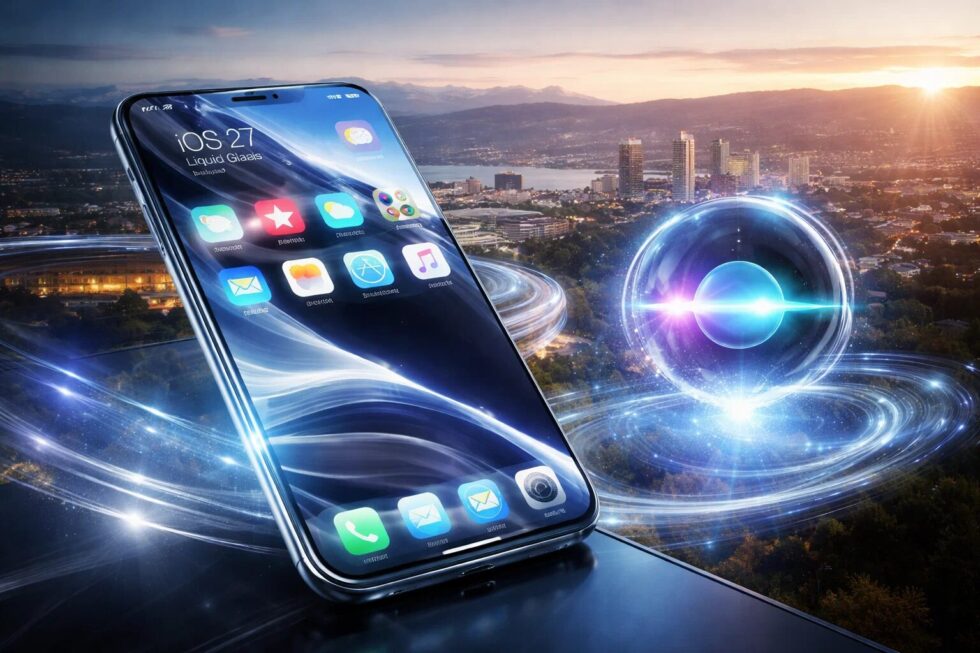
A major reason for this stability focus is the impending launch of the iPhone Fold in September 2026. iOS 27 includes extensive optimizations for foldable displays, including new windowing features that allow for true side-by-side multitasking—a first for the iPhone. For the UK business professional, this means being able to review a PDF contract on one half of the 7.8-inch inner display while participating in a Microsoft Teams call on the other, all while Siri handles background summarization of the meeting in real-time.
The Developer Frontier: Swift 7 and the UK Tech Scene
For the UK’s thriving developer community, WWDC 2026 introduces Swift 7. This language has been built from the ground up for "Neural-First" development. This allows a startup in East London or a coding house in Edinburgh to bake Gemini-level intelligence into their apps without the massive overhead of server-side AI costs.
High-Impact Developer Tools for 2026:
- Neural Logic Gates: Simplified code blocks that allow developers to integrate Gemini-based reasoning into local UK apps.
- Spatial Glass SDK: Tools to bring the Liquid Glass aesthetic to Vision Pro apps, catering to the UK's growing professional VR/AR market.
- Siri Intent 3.0: Allows UK retailers to offer "One-Tap Voice Checkout" via Apple Pay directly within a Siri conversation.
- Xcode 18: An AI-pair programmer optimized for UK coding standards and documentation, helping developers write cleaner, more efficient code.
- World Knowledge API: A new framework that allows third-party apps to access Apple's "World Knowledge Answers" platform, a direct competitor to AI search engines like Perplexity.
Hardware Evolution: The A19 and Beyond
While iOS 27 will run on older devices, the full "Liquid Glass" and "On-Device Gemini" experience is heavily optimized for the upcoming iPhone 18 and the current iPhone 17 Pro series. The iPhone 18, set for a September 2026 release, is rumored to feature the A20 Pro chip, built on TSMC’s cutting-edge 2nm process. This hardware leap is necessary to support the massive increase in local neural processing required by Siri 2.0.
For UK users, this also means the introduction of the Apple C2 modem. This Apple-designed 5G modem is expected to deliver significantly better power efficiency and support for high-speed mmWave networks, which are becoming increasingly prevalent in UK city centers. The integration of satellite-based features—including Maps and Photos via satellite—ensures that even in the most remote parts of the Scottish Highlands, UK users remain connected.
Business Strategies: Preparing the UK Workforce
UK-based power users and enterprises should adopt the following protocols to prepare for the iOS 27 ecosystem:
- Audit Legacy Hardware: The "Neural Gap" is real. To benefit from the new security architecture and Liquid Glass physics, company devices should ideally be at least iPhone 15 Pro models.
- Update MDM Policies: IT departments must review protocols to allow for "App-Specific Neural Access." This ensures AI can interact with company-approved apps like Slack without compromising the broader OS security.
- Two-Factor Enforcement: In 2026, 2FA is mandatory for all Apple Intelligence features. Ensure all UK mobile numbers associated with company accounts are verified and secured.
- Local Backups: As AI profiles become more unique, weekly encrypted backups to a local Mac are recommended to preserve your Siri "learning" profile and neural metadata.
- Employee Training: With the shift to an "Agentic" OS, employees will need to learn how to effectively prompt Siri to handle multi-app workflows, maximizing the productivity gains offered by iOS 27.
Summary for UK Users: The Verdict on 2026
WWDC 2026 proves that the iPhone has evolved beyond a communication device; it is now a proactive cognitive partner. The Liquid Glass design offers a level of aesthetic sophistication that aligns perfectly with British sensibilities, while the Gemini-powered Siri provides the efficiency required for the UK’s fast-paced digital economy. While the hardware requirements are steep for the most advanced features, the productivity gains—particularly in terms of time saved on administrative and logistical tasks—make the 2026 Apple lineup the most compelling in a generation.
The focus on stability and the optimization for foldable hardware suggests that Apple is laying the groundwork for the next ten years of mobile computing. For the UK consumer, this means a device that is more reliable, more capable, and more integrated into the fabric of British life than ever before.
Final Preparatory Steps for Autumn 2026:
- Review iCloud Storage: Proactive AI generates significantly more metadata. Consider moving to the 2TB UK plan to avoid sync issues.
- Check Trade-in Values: UK retailers like Currys and Apple UK typically offer "Price Locks" in June. This is the optimal time to lock in a value for your current device.
- Broadband Optimization: To handle hybrid cloud-AI tasks effectively, ensure your UK home has a high-speed Wi-Fi 7 connection.
- Update Your Apple ID: Ensure your recovery contact and legacy contact information are up to date before the neural profile rollout.
Frequently Asked Questions
When is iOS 27 released in the UK?
Following the June 8 announcement, a developer beta will launch immediately. The general public release for UK users will be in mid-September 2026.
Will I have to pay for the Gemini-powered Siri?
Standard features are free. A premium "Siri Pro" tier, offering unrestricted Gemini Ultra access for professional tasks, is expected to join the "Apple One Premier" bundle in the UK.
Is my data sent to Google?
No. Apple uses a "Privacy Relay" where queries are processed using Google’s tech on Apple’s secure UK servers. Google never receives your identity or IP address.
Can Siri handle regional UK accents now?
Yes. The 2026 neural engine features a "Regional Adaptation" mode that learns your specific phonetic patterns (Geordie, Scouse, etc.) over the first 48 hours.
Which iPhones are compatible with iOS 27?
iOS 27 supports iPhone 13 and newer, but advanced "On-Device Gemini" and Liquid Glass physics are exclusive to the iPhone 15 Pro and later models.
Will Intel-based Macs still be supported?
No. Internal reports indicate that macOS 27 will drop support for Intel-based Macs entirely, making Apple Silicon a requirement for the 2026 software generation.
What is the "iPhone Fold"?
The iPhone Fold is Apple's first foldable device, expected in September 2026. It will feature a 7.8-inch inner display and run optimized versions of iOS 27 apps side-by-side.
Read about the life of Westminster and Pimlico district, London and the world. 24/7 news with fresh and useful updates on culture, business, technology and city life: Game crimson desert review 2026: ambition, spectacle and a world that cannot quite hold together