London Coffee Festival 2026 runs from Thursday 14 May to Sunday 17 May at The Truman Brewery on Brick Lane, with the entrance at F Block G1, Ely's Yard, London E1 6QR, opening with two Industry Days on Thursday and Friday, followed by full public access across Saturday and Sunday, The WP Timesreports. Now in its 14th edition and organised by William Reed since 2024, succeeding Allegra Events, the festival features 275 artisan coffee and gourmet food brands, interactive workshops and demonstrations from world-class baristas, with the 2025 edition welcoming over 22,000 visitors and 260 exhibitors — numbers the 2026 edition is expected to surpass.
The festival arrives in a UK coffee market that has changed shape since the last edition. Specialty cafés have outpaced pre-pandemic openings, plant-based milk volumes in independent venues are now estimated at 35–40%, and matcha has moved from niche to peer category — a shift acknowledged this year by the first-ever Headline Matcha Sponsorship in the festival's history. Cold brew, treated as a summer-menu afterthought five years ago, gets its first dedicated competition. Pour-over, written off as a barista's hobby, gets a full zone. Each of these programming changes is a reading of where money and consumer attention are moving — which is why the event functions less as a trade fair and more as a forecast.
London Coffee Festival 2026: key facts at a glance
| Detail | Information |
|---|---|
| Dates | 14–17 May 2026 (Thursday–Sunday) |
| Venue | The Truman Brewery, F Block G1, Ely's Yard, London E1 6QR |
| Alternative entrance | 15 Hanbury Street, Old Truman Brewery |
| Industry Days | 14–15 May (Thursday, Friday) |
| Public Days | 16–17 May (Saturday, Sunday) |
| Exhibitors | 275 coffee and food brands |
| 2025 attendance | 22,000+ visitors |
| Organiser | William Reed |
| Nearest tube | Shoreditch High Street (5 min), Liverpool Street, Aldgate, Aldgate East (all 10 min) |
| Coffee Masters Final | 13:15, Sunday 17 May |
| Charity partner | Farm Africa |
Where the festival is held — and why Brick Lane still matters
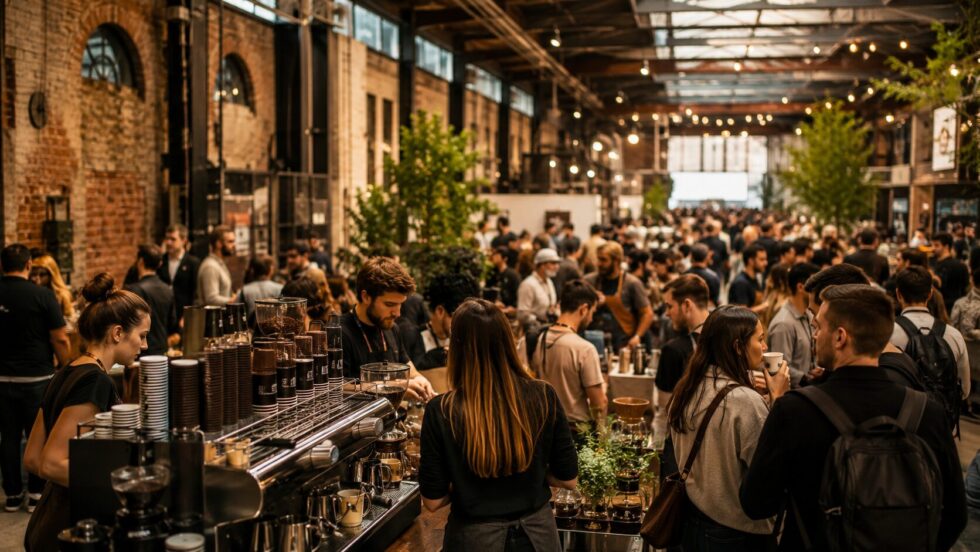
The festival takes place at the Truman Brewery on Brick Lane, with the main entrance at F Block G1, Ely's Yard, London E1 6QR, and an alternative entrance at 15 Hanbury Street. The site is a former industrial complex that has hosted the festival since 2011, and the choice has become inseparable from the event's identity.
Brick Lane sits at the intersection of Shoreditch, Spitalfields and Whitechapel — the three districts that drove London's independent café boom over the past decade. Within a ten-minute walk are Allpress, Nude Espresso, Climpson & Sons and Workshop Coffee, several of which were among the first wave of UK roasters to import the Antipodean café model in the early 2010s. The festival's geography is therefore not symbolic but operational: many trade visitors plan supplier meetings around café visits, and many consumer visitors extend a festival ticket into a half-day East London coffee crawl. This is one of the reasons attendance numbers translate so directly into commercial outcomes for participating brands — visitors are buying coffee at the festival and then drinking it again at retail within hours.
Dates and full schedule: how the four days actually work
The festival begins with two Industry Days on Thursday and Friday, and kicks off its public celebration on Saturday and Sunday. The split is not cosmetic. It exists because roasters, importers, equipment manufacturers and café owners need a working environment — quiet enough to negotiate, formal enough to present financials, structured enough to schedule back-to-back meetings. Weekend public traffic makes all of that impossible, which is why the trade-only buffer at the start is treated as the commercial backbone of the event.
Thursday 14 May — Industry Day 1. Trade-only access for hospitality and coffee professionals. Business meetings, equipment demos, supplier showcases, and the opening sessions in The Lab. This is the day most procurement decisions are made.
Friday 15 May — Industry Day 2. Continued trade access, with early Coffee Masters rounds running on the competition stage and the heaviest networking schedule of the four days. Free trade entry is available for professionals, excluding suppliers, consultants and distributors — a filter designed to keep the floor weighted toward operators rather than vendors selling to vendors. World Coffee Portal
Saturday 16 May — Public Day 1. Full public access opens. All 275 exhibitor stands are operational, the Roasters Village, Latte Art Live, Demo Bar and Drip District run full programming, and live music begins. This is the highest-footfall day.
Sunday 17 May — Public Day 2. Final public sessions, the LCF Awards, and the climax of the four days: the Coffee Masters final at 1:15pm on 17 May 2026. The afternoon is the most-watched live coffee event in Europe.
Tickets: how the tiers actually differ
Public tickets are structured around session length and lounge access. A standard single-session ticket grants entry to every zone — Roasters Village, Latte Art Live, Coffee Masters viewing, the Brew School, the Demo Bar and the Drip District — plus unlimited tasting from exhibitor stands. The premium Ultimate Ticket adds access to the Club Lounge with seating and refreshments, priority workshop booking, and reserved Coffee Masters viewing. Industry passes are separate and require professional verification.
What standard tickets effectively buy is the right to taste. Sample portions are small but cumulative: a typical weekend session involves 12 to 20 tastings, which means a single ticket holder leaves having sampled coffee from a meaningful cross-section of the UK and European specialty market — work that would otherwise take months of café visits and cost several times the ticket price. This is the festival's underlying value proposition for consumers, and the reason workshops, while excellent, are not necessary to justify attendance.
Hands-on workshops carry an additional fee. Headline masterclasses with named baristas — particularly those featuring World Barista Championship finalists — sell out within days of release, and the booking window opens earlier for premium ticket holders. Children under 5 attend free with no ticket needed; children aged 5–16 need a ticket and must be accompanied by an adult.
What's new for 2026 — and what it tells you about the market
The 2026 programme changes are a useful market signal in themselves. Four new features have been added, each addressing a category that has graduated from niche to commercial maturity.
The Demo Bar. New for 2026, the Demo Bar is where the industry's most exciting makers, creators and innovators step out into the spotlight, with coffee cuppings, machine demos, brewing demos, matcha tutorials and much more. It centralises live demonstrations that previously ran across multiple stands, giving smaller brands a high-traffic platform they couldn't otherwise afford.
The Drip District. New for 2026, the Drip District shines a light on the craft and culture of pour-over coffee from around the world. Pour-over was supposed to fade after the third-wave peak in the mid-2010s. Instead, it has stabilised as a premium menu format — the slow, theatrical, often £6+ brew that signals quality in cafés competing on craft rather than convenience.
The Sage Coffee School. A new partnership offering hands-on espresso masterclasses where attendees can learn the essential skills behind great specialty coffee — from dialling in the grind to pulling the perfect espresso shot and texturing silky milk. The format reflects a structural shift in the UK market: domestic espresso machines saw 22% sales growth in 2025, and home users now want training, not just product. World Coffee PortalPerfect Daily Grind
The TODDY Cold Brew Competition. For the first time, the festival is joining forces with TODDY to bring the ultimate Cold Brew Competition, taking place live at this year's festival — showcasing the very best in fresh cold brew coffee innovation and creativity. Cold brew has graduated from summer menu to year-round category in UK cafés, helped by ready-to-drink retail growth and the rise of nitro-on-tap formats.
Alongside these, The Lab will host structured industry sessions including "Every Ingredient Matters," led by La Marzocco, exploring how attention to detail boosts quality, supports sustainability and inspires the next generation, and "Scaling sustainably," where experts share the lessons, pitfalls and practical strategies behind expanding without compromising quality, values or culture. Both sessions reflect the central operational question facing UK specialty in 2026: how to grow margins without sacrificing the craft premium that justifies them.
Coffee Masters 2026: the competition that defines the festival
Coffee Masters is the only barista competition in the world that runs as a televised-style knockout across four consecutive days, and it remains the single most-watched element of the festival. Sixteen contenders, seven disciplines, one winner — judged by a panel of industry figureheads, the fast-paced knockout battle format will see 16 baristas showcase their skills head-to-head across a broad range of disciplines.
The disciplines test the full operational reality of working behind a specialty bar: espresso preparation under time pressure, milk technique and free-pour latte art, signature drink creativity, the "Order! Order!" speed round where competitors serve a ten-drink ticket against the clock, brewers cup precision, blind tasting, and creative challenges. The final takes place at 1:15pm on 17 May 2026 — by tradition, the most attended single hour of the four days.
What makes Coffee Masters commercially significant is the career impact. Past winners and finalists have gone on to open their own roasteries, take head trainer roles at major brands, and represent their countries at the World Barista Championship. For competitors, the festival is a career launchpad. For visitors, it is the rare chance to watch elite-level technical work at close range — most viewing positions are within three to five metres of the bar.
The Roasters Village and who's actually showing up
La Marzocco's Roasters Village returns in 2026, pulling an exclusive mix of the continents' best roasters into the buzz of the festival. Confirmed names this year include Brewing Dealers, Campbell & Syme, Catalyst, Clifton Coffee Roasters, Curious Roo, Elsewhere Coffee, Groundstate Coffee Roasters, Kiss the Hippo, Minifundi, Ninth, Oddy Knocky Coffee, Redemption Roasters, Routes Coffee Roasters, Scenery, SEND Coffee, Terraform Coffee and Trevo Coffee Roastery.
The lineup is more strategically interesting than it looks. Kiss the Hippo and Clifton are established mid-scale roasters with multi-site retail. Redemption Roasters operates the prison-based training model that has become one of UK specialty's most-discussed social enterprises. SEND Coffee and Curious Roo represent the newer wave of small-batch operators competing on green-coffee storytelling rather than retail footprint. Together they map the structural diversity of the UK roasting sector in 2026 — from social-impact business models to micro-roasteries to scaled regional players.
La Marzocco will also host the True Artisan Café, a rotating pop-up giving independent operators a platform to share their craft — effectively a live audition for cafés to test their concept in front of an international audience.
The Brew School and the rise of trained consumers
The Brew School, brought to you by Brewed By Hand, is an exciting experience that takes you on a 45-minute journey through the world of coffee. Visitors can explore flavour in depth through a 45-minute guided experience in personalised brewing.
The Brew School's commercial logic is straightforward: domestic specialty coffee equipment sales have grown faster than café revenue for three consecutive years, and trained consumers buy more expensive coffee. Roasters who invest in consumer education at festivals see direct lift in retail bag sales and subscription conversions. The Brew School, the Sage Coffee School and the Demo Bar collectively form the strongest consumer-education programming the festival has ever fielded — and that is itself a market signal.
The Hyde Park Bar, the Food Court and the festival's other half
Coffee is the headline, but the festival also functions as a hospitality event. The Hyde Park Bar offers coffee cocktails alongside curated DJ sets from acclaimed artists such as Justin Robertson and Ray Mang, and the Food Court brings together some of the most exciting food concepts in the city. There is also a Chill Out Zone on the first floor for visitors who need a break from the floor.
This second layer is what distinguishes the London Coffee Festival from purely commercial trade shows in Milan or Amsterdam. Visitors come for the coffee but stay for the atmosphere, and the four-day footfall numbers reflect that combination. The festival is treated as a destination weekend by visitors travelling in from Manchester, Berlin, Paris and increasingly Stockholm and Copenhagen.
How to get to the Truman Brewery
The Truman Brewery is easily reached by tube, rail, bus or on foot.
Underground and Overground. Shoreditch High Street (Overground) is 5 minutes' walk. Aldgate East (District, Hammersmith & City), Liverpool Street (Central, Metropolitan, Circle, Hammersmith & City, Elizabeth line, National Rail) and Aldgate (Circle, Metropolitan) are all roughly 10 minutes. Old Street (Northern line, National Rail) is around 20 minutes.
Bus routes. From the West End: 8, 55, 242. From East London: 8, 26, 48, 55, 57, 242, 388. From South London: 35, 47, 48, 78, 149. From the City: 26, 55, 242, 243, 388.
Driving is strongly discouraged. The venue sits inside both the Ultra Low Emission Zone and the Congestion Charge zone, and parking is extremely limited. The festival is also cashless, with SumUp as official payment partner, so card or mobile wallet is required throughout.
Accessibility. All event spaces are wheelchair accessible with a combination of ramps and lifts within the Old Truman Brewery, and all staff and security are briefed to assist.
The festival has positioned sustainability as a core operational standard rather than a marketing add-on. The London Coffee Festival is 100% compostable — every single-use cup at the festival must be fully compostable, a policy enforced across all exhibitors regardless of brand size. The cashless format reduces material waste and queue times in equal measure.
The Lab programming reinforces the same theme. The two flagship sustainability sessions, "Every Ingredient Matters" and "Scaling sustainably," focus on the operational reality of running a sustainable business rather than the marketing of one — a useful distinction for café operators tired of greenwashing panels.
Charity partner. Farm Africa is the official charity partner, and visitors can add a donation during ticket checkout. Farm Africa works with coffee farmers in Ethiopia, Uganda and DRC, where some of the world's best coffee is grown — many of whom earn less than $1 a day. The partnership directly addresses the structural pricing gap that the specialty industry has spent a decade arguing about: producers receive a fraction of retail value, and most consumer-facing campaigns have not closed that gap meaningfully.
Practical visitor strategy
The two most common mistakes first-time visitors make are caffeine overload by hour two and trying to see everything. A more efficient approach:
| Visitor type | Priority focus | Skip |
|---|---|---|
| First-time / casual | Roasters Village, Latte Art Live, Demo Bar | Industry-only Lab talks |
| Home brewing enthusiast | Brew School, Drip District, Sage Coffee School | Trade networking |
| Café owner / barista | Industry Days, Coffee Masters, The Lab | Generalist consumer zones |
| Industry professional | Thursday–Friday, La Marzocco sessions | Weekend public sessions |
| Foodie / lifestyle | Food Court, Hyde Park Bar, evening DJ sets | Technical cuppings |
Caffeine management. Even small portions add up — 15 to 20 tastings can equal 400 to 600mg of caffeine, well above the EFSA daily safety threshold. Alternate espresso with filter, drink water between samples, and use the spittoons at cupping stations.
Logistics. Book weekend tickets at least three weeks in advance. Arrive 15 minutes before your session. Wear comfortable shoes — expect 8,000 to 12,000 steps per session. Bring a reusable cup (several exhibitors offer discounts for use). Eat properly beforehand. Plan an East London café visit afterwards: Allpress, Nude Espresso or Workshop are all within 10 minutes.
What the 2026 edition says about the UK coffee market
The festival sits at the centre of a market worth approximately £5.8 billion in retail value, with specialty growing 8 to 10% annually while the broader hospitality sector continues to struggle with margins. Independent café numbers in Greater London have rebounded past pre-pandemic levels, with more than 2,400 specialty venues now operating across the capital.
The 2026 programme reads as a structured response to where that market is moving. Premiumisation has pushed the average specialty cup in central London past £4.20, which has made consumer education and home brewing skills commercially relevant in a way they weren't five years ago — hence the expanded Brew School and the new Sage partnership. Plant-based milk now accounts for an estimated 35 to 40% of café milk volume in specialty venues, a shift visible across the exhibitor floor. Matcha's elevation to headline sponsor category is the festival's clearest acknowledgement that the "coffee shop" is becoming the "specialty drinks shop." Cold brew's promotion to dedicated competition reflects its year-round volume in UK cafés. Pour-over's revival in the Drip District signals that the craft premium has stabilised rather than receded.
The festival functions as both a barometer and an accelerator for these trends. Many products launched in the Roasters Village or the Demo Bar reach mainstream UK retail within twelve months. For brands, the four days at Brick Lane are the closest thing the UK specialty industry has to a single, condensed product launch window.
Frequently asked questions
When is the London Coffee Festival 2026? Thursday 14 May to Sunday 17 May 2026, with two Industry Days (Thursday and Friday) followed by public days (Saturday and Sunday).
Where is it held? At the Truman Brewery on Brick Lane, with the entrance at F Block G1, Ely's Yard, London E1 6QR, and an alternative entrance at 15 Hanbury Street.
Who organises it? William Reed, a digital publisher specialising in the global food and drink industry, took over as organiser in 2024, succeeding Allegra Events.
How many exhibitors and visitors? 275 artisan coffee and gourmet food brands in 2026; the 2025 edition welcomed over 22,000 visitors and 260 exhibitors.
Can children attend? Yes — children under 5 attend free with no ticket; children aged 5–16 need a ticket and must be accompanied by an adult.
When is the Coffee Masters final? 1:15pm on Sunday 17 May 2026.
Is it cashless? Yes — the festival is a cashless event, with SumUp as the official payment partner.
What's new for 2026? The Demo Bar, the Drip District for pour-over, the Sage Coffee School with hands-on espresso masterclasses, the TODDY Cold Brew Competition, and the first-ever Headline Matcha Sponsorship.
How do I get there? Shoreditch High Street is 5 minutes' walk; Liverpool Street, Aldgate East and Aldgate are all around 10 minutes. Driving is discouraged due to ULEZ.
Is the venue accessible? Yes — all event spaces are wheelchair accessible with ramps and lifts, and there is a Chill Out Zone on the first floor.
Can I buy coffee to take home? Yes. Most roasters sell retail bags directly from their stands, often with festival-only discounts and exclusive releases.
The 2026 edition of the London Coffee Festival lands at a moment when UK specialty coffee has stopped behaving like a subculture and started behaving like a mature premium category — with all the structural questions that brings. Margins are tighter, consumer expectations are higher, the matcha shelf is bigger than it was two years ago, and the operators winning are the ones who have built training infrastructure into their business model rather than treating it as marketing.
The programming for 14–17 May reflects exactly that environment. The Industry Days are the commercial backbone. The Coffee Masters final is the technical showcase. The new zones — Demo Bar, Drip District, Sage Coffee School, TODDY Cold Brew — are the festival's reading of which categories are graduating into the mainstream. The Lab sessions are where operators will quietly discuss the harder question of how to scale without losing the craft premium that makes specialty coffee worth what it costs.
Read about the life of Westminster and Pimlico district, London and the world. 24/7 news with fresh and useful updates on culture, business, technology and city life: When London bus routes change in May 2026 full TfL list of routes dates night buses and map