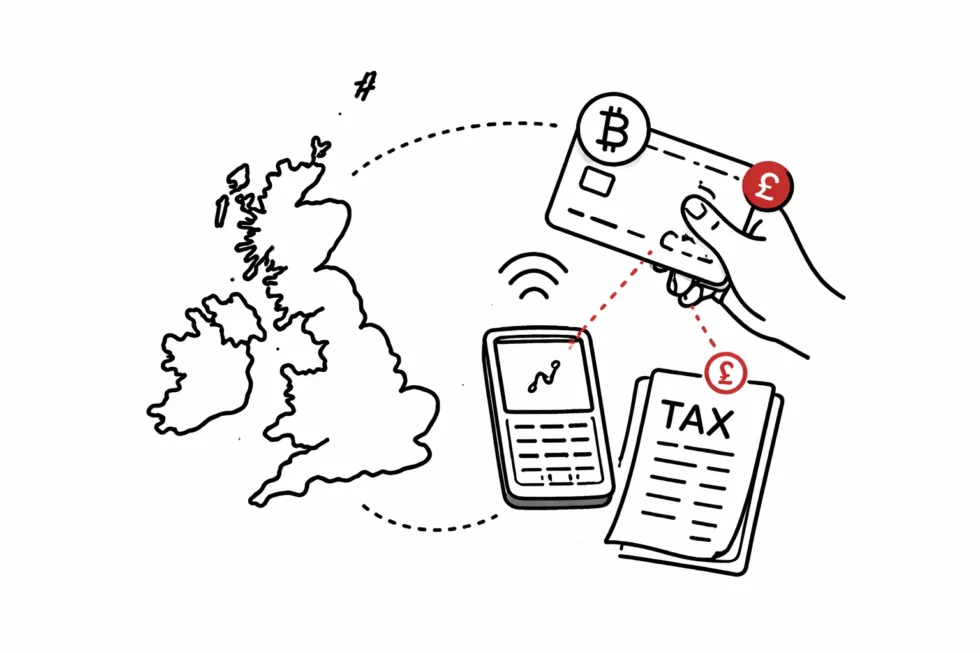
Crypto cards have become a practical bridge between exchanges and everyday spending in London: you hold crypto (or stablecoins) in an app, the provider converts it to GBP either at the till or when you top up, and you pay on the Visa/Mastercard network like any other card. The catch is that the UK treats most “spend” events as tax-relevant disposals, banks increasingly apply transfer limits to exchanges, and FCA rules now shape how these products can be marketed to you. As the The WP Times editorial team reports, the real due diligence is no longer about “does it work”, but how it converts, what it costs, what it triggers for tax, and whether your funding bank will block the rails.
What you can and can’t do with crypto cards in the UK
Crypto cards in Britain do not give you a parallel financial system. They give you a regulated bridge between crypto and pounds. What you are allowed to do with them is defined not by the crypto platform, but by card networks, UK banks and financial-crime rules. Some payments flow as easily as with any debit card. Others are blocked, limited or flagged long before they ever reach the blockchain.
What you can do
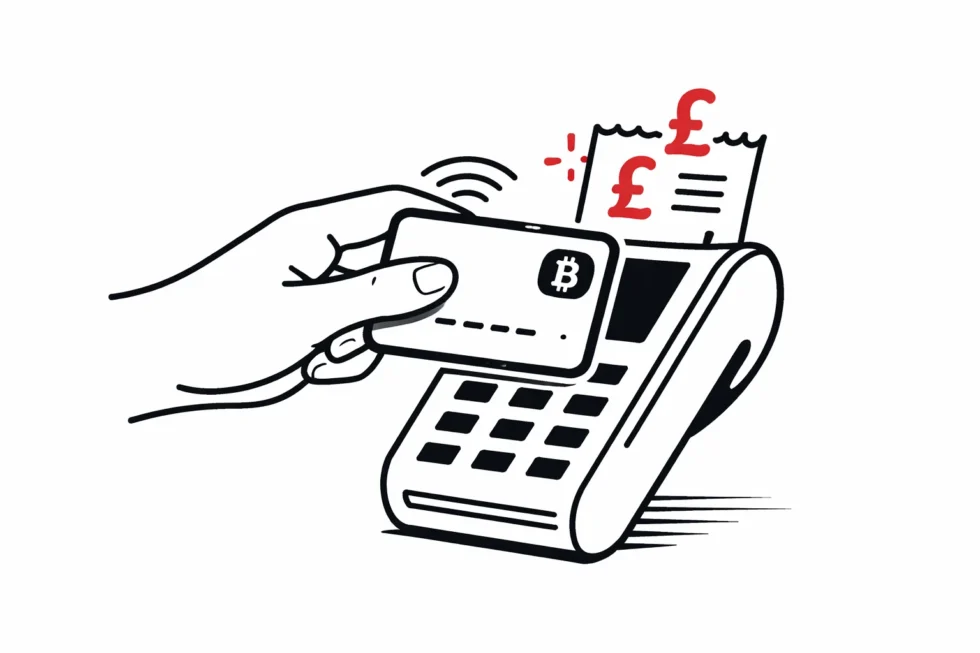
- Pay at merchants that accept Visa/Mastercard (depending on the card programme). Networks settle in fiat; the merchant receives GBP (or local fiat), not your crypto. Visa describes these programmes as converting a customer’s digital currency into local fiat at point of sale. Visa
- Convert automatically either:
- At point of sale (the app converts when you tap), or
- On top-up (you convert in-app, then spend from a GBP/e-money balance). Crypto.com explicitly states crypto is converted to market currency before being loaded onto the card for purchases/ATM use. Crypto.com
- Earn rewards/cashback (usually paid in a token) on eligible spend, depending on tier and terms. Examples: Crypto.com advertises “up to 5% back” (paid in CRO) and Wirex says users can earn “up to 8%” in WXT under its Cryptoback programme; Plutus markets “up to 9% back” in rewards. Wirex+3Crypto.com+3Wirex+3
What you can’t assume you can do
- You can’t rely on your UK bank allowing all crypto funding flows. Many banks impose limits on payments to exchanges (and some block certain routes entirely). HSBC publishes transaction caps; NatWest and Santander publish daily/rolling limits; Starling states it no longer supports buying/selling crypto via debit card or bank transfers. Starling Bank+3HSBC UK+3NatWest+3
- You may not be able to use some credit cards to buy crypto. Barclays, for example, states that from 27 June 2025 you can no longer make crypto-currency transactions using a Barclaycard. Barclays
- You can’t treat crypto spending as “tax-free because it’s a card”. HMRC includes “using tokens to pay for goods or services” in the definition of a disposal. GOV.UK
How “instant conversion” really works — and what the system actually records
When a crypto card is tapped in a London shop, two independent financial records are created at the same time. This is what makes crypto spending very different from cash.
First, the card network creates a retail payment record.
This is the same system used by high-street banks. It stores the merchant’s name, the exact amount in pounds, the time of the transaction and the merchant category (such as supermarket, airline, or restaurant). From the retailer’s point of view, it looks exactly like a normal debit-card purchase.
Second, the crypto platform creates a conversion record.
Behind the scenes, the platform selling the crypto logs which asset was used, how much was exchanged, what exchange rate applied, how much was charged in fees or spread, and how many pounds were delivered to settle the card payment.
These two records are linked by time, value and reference number. Together, they form a complete financial footprint of the transaction.
This dual-ledger structure is what allows crypto cards to function inside the traditional financial system. It also explains why they are fully traceable. There is always a precise sterling value attached to every crypto payment, down to the penny, at the exact moment of purchase.
For tax authorities, this is crucial. It means every coffee, train ticket or hotel booked with a crypto card has a clearly defined GBP value, which becomes the reference point for calculating gains or losses on the crypto that was sold to fund the purchase.
In practice, crypto cards do not blur the line between crypto and money — they convert it into a tightly measured, regulated monetary transaction the instant you pay.
UK tax: why every tap of a crypto card is a taxable moment
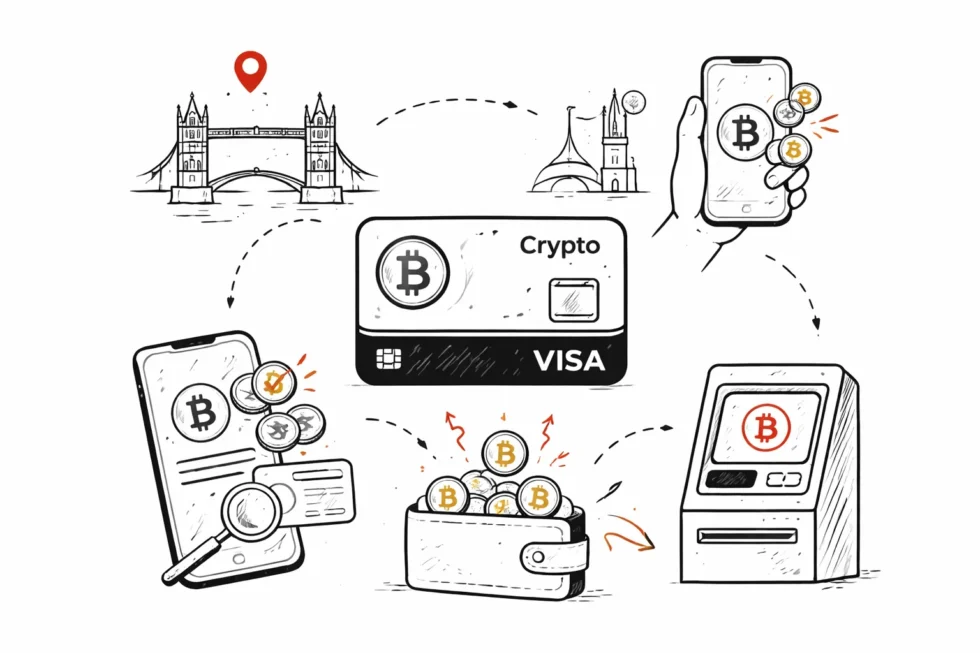
In the British tax system, paying with crypto is not treated like spending cash. It is treated like selling an asset. Whenever a crypto card converts Bitcoin, Ethereum or another token into pounds to pay a shop, the law considers that crypto to have been disposed of. In tax terms, this is the same as if the user had sold the asset on an exchange and then spent the money.
This means that ordinary daily spending — coffee, transport, groceries, hotel bookings — can quietly generate dozens or even hundreds of taxable transactions over the course of a year.
What this means in practice
If you spend Bitcoin or Ethereum directly through a crypto card, each purchase locks in a gain or a loss based on the difference between what you originally paid for that crypto and its value in pounds at the moment you spent it. A £4 sandwich can be a taxable event if the crypto used to pay for it has risen in value since it was acquired.
Stablecoins reduce price swings, but they do not remove the tax logic. The transaction is still a conversion of a cryptoasset into pounds, and it still creates a record that can fall under capital gains reporting if thresholds are exceeded. Crypto cards therefore turn everyday life into a long chain of small financial disposals, each one recorded in pounds at the exact time of payment.
What a UK user must keep on record
To stay compliant, anyone using crypto cards in Britain should be able to reconstruct their spending history with the following data:
• the GBP value of every payment at the moment it was made
• which crypto asset was used
• how much of that asset was sold
• any fees or exchange spread applied
• monthly statements from the crypto platform
• bank records showing how the account was funded and withdrawn
This audit trail is what allows gains and losses to be calculated accurately. Without it, crypto card users risk losing control over their tax position as spending accumulates.
Crypto cards make digital assets easy to spend. They also make every transaction part of a financial and tax record.
Regulation: what the FCA regime really changes for UK crypto users
The UK has not banned crypto — it has reclassified it as a regulated financial risk product.
Since October 2023, any company that promotes crypto cards, crypto accounts or crypto rewards to UK consumers must follow the same type of marketing discipline that applies to investment products. This has quietly reshaped the entire market. Crypto firms can no longer advertise in Britain the way they do elsewhere. They must explain risk, avoid misleading incentives and prove that their promotions meet strict compliance standards. That is why many crypto card providers now show warnings, restrict bonuses or remove referral schemes for UK customers.
What this means in everyday life
For users in London and across the UK, this regime produces three visible effects.
First, promotions look more serious. You will see fewer “free crypto”, “guaranteed rewards” or “risk-free” style claims. Instead, platforms are forced to explain volatility, loss risk and product limits.
Second, some features disappear or arrive late in Britain. Many crypto card benefits that exist in the EU, the US or Asia are either restricted, delayed or removed for UK users because they do not meet FCA promotion rules.
Third, who is allowed to advertise matters. Only firms that meet FCA standards — or whose promotions are approved by authorised UK firms — can legally market crypto products to British residents. If a company is trying to sell crypto cards in the UK without clear regulatory footing, it is a warning sign.
How this protects the consumer
The FCA framework does not remove risk from crypto. What it does is reduce the risk of being misled. It makes it harder for companies to hide fees, exaggerate returns or disguise the true cost of using crypto cards and rewards programmes. When marketing is tightly controlled, pricing and product structure become more transparent. For British users, this means that crypto cards now operate inside the same trust boundary as other financial products — not outside it.
The banking reality in Britain: why your bank matters more than your crypto card
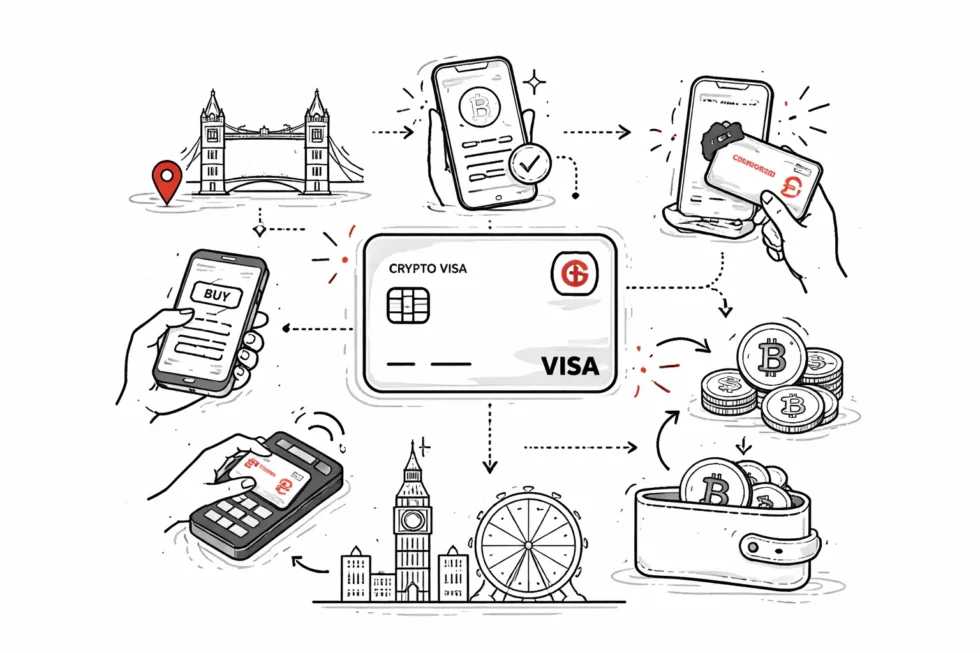
A crypto card may look like the centre of your digital money life, but in the UK the real gatekeeper is still your bank account. Every crypto card relies on traditional banking rails to be funded. Wages, savings and business income all start in pounds, and before crypto can be spent, it has to pass through the UK banking system. This is where most friction now occurs.
Over the past two years, British banks have moved from passive observation to active control. They monitor payments to crypto platforms, set limits on how much can be transferred and, in some cases, block entire categories of crypto-related transactions.
What these limits do in practice
These restrictions are not just about “buying crypto”. They affect:
• how quickly you can load money onto a crypto platform
• whether large top-ups are flagged or declined
• how easily profits can be withdrawn back to your bank
• whether salary and business income can flow smoothly into crypto-linked accounts
Even if a crypto card works perfectly at the checkout, your ability to use it depends on whether your bank allows the underlying money flows.
Why this changes how crypto cards are used
For everyday spending, this means reliability matters more than headline features.
A card that offers high cashback or flashy rewards is useless if the account behind it cannot be funded consistently. UK users who receive regular income, pay rent, run businesses or manage household bills need funding rails that are predictable and stable.
In Britain, crypto cards do not replace banks. They sit on top of them. And the tighter banks make their controls, the more important it becomes to choose platforms that integrate smoothly with mainstream UK banking rather than constantly triggering compliance alarms.
Cashback and rewards: what “up to X% back” really means in the UK
Unlike bank cards that pay fixed rewards in pounds, most crypto cards credit users with platform-issued tokens. Those tokens fluctuate in value, come with programme rules, caps and exclusions, and must be converted into GBP before they can be spent. That conversion introduces fees and tax consequences. At the same time, the cards themselves are not issued by the crypto firms, but by regulated payment institutions operating on Visa and Mastercard rails. This means every reward sits inside the UK’s compliance, reporting and risk-control framework.
In practice, crypto cashback functions less as a shopping benefit and more as a small, continuously repriced crypto position generated by everyday spending.
Who actually issues crypto cards in the UK
Crypto firms do not operate card schemes on their own. They rely on licensed financial institutions that provide compliance, settlement and consumer-protection rules.
| Crypto brand | Card issuer | Network |
|---|---|---|
| Crypto.com | Licensed e-money institution | Visa |
| Coinbase | Regulated payment partner | Visa |
| Wirex | UK/EU e-money institution | Visa |
| Plutus | E-money institution | Mastercard |
| Revolut | UK bank | Visa & Mastercard |
This structure matters. Consumer protection, chargebacks, fraud monitoring and account freezes are governed by the issuing institution, not by the crypto brand’s marketing promises. Crypto cards do not exist outside the financial system — they are built on top of it.
Why advertised cashback is rarely what users actually receive
When platforms promote “up to 5%” or “up to 8%” cashback, those numbers usually apply only under ideal conditions.
In practice:
• the highest rate is limited to premium subscription tiers
• monthly spending caps apply
• many merchant categories are excluded
• rewards are paid in volatile tokens
• programme rules can change at any time
The headline percentage is therefore a ceiling, not a guarantee. Most users receive less — often significantly less — in usable value.
What really happens when cashback is paid
When a crypto card issues cashback, four things occur:
- The platform credits the user with its token.
- That token’s market value fluctuates.
- To use it, the user must convert it into pounds.
- That conversion creates a taxable event.
Cashback is therefore not free money. It is a small crypto position that happens to be delivered via shopping.
An analyst’s rule of thumb
Real cashback value =
headline rate − fees − spreads − volatility − tax friction
For many British consumers, a conventional debit or credit card paying a steady 1–2% in pounds can be more predictable than a crypto card advertising 8% in tokens.
What UK users should actually compare
Instead of chasing the highest percentage, serious users should look at five structural factors.
1) Conversion timing
Is crypto converted at the till, or when funds are topped up?
This affects fees, transparency and tax timing.
2) Funding rails
Does the account support Faster Payments?
Do UK banks regularly block or restrict transfers?
3) Fees
Beyond card fees, check:
• crypto-to-GBP spread
• FX mark-ups
• ATM charges
• inactivity or tier costs
4) Controls
Can you lock the card, set limits, choose which asset is spent and export transaction records for HMRC?
5) Rewards structure
Are there caps, exclusions, lock-ups or token-price risk?
Why this framework matters
Crypto cards operate at the intersection of three systems:
• crypto exchanges
• UK banking
• card networks
Cashback, fees and usability are shaped by all three. If a bank tightens controls, a regulator restricts promotions, or a reward token falls in value, the real benefit of a crypto card can change overnight.
For British users, the rational strategy is not to chase the biggest advertised number, but to choose the most transparent, stable and bank-compatible setup.
Comparative framework
| Area | What to state | Why it matters |
|---|---|---|
| Tax trigger | Crypto spending counts as a disposal | Creates many small taxable events |
| Marketing | FCA-regulated promotions | Limits misleading claims |
| Bank rails | Funding limits apply | Affects usability |
| Card structure | Issued by e-money institution | Determines consumer protection |
| Rewards | Paid in tokens | Value fluctuates |
| Conversion | At point of sale or top-up | Impacts fees and tax timing |
For London and the wider UK, crypto cards have moved beyond novelty. They now function as ordinary payment tools, backed by Visa and Mastercard and powered by instant in-app conversion. What determines their real usefulness is not technology, but structure. Every transaction is filtered through three forces: HMRC’s tax rules on crypto disposals, the FCA’s control over how these products are sold to consumers, and the limits imposed by British banks on funding and withdrawals. Together, they decide whether a crypto card is a smooth spending tool or a source of hidden cost, reporting burden and restricted access.
Read about the life of Westminster and Pimlico district, London and the world. 24/7 news with fresh and useful updates on culture, business, technology and city life: Why US inflation data, Micron’s outlook and the Bank of England are reshaping global markets