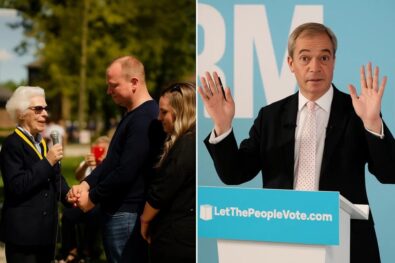
The Narborough Whetstone by-election delivered a narrow but strategically significant result in the latest Leicestershire election results, with Reform UK holding the seat in a six-way contest that exposed tightening margins and shifting voter alignment across the Leicestershire County Council election landscape. Dee North secured 1,033 votes (32.9%), defeating Conservative candidate Les Phillimore on 927 votes, while the Green Party’s Mike Jelfs finished a close third on 884 votes, underscoring a tightly packed three-way contest rather than a clear-cut victory, The WP Times reports, citing BBC News.
The by-election was triggered by the resignation of former councillor Andrew Thorp, and its outcome reinforces Reform’s position as the largest single party at County Hall while simultaneously highlighting erosion from its previous 42% vote share at the last full Leicestershire County Council election in May 2025. The reduced margin, combined with a turnout of just 29.55%, underlines both voter fragmentation and the growing competitiveness of local contests, where outcomes are increasingly decided by narrow vote differentials rather than clear mandates.
Narborough Whetstone by-election result breakdown and vote distribution
The detailed Leicestershire election results from the Narborough and Whetstone division illustrate a highly competitive field, with multiple parties clustered within a relatively narrow vote band. The spread confirms a structural shift in local elections, where three parties can realistically contest first place.
Full result
| Candidate | Party | Votes |
|---|---|---|
| Dee North | Reform UK | 1,033 |
| Les Phillimore | Conservative | 927 |
| Mike Jelfs | Green Party | 884 |
| Ande Savage | Liberal Democrat | 134 |
| Lisa Pendery-Hunt | Labour | 124 |
| Martin Garfoot | Advance UK | 28 |
This distribution shows that
- Reform UK retained the seat but with a reduced vote share
- Conservatives achieved a measurable swing back compared with 2025
- The Green Party approached second place, indicating structural growth
- Labour and Liberal Democrats remained marginal in this division
The closeness between first, second and third positions—just 149 votes separating first and third—highlights the volatility embedded in the current Leicestershire County Council election cycle.
Shifting vote share: what the Leicestershire election results signal
The Narborough Whetstone by-election result indicates a measurable redistribution of support rather than a static outcome. Reform UK retained the seat, but its vote share declined from 42% at the May 2025 Leicestershire County Council election to 32.9% in this contest — a reduction of 9.1 percentage points. In absolute terms, this translates into a narrower lead over both the Conservative and Green candidates, with the gap between first and third place reduced to 149 votes, confirming compression across the leading vote blocs.
The Conservative vote rose to 927, representing a recovery in both share and relative position compared with the previous county-wide baseline. The Green Party’s 884 votes (28.2%) places it within 43 votes of second place, marking a statistically significant narrowing between second and third positions. This clustering of three parties within a sub-5 percentage point range indicates a transition from single-party lead margins to competitive overlap.
Key electoral movements (vote share basis)
- Reform UK: 42% → 32.9% (−9.1 pp)
- Conservatives: estimated increase of ~8 pp from previous baseline
- Greens: rise to 28.2%, within competitive range of second place
From a structural perspective, the distribution suggests that no single party currently commands a dominant share exceeding one-third of the vote in this division. Instead, the data reflects a tripolar alignment, where three parties operate within a competitive threshold capable of producing alternative outcomes under minor variations in turnout or vote transfer. Observed structural characteristics:
- Vote compression among top three candidates (32.9% / ~29% / ~28%)
- Reduced margin of victory relative to previous election cycle
- Increased competitiveness between second and third positions
- Limited vote accumulation among smaller parties (combined <10%)
This configuration increases sensitivity to marginal changes. For example, a shift of fewer than 100 votes would have been sufficient to alter the ranking between second and third, while a swing of approximately 200 votes could have changed the winning outcome. Such margins place greater statistical weight on turnout composition rather than absolute vote totals.

What candidates said after the Narborough Whetstone by-election
Post-result statements provide direct insight into how each party is interpreting the same dataset within the Leicestershire election results framework.
Dee North (Reform UK) framed the outcome in terms of mandate continuity and local representation:
“It was a tough campaign, but I’m grateful for the trust voters have put in me… residents have voted for stronger representation on local issues.”
Les Phillimore (Conservative) referenced measurable movement in vote share:
“The real positive was that we pulled about an 8% swing back to the Conservatives… it’s a good result,” (Phillimore, Leicester, post-result interview).
Mike Jelfs (Green Party) identified comparative positioning over time:
“It shows the progress the Greens are making. A few years ago we would not have been near this kind of result,” (Jelfs, Leicestershire, election night).
Each statement corresponds to a different data point: retention (Reform), swing recovery (Conservative), and upward trajectory (Green), without contradiction in the underlying figures.
Council control: implications for Leicestershire County Council election balance
Following the Narborough Whetstone by-election, the overall composition of Leicestershire County Council remains unchanged in terms of party hierarchy, but the margin dynamics within individual divisions have become more relevant to control stability.
Current composition
- Reform UK: 24 councillors
- Conservatives: 15 councillors
- Liberal Democrats: 11 councillors
- Labour: 2 councillors
- Others: limited representation
Reform UK continues to operate as the largest single party but does not hold an outright majority. In numerical terms, the threshold for majority control is not met, meaning governance depends on voting alignment across parties or issue-based support.
Implications derived from composition
- A net change of a small number of seats would alter control dynamics
- By-elections carry amplified impact due to the absence of a majority
- Vote distribution at division level becomes a leading indicator of council stability
The reduced vote margin observed in this by-election does not immediately change seat allocation, but it introduces a measurable increase in exposure to future seat variation.
Turnout in the Narborough Whetstone by-election was recorded at 29.55%. In statistical terms, this level of participation limits total vote volume and increases the proportional impact of smaller, organised voting groups. At this turnout level, the difference between candidates is determined by relatively small absolute vote counts. For example, the winning margin over second place (106 votes) represents a fraction of the total electorate, indicating that participation shifts — rather than broad opinion changes — can influence outcomes.
Turnout-related effects
- Lower total vote base increases volatility
- Mobilised voter segments gain proportional influence
- Outcome sensitivity to marginal turnout changes rises
Structural implications for future contests
- Tactical coordination can influence outcomes within narrow margins
- Localised campaign factors carry increased weight relative to national trends
- Multi-party competition sustains a fragmented electoral field
In aggregate, the Narborough and Whetstone result demonstrates a quantifiable shift toward compressed, multi-party competition, where electoral outcomes are determined within narrow statistical ranges rather than broad vote share differentials.
Read about the life of Westminster and Pimlico district, London and the world. 24/7 news with fresh and useful updates on culture, business, technology and city life: London elections on 7 May 2026: who can vote, voter ID rules and what Londoners need to know before polling day