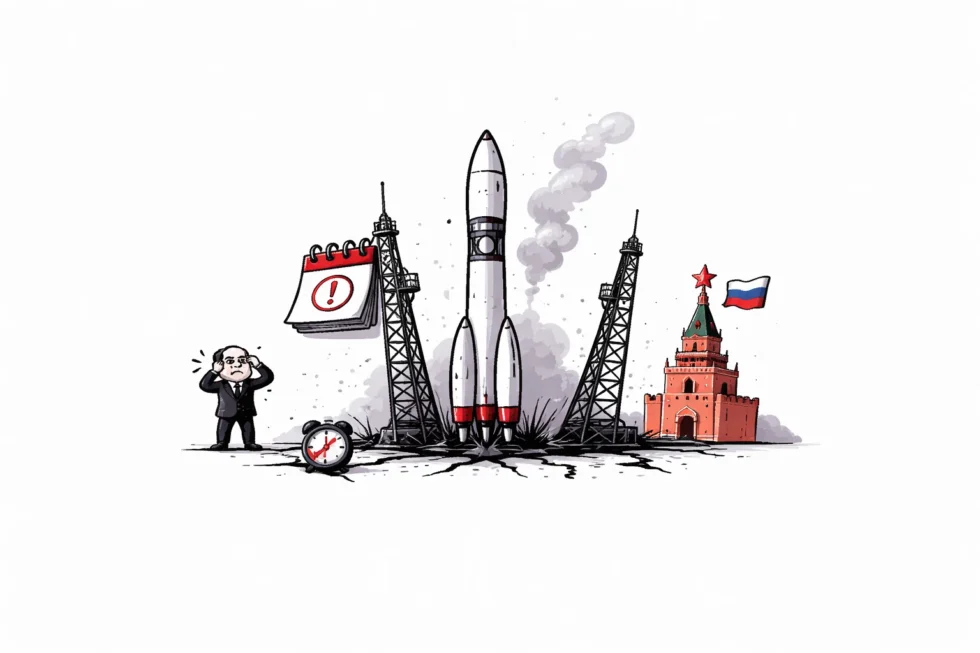
Russia and Kazakhstan have postponed the first launch of their joint Baiterek space programme, including the debut flight of Russia’s new Soyuz-5 rocket, after last-minute technical checks revealed problems with onboard and ground systems. The delay represents another major setback for Moscow’s struggling space industry, which is attempting to position Soyuz-5 as a competitor to Elon Musk’s SpaceX. This is reported by The WP Times, cited by Bloomberg.
According to Roscosmos, Russia’s state space agency, the launch was halted to allow for additional inspections of flight electronics and launch-pad infrastructure. The Baiterek programme is described by Russian officials as being in its “final phase”, but engineers have insisted that extra testing is needed to guarantee a safe first flight.
The Soyuz-5 was scheduled to lift off before the end of the year from the newly built Baiterek complex at Baikonur Cosmodrome in Kazakhstan, a site that for decades served as the backbone of Russia’s orbital ambitions. Moscow has promoted the rocket as a modern replacement for older Soviet-era launch systems and a key pillar of its commercial space strategy.

However, development of Soyuz-5 has been repeatedly delayed by technical failures, supply-chain problems and Western sanctions, first imposed after Russia’s annexation of Crimea in 2014 and significantly expanded following the full-scale invasion of Ukraine in 2022. Roscosmos said a new launch date will only be confirmed once all systems have passed testing and both Russian and Kazakh partners have signed off on readiness.
The setback comes as Russia’s wider space programme continues to face serious disruption. In late November, a Baikonur launch pad was damaged during a mission to the International Space Station, temporarily grounding crewed flights. Repairs are not expected to be completed until the end of February.
Russia has increasingly relied on its own domestic launch sites to maintain orbital access. On 25 December, a Soyuz-2.1arocket successfully launched from the Plesetsk Cosmodrome, while another Soyuz mission is scheduled for 28 December from Vostochny in the Far East. Earlier this month, a Proton-M rocket launch planned for 15 December was also cancelled at Baikonur, further underlining the scale of the crisis facing Russia’s space industry.
In another serious incident on 27 November, a service capsule collapsed during the launch of Soyuz MS-28 to the ISS, forcing the suspension of all crewed missions. It was the most significant disruption to Russia’s human spaceflight programme in decades.
Read about the life of Westminster and Pimlico district, London and the world. 24/7 news with fresh and useful updates on culture, business, technology and city life: France issues statement on peace talks ahead of meeting between Zelenskyy and Macron