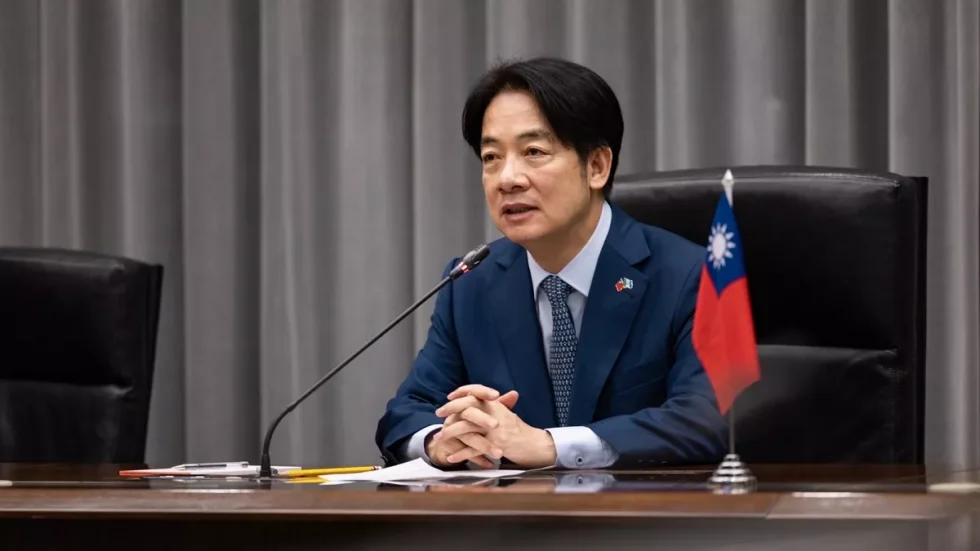
Taiwan’s President William Lai Ching-te has delivered one of the most forceful addresses of his presidency, warning that China’s military escalation threatens not only Taiwan’s security but also the stability of the democratic world.
Speaking in Taipei, Lai said the security climate was “as tense as it has been for decades”. He accused Beijing of carrying out “unprecedented air and naval operations” near the Taiwan Strait, combined with cyberattacks, disinformation campaigns and other hybrid tactics designed to “unsettle society and shift the balance of power in the Strait”. As reported by The WP Times, citing Reuters, the anniversary has become less a moment of remembrance than a contest of historical narratives between Beijing and Taipei.
Taiwan’s Defence Ministry recently reported over 60 Chinese military aircraft crossing the Strait’s median line in a single day – the highest number since records began. Such manoeuvres, Lai argued, are no longer symbolic “shows of strength” but deliberate steps to undermine deterrence.
Beijing rejects accusations, repeats sovereignty claims
The Chinese Foreign Ministry dismissed Lai’s warning as “provocative rhetoric”, accusing him of “undermining the post-war order and universal justice”. Beijing maintains that Taiwan is an inseparable part of China, despite never having governed the island since the Nationalist retreat in 1949.
State media repeated President Xi Jinping’s vow that “reunification cannot be stopped by any force”, framing Lai’s remarks as evidence of separatism. Analysts in London warn that such language is not mere posturing: it reflects Beijing’s broader shift towards normalising military pressure as part of everyday diplomacy.
Taiwan raises defence spending to record levels
In response, Taipei has pledged to increase defence expenditure significantly. The island already spends more than 3 per cent of GDP on its armed forces – higher than most NATO states – and intends to push that figure to 5 per cent within five years.
The government has prioritised anti-ship and air-defence systems, as well as investments in drones and cyber resilience. Joint military drills with the United States and Japan have intensified, while informal security dialogues with Germany, France and the UK have also expanded.
British naval vessels have joined “freedom of navigation” operations in the Indo-Pacific on several occasions, underscoring London’s post-Brexit ambition to project a global presence.
Implications for Europe and NATO
President Lai argued that the Taiwan Strait is not simply an Asian flashpoint but a test case for the democratic order. “If authoritarian pressure succeeds here, it will embolden similar actions elsewhere,” he said.
For Europe, the challenge is acute. Germany relies heavily on trade with China, while NATO has increasingly identified Beijing as a “systemic challenge”. A senior EU diplomat told Renewz.de that the Taiwan crisis “forces Europe to confront the uncomfortable question of whether it can defend democratic values while maintaining economic dependency”.
Britain, which signed a “tilted to the Indo-Pacific” strategy in 2021, has been more vocal. Foreign Secretary David Lammy reiterated that “peace and stability in the Taiwan Strait are of direct concern to the UK and its allies”.
Historical echoes: the 80th anniversary of Japan’s surrender
This September marked 80 years since Japan’s capitulation in the Second World War – an anniversary that continues to shape competing narratives across East Asia.
Beijing: parade as projection of power
In Beijing, the date was commemorated with a grand military parade on Tiananmen Square, featuring more than 12,000 troops of the People’s Liberation Army. President Xi Jinping presided over the event, which included displays of newly developed missile systems, drones and armoured units. Xi declared that “humanity once again faces the choice between peace and war”, framing China as both the guardian of historical justice and a rising global power.
Foreign guests included Russia’s President Vladimir Putin and North Korea’s leader Kim Jong Un, underlining Beijing’s willingness to stand shoulder-to-shoulder with other authoritarian regimes. For many observers, the spectacle was less about remembrance than about demonstrating military might and reinforcing the Communist Party’s claim to legitimacy.
Taipei: remembrance and restraint
Across the Taiwan Strait, the commemoration took on a very different tone. President William Lai stressed that Taiwan would not “celebrate peace through the barrel of a gun”, a pointed rebuke to Beijing’s display. Instead, ceremonies in Taipei honoured the soldiers and civilians who fought and suffered under the banner of the Republic of China, which signed the Japanese surrender documents in 1945.
Taiwanese officials used the moment to challenge what they see as China’s “historical revisionism” – the Party’s insistence that the Communist movement, rather than the Nationalist government, was the principal force behind Japan’s defeat. Veterans’ associations in Taiwan highlighted first-hand accounts of the Nationalist army’s sacrifices, contrasting them with the limited wartime role of Mao’s guerrilla forces.
Symbolism and contested memory
The anniversary has therefore become a political theatre in its own right. In Beijing, history is harnessed to justify territorial claims and bolster authoritarian cohesion. In Taipei, memory is used to assert democratic identity and international solidarity.
For Europe and Britain, the divergent commemorations carry a reminder of the region’s fragility: historical memory is not a settled archive but an instrument of power. As Taiwan’s president put it, “freedom and democracy must be defended when challenged – or they will be lost”.
Read about the life of Westminster and Pimlico district, London and the world. 24/7 news with fresh and useful updates on culture, business, technology and city life: Russia’s Kh-101 cruise missile: expensive weapon at the centre of the Ukraine war