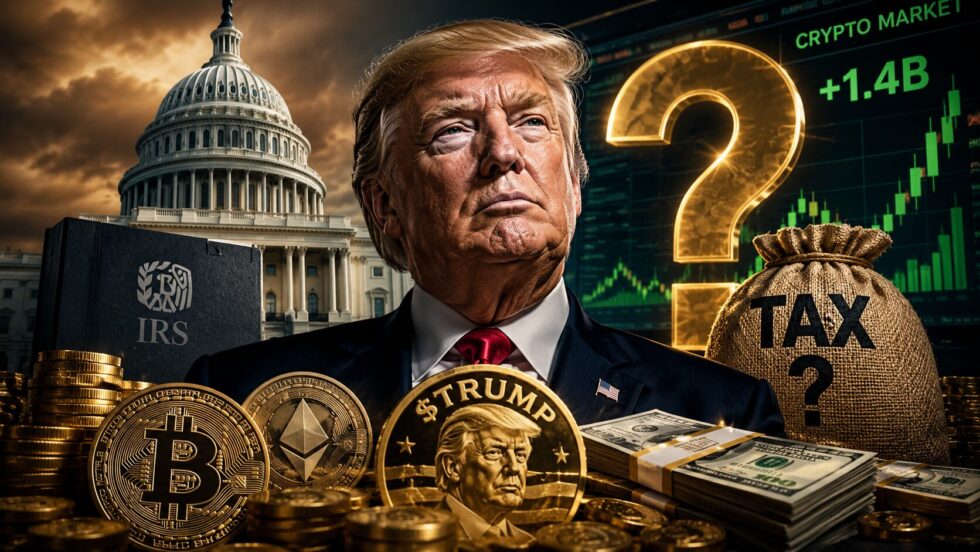
Money from Donald Trump’s crypto empire has triggered a new tax and ethics row in Washington after financial disclosures reviewed on Tuesday, 30 June 2026, showed the US president reported more than $1.4bn in income from cryptocurrency ventures, including World Liberty Financial, token sales and $TRUMP meme coin royalties, The WP Times reported. The central question is now not only how Trump made the money, but how much of it is taxable, whether it was paid personally or through corporate entities, and whether deductions, losses or lower tax treatment could sharply reduce the final bill.
CBS News reported on 2 July 2026 that Trump’s crypto windfall appears taxable and that one accountant specialising in cryptocurrency income considered a tax bill of at least $250m reasonable, while a basic top-rate federal calculation could reach about $518m if the full $1.4bn were treated as individual ordinary income at 37%. But tax lawyers told the broadcaster the real figure is impossible to verify from public filings alone because Trump has not released his tax returns and the disclosure does not show the full ownership structure behind the companies receiving the income.
Money From Crypto Became Trump’s Biggest Reported Income Stream
Trump’s 2025 financial disclosure marked a sharp change in how the president’s fortune is now being generated. Reuters reported on 30 June 2026 that Trump disclosed more than $1.4bn in income from crypto-related ventures, making digital assets his primary source of revenue for the year. The same filing showed about $800m from World Liberty Financial, including $520m from token sales and $250m from the sale of business interests, plus about $635m from meme coin activity.
That is a dramatic rise from the previous disclosure, when Trump reported $57.35m from World Liberty token sales. Reuters also estimated that the Trump family has made at least $2.3bn from crypto-related projects since Trump returned to the White House in 2025.
| Source of money | Reported figure | Why it matters |
|---|---|---|
| World Liberty Financial | About $800m | Includes token sales and business-interest proceeds |
| World Liberty token sales | About $520m | Could be taxed differently depending on structure |
| Sale of business interests | About $250m | May raise capital gains questions |
| $TRUMP meme coin income | About $635m | Reported as royalties or coin-linked revenue |
| Total crypto-related income | More than $1.4bn | Main driver of Trump’s 2025 reported income |
| Previous year World Liberty figure | $57.35m | Shows the scale of the jump |
How The Trump Crypto Tax Bill Could Reach Hundreds Of Millions
The simplest tax calculation is brutal. If the entire $1.4bn were taxed personally at the top US federal individual income tax rate of 37%, the federal bill alone would be about $518m before deductions. That figure does not include state taxes, self-employment issues, corporate structures or any offsetting losses.
But the final tax bill could be far lower. The reason is classification. Under IRS rules, digital assets are generally treated as property, which means gains may be taxed under capital gains rules in some cases. But royalties, licensing payments, business revenue and compensation-like income can be treated as ordinary income. The public disclosure does not settle which category applies to each part of Trump’s crypto income.
CBS News quoted Omri Marian, a law professor specialising in cryptocurrency taxation, saying the problem is that the public cannot see the beneficial ownership structure: (“What we know is that he did very well for himself, but we don’t know how the beneficial ownership is structured,” Omri Marian told CBS News). He added that analysing the filing was like looking at (“a black box”) because the internal corporate arrangements are not visible.
Why The Tax Answer Is Not Clear From The Disclosure
The key issue is that a financial disclosure is not a tax return. A disclosure tells the public broad categories of income, assets and liabilities. A tax return shows the actual taxable income, deductions, losses, credits and legal entities involved.
That matters because Trump’s crypto income could have moved through several routes. It may have been paid directly to him, to a Trump-controlled company, to a licensing entity, to a partnership, or to a pass-through business. Each structure can affect timing, tax rate and final liability.
The White House declined to answer CBS News questions about whether Trump paid taxes on the crypto income, whether it was taxed personally or through businesses, and whether operating losses were applied against the crypto gains.
The Main Tax Questions Still Unanswered
- Was the $1.4bn paid directly to Trump or to Trump-linked companies?
- Was the $635m from $TRUMP treated as royalty income, business income or capital gain?
- Were World Liberty proceeds taxed as token sales, equity proceeds or partnership income?
- Were older business losses used to reduce the tax due?
- How much income was realised cash and how much remained tied to tokens?
- Did foreign investors or politically connected buyers affect the value of the ventures?
- Will Congress seek the returns or the underlying company records?
How Trump Made Money Even As Meme Coin Investors Lost
The $TRUMP meme coin is central to the story because it shows how the issuer can earn even when ordinary traders lose. CNN reported that $TRUMP surged to a market valuation of about $15bn after launch before falling sharply, while Trump-linked entities still benefited from fees, royalties and token-related revenue.
Meme coins normally have no underlying business, dividend stream or conventional asset backing. Their value depends on attention, speculation, online momentum and, in this case, political identity. That makes them extremely risky for retail buyers.
Trump told reporters at Joint Base Andrews that his gains were linked to the wider market: (“You know why I’m profiting, because the stock market’s going up,” Trump said before travelling to North Dakota). He also said: (“I don’t get involved... We have funds that run my money,” according to Reuters-linked reporting).
But crypto revenue is not the same as a passive stock-market gain. Reuters and CBS reporting show much of the money came from token sales, licensing and business structures connected to Trump-branded or Trump-family-linked ventures.
Why World Liberty Financial Is So Important
World Liberty Financial is one of the largest pieces of the disclosure. The company, co-founded with members of Trump’s family, generated hundreds of millions of dollars for Trump through token sales and business-interest proceeds. Reuters put the World Liberty figure at about $800m in the 2025 disclosure.
That matters because World Liberty is not just a private investment. It sits inside the wider political debate about crypto regulation. Trump’s administration has taken a more crypto-friendly stance, including support for stablecoin rules and lighter oversight. Critics argue that this creates at least the appearance of a conflict of interest because policies affecting the crypto sector can also affect the value and profitability of Trump-linked ventures.
The White House has denied wrongdoing and says Trump’s policies are designed to support American innovation and markets, not his personal fortune. Ethics experts quoted by Reuters, AP and other outlets argue that the scale of the income shows why stronger rules are needed for presidential business interests.
The Ethics Issue: Private Profit And Public Power
The ethical controversy is wider than tax. A sitting president is reporting huge income from an industry that federal agencies regulate. That creates questions about enforcement, legislation, investor access and foreign money.
The Associated Press reported that Trump’s 2025 income included more than $1.2bn from crypto businesses, alongside real estate, clubs, branded merchandise, licensing and legal settlements. AP also noted concerns over foreign-linked investments and crypto ventures involving large outside buyers, while Trump’s team denies improper conduct.
The Washington Post reported that Trump’s total 2025 income topped $2bn and that his earnings far exceeded the roughly $600m reported in 2024. The Post described the scale of the gains as without modern presidential precedent.
What Could Happen Next?
The immediate political pressure will focus on transparency. Democrats are likely to demand more detail about Trump’s tax treatment, ownership structures and foreign-linked crypto transactions. Republicans may face questions about whether existing ethics law is strong enough for a president whose branded digital assets can produce hundreds of millions of dollars while he is in office.
For taxpayers and investors, the case is useful because it shows how crypto income is not automatically simple. A meme coin, token sale, royalty agreement and business stake can all produce different tax outcomes. The same headline number can lead to very different tax bills depending on structure.
For Trump, the public number is already clear: more than $1.4bn in crypto-related income was reported for 2025. The private number remains unknown: the actual amount paid to the IRS.
What Is The Bottom Line On Trump’s Crypto Money
The bottom line is that Trump’s crypto money could produce a tax bill running into hundreds of millions of dollars, but the public cannot calculate the exact figure from the financial disclosure alone. CBS News reported that a $250m-plus tax bill is plausible, while a simple top-rate federal calculation on $1.4bn at 37% would reach about $518m before deductions, losses or corporate structures are considered. Reuters reported that crypto has become Trump’s main disclosed income source, and The Washington Post said his total 2025 income rose above $2bn.
The key problem is transparency. A disclosure form shows broad income categories, but it does not show the private tax return, the ownership chain, the deductions claimed or whether income was routed through companies before reaching Trump personally.
The most important unanswered points are:
- whether the $1.4bn was paid directly to Trump or through Trump-linked companies;
- whether the money was treated as ordinary income, capital gains, royalties or corporate revenue;
- whether business losses reduced the taxable amount;
- how much of the income came from realised cash rather than token value;
- whether foreign or politically connected crypto buyers affected the scale of the gains;
- whether Congress, courts or regulators will ever see the records needed to verify the tax bill.
The unanswered question is not whether the money is politically explosive. It is. The unanswered question is how much tax Trump actually paid on it — and whether voters will ever see the documents needed to know.
Read about the life of Westminster and Pimlico district, London and the world. 24/7 news with fresh and useful updates on culture, business, technology and city life: Santander 8% savings account: what the new regular saver really means for UK customers