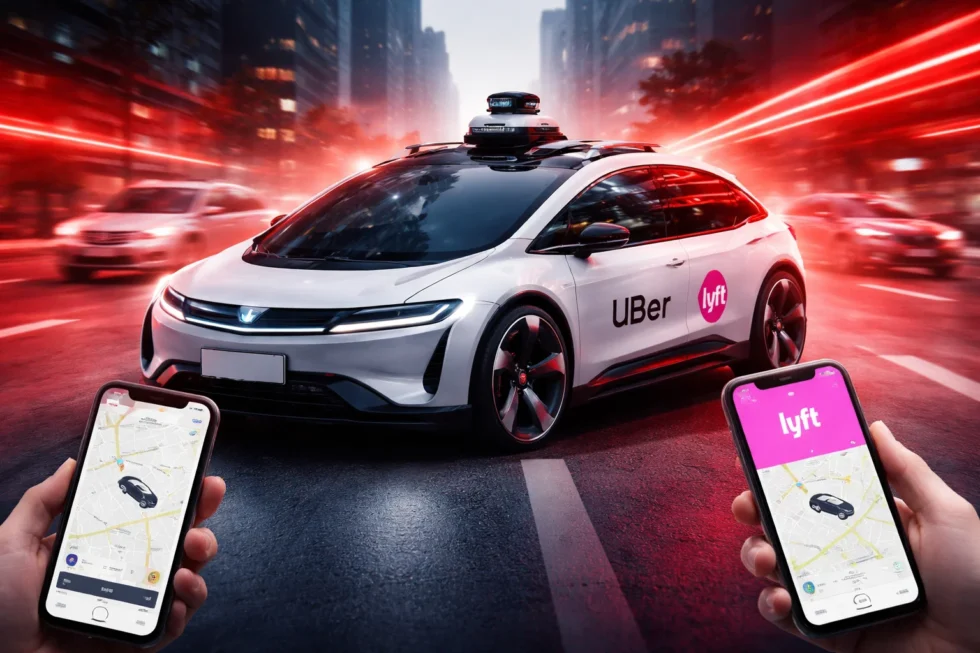
Uber and Lyft have confirmed plans to deploy fully electric, driverless robotaxis on the streets of London in 2026 after signing strategic partnerships with China’s technology group Baidu, whose Apollo Go platform already operates one of the world’s largest autonomous taxi fleets. The companies say the pilot will begin in the first half of 2026, pending regulatory approval, and will integrate Baidu’s purpose-built RT6 robotaxi vehicles directly into the Uber and Lyft apps, allowing passengers to book rides without a human driver. The programme will initially launch with dozens of vehicles, before expanding to hundreds if safety and regulatory targets are met. The WP Times reports, citing Associated Press and Reuters.
London becomes a frontline for autonomous transport
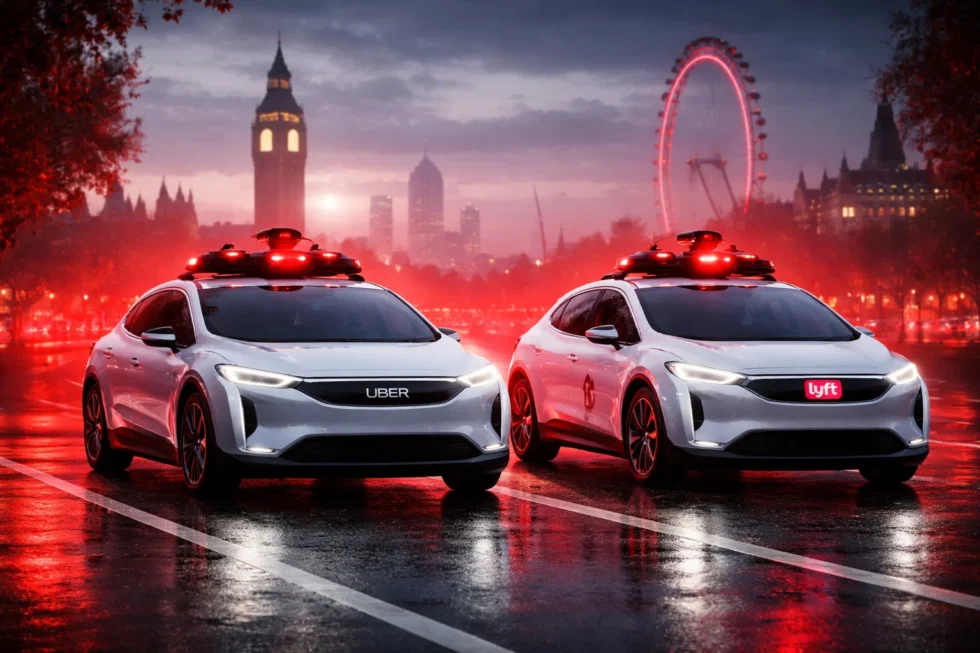
The UK has moved faster than most European countries to prepare its roads for driverless vehicles. The Automated Vehicles Act, passed in 2024, created a legal framework that allows fully autonomous cars to operate commercially by shifting legal responsibility from passengers to the fleet operator and manufacturer. This has turned Britain — and London in particular — into a magnet for global autonomous-vehicle developers seeking to prove their systems in one of the world’s most complex urban environments.
London offers a uniquely demanding testing ground: heavy traffic, dense pedestrian movement, cyclists, delivery vehicles and an intricate road layout that exposes weaknesses in navigation software far more quickly than suburban or highway driving. Success in London is therefore seen by the industry as a benchmark for global readiness.
Who is supplying the technology
Baidu’s Apollo Go division is not a laboratory project but a mass-scale commercial system. In China, the company already operates robotaxi services across cities such as Beijing, Wuhan and Shenzhen, completing millions of paid passenger journeys every year. Many of these vehicles run without safety drivers, meaning the software alone is responsible for steering, braking and hazard avoidance.
The RT6 robotaxi model being prepared for London was designed specifically for ride-hailing. It is electric, purpose-built for urban operation and optimised for high-frequency stop-and-go traffic rather than long motorway driving.
How the UK trials will work
Passengers will book robotaxis through the standard Uber or Lyft apps, but the vehicles will operate without a human driver. The first phase will be limited to geofenced districts of London, where road layouts, junctions and traffic flows have been digitally mapped at centimetre-level accuracy — a requirement for Level-4 autonomous driving.
Under the Automated Vehicles Act, every robotaxi must transmit continuous operational data to the operator and UK regulators, including speed, braking, sensor status and incident logs. Vehicles must also be connected to remote control centres, where trained supervisors can halt or reroute a car if its software detects abnormal behaviour.
Regulators will not rely on marketing claims. Approval to expand beyond the pilot will depend on measured performance:
- collision and near-miss rates
- emergency braking frequency
- disengagements where the system fails
- response times to hazards
These metrics will be compared directly against human-driven taxi benchmarks in London traffic. Only if autonomous vehicles demonstrate equal or better safety outcomes will regulators authorise larger fleets. In practical terms, the UK trial is designed as a live, data-driven safety audit of autonomous driving under real-world urban conditions.
Why Uber and Lyft are pushing autonomy
Labour is the structural bottleneck of ride-hailing. In mature markets, driver compensation typically absorbs 50–65 per cent of gross booking revenue, leaving platforms with thin operating margins even at high volume. This is why neither Uber nor Lyft has ever achieved durable profitability in core mobility services despite billions in annual turnover.
Autonomous fleets invert that cost structure. Replacing human drivers with capital-intensive vehicles and software shifts spending from variable labour to depreciable assets and energy, allowing gross margins to scale with utilisation. Once vehicles operate 16–20 hours per day, the economics begin to resemble airline or logistics models rather than taxi services.
Both companies previously attempted to build this technology in-house, spending billions of dollars on proprietary autonomous programmes before shutting them down as commercially unsustainable. Partnering with Baidu allows them to access production-grade autonomous systems without carrying the R&D burden, accelerating time-to-market while reducing financial risk. In effect, autonomy is no longer a technological experiment for Uber and Lyft — it is their clearest remaining path to a fundamentally different, and potentially profitable, business model.
Safety, trust and public acceptance
Autonomous systems do not suffer fatigue, distraction or impairment, and their sensor suites can monitor 360 degrees of traffic simultaneously. Baidu’s Chinese fleet reports lower accident rates than human-driven taxis in comparable cities, but UK regulators will require British road data before drawing any conclusions. Public acceptance will be just as important as regulatory approval. Surveys consistently show that while many passengers are curious about robotaxis, trust in fully driverless vehicles remains fragile, especially in dense urban traffic.
What this means for London drivers
London currently has over 110,000 licensed private-hire drivers, many of whom rely on ride-hailing platforms for income. Robotaxis will initially operate at a small scale, but if the technology proves reliable, it could reduce demand for human-driven cars in central areas over time.
There is currently no government programme to support drivers through this technological transition, raising questions about how the workforce will be protected as automation accelerates.
Why the UK matters globally
If robotaxis can operate safely and commercially in London, they can operate almost anywhere. That is why Baidu, Uber and Lyft see the UK not just as a local market, but as a gateway to Europe and other highly regulated regions. The 2026 trials will therefore be more than a transport experiment — they will be a test of whether autonomous mobility is ready to become part of everyday urban life.
Read about the life of Westminster and Pimlico district, London and the world. 24/7 news with fresh and useful updates on culture, business, technology and city life: What is Boxing Day in Britain — how it is celebrated, why it exists, and how London does it differently