British holidaymakers face a reshaped summer flying schedule after the UK government on Saturday set out emergency contingency plans allowing airlines to cancel or consolidate flights weeks in advance to conserve jet fuel, with Transport Secretary Heidi Alexander confirming a fast-track consultation on relaxing take-off and landing slot rules amid ongoing disruption to global supplies caused by the conflict in the Middle East and the closure of the Strait of Hormuz, The WP Times reports. The Department for Transport stressed there are no immediate supply issues at British airports, but said carriers including British Airways, Virgin Atlantic and easyJet need legal headroom now to lock in realistic timetables before the peak July and August travel window, when millions of Britons are due to fly to Spain, Greece, Italy, Portugal and other Mediterranean destinations from hubs such as Heathrow, Gatwick, Manchester and Stansted.
What the new slot rules will allow airlines to do
Under the proposals discussed at a 30 April roundtable in London, carriers will be permitted to hand back a limited share of their allocated airport slots without forfeiting the right to operate them in the equivalent season next year. The shift breaks with the long-standing "use it or lose it" 80/20 rule that has historically forced airlines to fly near-empty aircraft, known in the industry as "ghost flights", simply to defend valuable runway capacity. Officials say the change will let airlines merge thinly booked services on routes where several daily rotations cover the same destination, transferring passengers onto earlier or later flights with weeks of notice rather than scrambling at the gate. The measure builds on a parallel update from Airport Coordination Limited, the UK's independent slot coordinator, which has already signalled flexibility where fuel shortages prevent operations, and effectively converts a regulatory shield into an active scheduling tool for airlines heading into peak season.
Key elements of the contingency package include:
- Pre-emptive consolidation: Airlines can merge duplicate daily services on the same route to reduce fuel burn before any shortfall materialises at terminals.
- Protected slot rights: Carriers handing back slots in advance will not lose them in the next equivalent season, removing the financial penalty for cautious planning.
- Earlier passenger notification: The Civil Aviation Authority expects "as much notice as possible" of cancellations, cutting last-minute airport chaos and rebooking queues.
- Daily fuel monitoring: The DfT is tracking jet fuel stocks alongside refiners and airports, with domestic production reportedly stepped up at UK refineries.
- Diversified imports: The UK is drawing supply from non-Strait routes, including the United States, to insulate the network from Gulf shipping risks.
- No automatic refund triggers: Existing passenger rights apply, but consolidation is not classed as force majeure for airlines.
Why ministers are acting before any shortage hits
The decision to legislate in advance reflects what officials describe as a deliberately precautionary posture rather than a reaction to current shortages on the ground. Speaking after the industry roundtable in Whitehall, Heidi Alexander said the government has been monitoring jet fuel supplies daily since the Strait of Hormuz closed and is determined to insulate the country from the impact of the situation in the Middle East before stress reaches the departure gate. The political calculation is clear in Downing Street: a repeat of the post-pandemic summer of mass cancellations, when thousands of British passengers were stranded at Manchester, Bristol and Luton with little warning, would be deeply damaging at the start of the holiday season. By giving carriers permission to thin schedules now, ministers hope to convert what could have been chaotic last-minute cancellations into orderly, weeks-ahead rebookings that travellers can plan around with their tour operators.
Industry backs the plan as airports urge caution
The aviation sector has broadly welcomed the move, while stressing that operations remain entirely normal for the time being and that no carrier has reported any fuel uplift problems at British airports this spring. Tim Alderslade, chief executive of Airlines UK, said the trade body welcomed the government's contingency planning, including slot alleviation, describing it as a measure that enables airlines to adjust schedules responsibly, avoid unnecessary flying and continue operating efficiently while protecting connectivity for passengers (statement issued via the Department for Transport, London, 3 May). Karen Dee, chief executive of AirportsUK, struck a similar note, telling officials that although partners across the sector continue to report no shortage of jet fuel supplies, it is sensible for government to consult on possible action if the picture were to change at short notice (AirportsUK statement, London). Rob Bishton, chief executive of the UK Civil Aviation Authority, added that UK passengers benefit from some of the strongest rights in the world and that airlines retain a clear duty of care if disruption does occur on the day of travel (CAA statement, Gatwick).
How the consultation timeline will work
Whitehall officials have made clear that the consultation period has been deliberately compressed to give airlines clarity before summer schedules harden in early June, when most carriers publish definitive timetables for July, August and September. The Department for Transport will gather written evidence from airlines, airport operators, slot coordinators and consumer groups in the coming days, with secondary legislation expected to be laid before Parliament shortly afterwards if ministers decide to proceed. Crucially, the temporary nature of the measure has been stressed at every stage: the slot relaxation is designed to lapse once supply stability returns, and ministers have ruled out any permanent dilution of the 80/20 framework that governs UK aviation in normal conditions. Industry sources expect the first formal hand-backs to be announced within two to three weeks of the rules coming into force, focused initially on short-haul European leisure routes where multiple daily frequencies make merging operationally straightforward.
What passengers are entitled to if a flight is cancelled
Despite the new flexibility being offered to carriers, the Department for Transport has used the announcement to remind travellers that their statutory protections under UK261 are entirely unchanged by the consultation. If an airline cancels a flight at any stage, passengers retain a legal right to choose between being re-routed — including on a rival carrier where necessary — or receiving a full refund within seven days. Where flights are significantly delayed, the duty of care obligation kicks in: at least two hours for short-haul, three hours for medium-haul and four hours for long-haul services. In those cases passengers must be offered food, drink, communication and, where the delay extends overnight, hotel accommodation at the airline's expense. Travellers affected by changes are advised to contact their airline, travel agent or tour operator first before pursuing claims, and to keep all receipts for reasonable expenses incurred during disruption.
| Flight type | Delay threshold | Care entitlement |
|---|---|---|
| Short-haul (under 1,500 km) | 2 hours | Food, drink, communication |
| Medium-haul (1,500–3,500 km) | 3 hours | Food, drink, communication |
| Long-haul (over 3,500 km) | 4 hours | Food, drink, communication, hotel if overnight |
| Any cancelled flight | Immediate | Re-routing or full refund within 7 days |
The wider supply picture heading into peak season
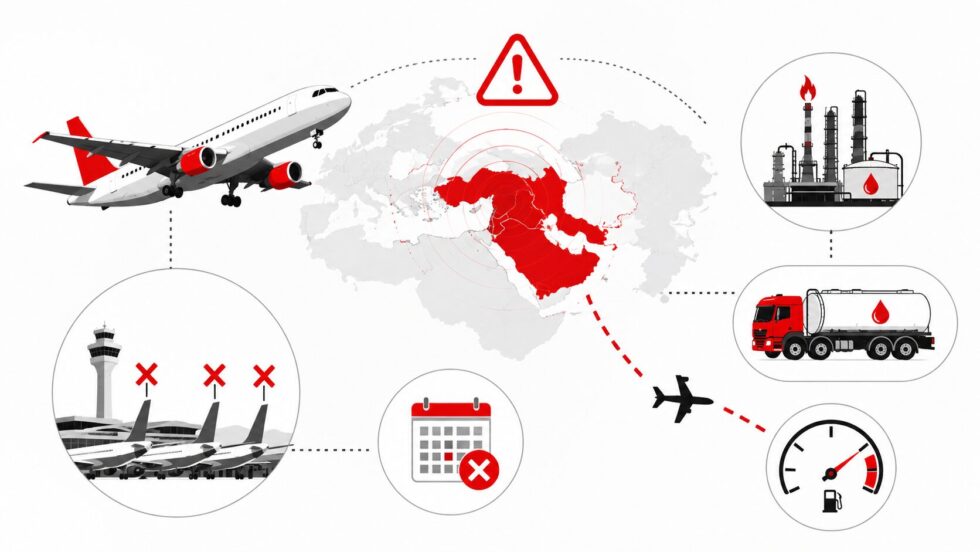
Officials have been careful to frame the legislative push as insurance rather than alarm, and the underlying fuel data supports that framing for now. Domestic jet fuel output has been stepped up at UK refineries, with Fawley, Stanlow and Pembroke all running at elevated utilisation rates this spring, while import flows from the United States Gulf Coast and other suppliers outside the Persian Gulf are being prioritised to dilute exposure to the closed Strait of Hormuz, through which a significant share of global crude and refined product has traditionally moved. Industry analysts expect the first wave of consolidated flights to be announced in the coming weeks, focused initially on short-haul European leisure routes where multiple daily frequencies make merging straightforward, with intercontinental long-haul services from Heathrow expected to remain largely untouched. The strategic aim, repeatedly emphasised by ministers and airline bosses alike, is to protect the connectivity that underpins the £28 billion outbound tourism market without resorting to the kind of chaotic, day-of-travel cancellations that defined the troubled summers of 2022 and 2023.
What British holidaymakers should do now
For families heading abroad in July and August, the practical guidance from both the Civil Aviation Authority and consumer groups is to remain watchful but not anxious about the situation. Travellers are advised to download their airline's app, ensure contact details are up to date with both the carrier and any tour operator, and consider taking out comprehensive travel insurance that explicitly covers consolidation-related disruption, including missed connections and additional accommodation costs. Where a flight forms part of a package holiday, ABTA-protected operators carry primary responsibility for re-routing and refunds, which gives those travellers an additional layer of protection compared with passengers who have booked flights and hotels separately online. The overarching message from Whitehall is that flying from British airports this summer should remain broadly reliable — but checking inbox, app notifications and airline updates daily, well before heading to the airport, has rarely been more important for anyone with a Mediterranean booking in the diary.
Read about the life of Westminster and Pimlico district, London and the world. 24/7 news with fresh and useful updates on culture, business, technology and city life: Snooker final 2026: Shaun Murphy vs Wu Yize after Crucible drama and Higgins defeat