The British political landscape in March 2026 is undergoing a historic shift, characterized by the unprecedented collapse of the traditional two-party dominance that has defined Westminster for over a century. For the first time in modern polling history, neither the Labour Party nor the Conservative Party holds a clear lead, as voters increasingly pivot toward insurgent movements and specialized interest groups. This volatility is not merely a protest phase but a systemic realignment, where economic stagnation, dissatisfaction with the post-Brexit settlement, and the government’s handling of international conflicts—specifically the escalating tensions in the Middle East—have created a vacuum now being filled by Reform UK and the Green Party. For the British electorate, this fragmentation promises a 2026 local election cycle that may permanently alter the country's legislative direction and the survival of the First-Past-The-Post (FPTP) voting system. This is reported by The WP Times.
The Polling Revolution: Reform UK’s Disruptive Dominance
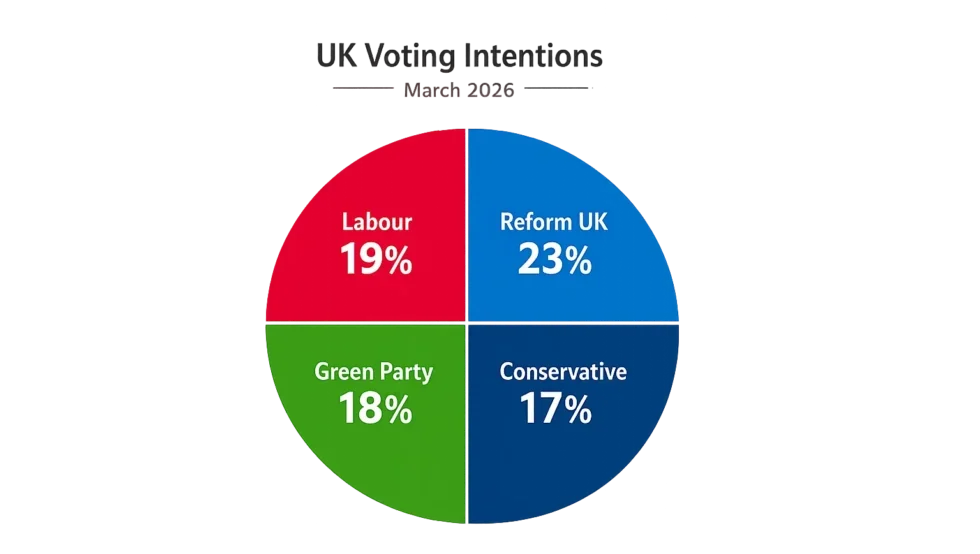
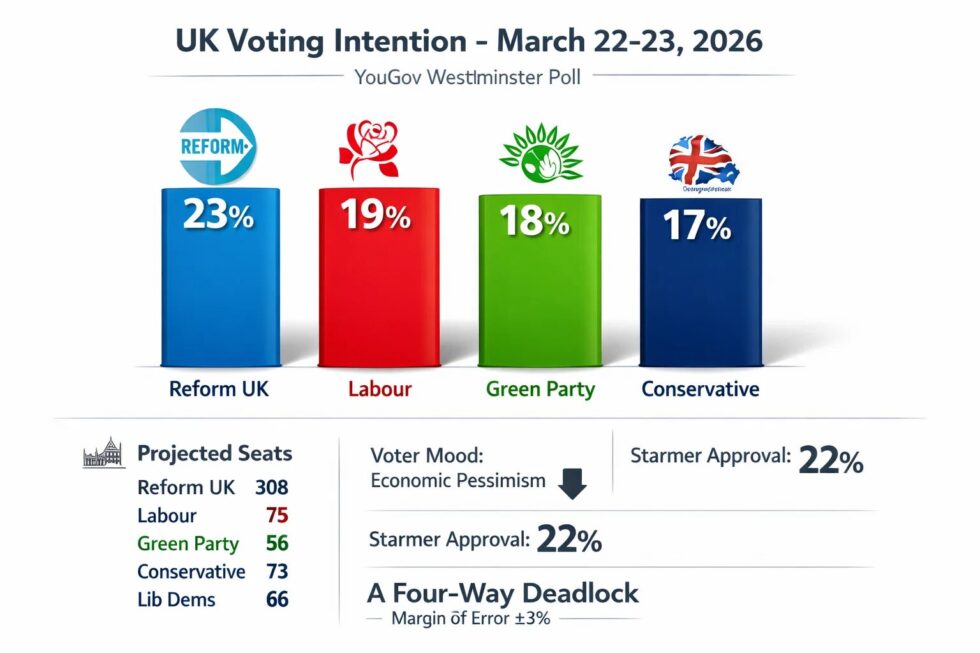
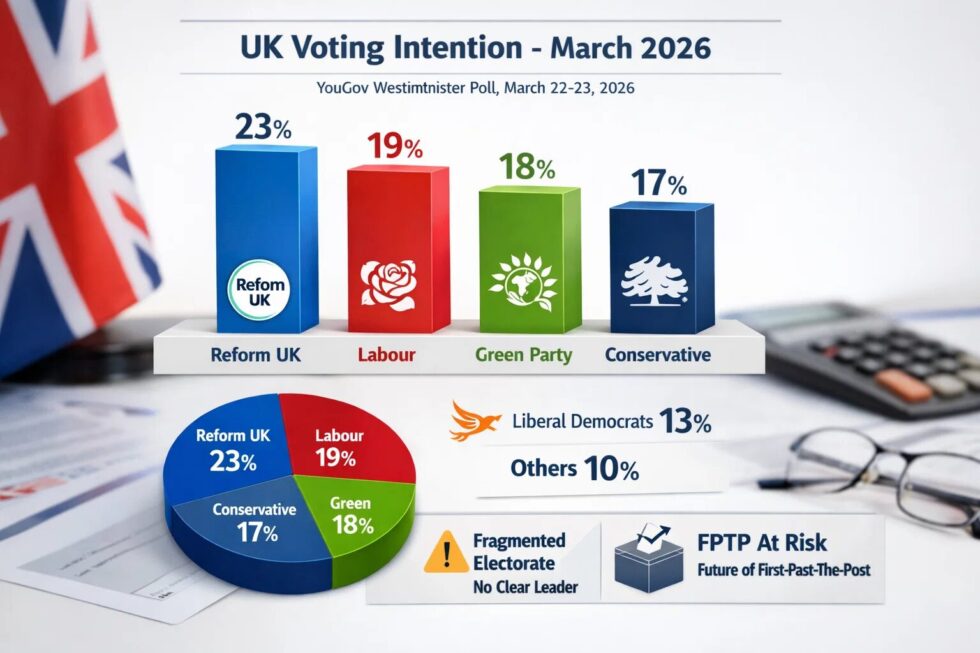
As of late March 2026, Reform UK, led by Nigel Farage, has consistently emerged as the leading force in national voting intention, marking a paradigm shift in British electoral politics. According to the latest YouGov Westminster data (March 22-23, 2026), Reform UK leads with 23% of the vote share, followed by Labour at 19%, the Greens at 18%, and the Conservatives trailing in fourth place at 17%. This statistical deadlock among four parties within a 6-point margin indicates that the UK is no longer a two-party state in terms of public preference, even if the parliamentary structure has yet to catch up.
- Support Base: Reform UK has successfully cannibalized the Conservative "Right," attracting voters frustrated by immigration levels and perceived economic inertia.
- Labour’s Slump: Keir Starmer's Labour Party has dropped from its 2024 landslide highs of 34% to just 19%, the lowest polling for a governing party since the 1980s.
- The Green Surge: The Green Party’s 18% share reflects a significant migration of younger, urban voters away from Labour over environmental policies and foreign policy stances.
- The "Margin of Error" Election: With five parties within 10 points of each other, minor shifts in the coming weeks will determine the May 7 local government and mayoral outcomes.
- Practical Recommendation: Political strategists should focus on "hyper-local" campaigning, as national swings are becoming less predictive of individual constituency results in 2026.
Keir Starmer’s Leadership Crisis: Between War and Domestic Reform
Prime Minister Keir Starmer enters the second quarter of 2026 facing a multi-front assault on his authority, with personal favorability ratings hitting a record low of -48. The central point of contention is his refusal to follow the United States blindly into a widening Middle Eastern conflict, a move that has alienated traditional Atlanticists while failing to satisfy the anti-war wing of his own party. Internal reports suggest that rebel MPs are already coordinating a potential leadership challenge (or "coup") following the expected local election losses in May.
- The Iran War Factor: Starmer’s hesitance to join a coalition has been labeled "cowardice" by right-wing media but "insufficiently neutral" by his left-wing critics.
- Approval Metrics: Only 22% of Britons now view the Prime Minister favorably, according to March 2026 YouGov trackers.
- The "Reeves Shambles": Chancellor Rachel Reeves faces calls to resign following a Budget that failed to curb inflation, which remains stubbornly above the 2% target.
- US Relations: Tensions with the Trump administration over trade tariffs and paracetamol pricing have further weakened the "Special Relationship" narrative.
- Strategic Advice: To survive 2026, the Prime Minister must pivot from reactive "appeasement" to a proactive narrative of national resilience, bypassing hostile traditional media via direct digital engagement.
The Conservative Abyss: Kemi Badenoch’s Struggle for Relevance
Despite Kemi Badenoch’s efforts to rebrand the Conservative Party as a fighting opposition, the party remains stuck at 17% in national polls. The primary issue for the Conservatives is the "pincer movement" they face: losing moderate voters to the Liberal Democrats and hardline supporters to Reform UK. While Badenoch has seen a minor personal boost in favorability (-25 compared to Starmer’s -48), this has not yet translated into a recovery for the party brand, which continues to suffer from the legacy of the 2024 defeat.
| Party | Support % (March 2026) | Trend (vs. Feb 2026) | Seats Prediction (Model) |
| Reform UK | 23% | -2% | 308 (Projected) |
| Labour | 19% | +2% | 75 (Projected) |
| Green Party | 18% | -1% | 56 (Projected) |
| Conservative | 17% | 0% | 73 (Projected) |
| Lib Dems | 13% | -1% | 66 (Projected) |
Source: Averaged 2026 Westminster Polling / Electoral Calculus Projections.
Local Elections 2026: The May 7 Battleground
The upcoming elections on May 7, 2026, are being described by the Electoral Commission as the most significant mid-term test in British history. Voters will elect local councils, the Scottish Parliament, and Senedd Cymru (Welsh Parliament). Data from the 2025 local elections, where Reform UK won 41% of the contested seats and gained control of 10 councils, suggests that the "Reform Wave" is likely to consolidate its power in 2026, particularly in the North of England and the Midlands.
- Scottish Parliament: The SNP is under threat from a Resurgent Labour in Scotland, though current polling suggests a "No Overall Control" outcome is most likely.
- Senedd Cymru: Plaid Cymru is currently on track to become the largest party in Wales for the first time, benefiting from Welsh Labour's decline.
- Mayoral Races: In London and the West Midlands, incumbents are facing unprecedented challenges from independent and Green candidates.
- Voter ID Requirements: 2026 marks the first major test of the expanded Voter Authority Certificate system; voters must apply for free ID by April 28.
- Tactical Voting: Expect high levels of "negative tactical voting," where electors vote for the candidate most likely to defeat their least favorite party rather than for their preferred choice.
Economic Pessimism and the 2026 Fiscal Reality
The driving force behind the 2026 political volatility is a deep-seated economic pessimism. According to the Office for Budget Responsibility (OBR), real wages have failed to return to pre-2022 levels, and the cost of housing in 2026 continues to outpace inflation. This "cost of living crisis 2.0" has made voters susceptible to the populist economic messaging of Reform UK, which promises radical tax cuts and a total halt to "illegal migration," which Home Secretary Shabana Mahmood recently admitted is "tearing the country apart."
- Practical Impact: High interest rates are expected to stay until late 2026, limiting the government's ability to offer "sweetener" policies before the local elections.
- The "Hidden" Tax: Bracket creep (fiscal drag) is estimated to cost the average household an additional £1,200 in 2026.
- Youth Unemployment: The Green Party's rise is directly linked to a 14% increase in youth underemployment in 2026.
- Regulatory Context: New laws regarding the "Gig Economy" are under review as the government tries to balance labor rights with business flexibility.
- Risk Factor: Continued strikes in the public sector, particularly within the NHS, are likely to peak in April, just weeks before the polls open.
Who is currently leading the UK polls in 2026?
Reform UK is currently leading with approximately 23-25% of the vote, though the race remains extremely tight with four parties in a dead heat.
When are the next major elections in the UK?
The local, Scottish, Welsh, and mayoral elections are scheduled for Thursday, May 7, 2026.
What is the registration deadline for the 2026 elections?
Voters must register by 11:59 pm on Monday, April 20, 2026, to participate in the May elections.
Is Keir Starmer still the Prime Minister?
Yes, but he faces significant pressure from within his party and record-low favorability ratings of -48 as of March 2026.
Can Nigel Farage become Prime Minister in 2026?
Under the current FPTP system, a high vote share for Reform UK might not translate into a majority of seats, but current models project them as the largest party in a hung parliament scenario.
What ID is required to vote in 2026?
Voters must present a valid photo ID. Those without one can apply for a free Voter Authority Certificate until April 28, 2026.
Read about the life of Westminster and Pimlico district, London and the world. 24/7 news with fresh and useful updates on culture, business, technology and city life: London elections on 7 May 2026: who can vote, voter ID rules and what Londoners need to know before polling day