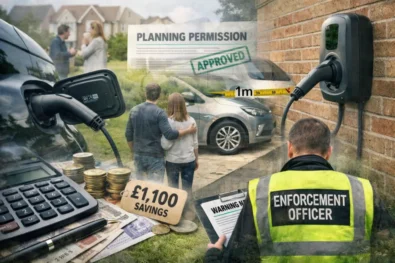
The global energy landscape in 2026 has reached a definitive turning point where the automotive and power sectors are no longer operating in silos. As geopolitical instability in the Middle East and the closure of the Strait of Hormuz drive crude oil prices toward $140 per barrel, the economic argument for electric vehicles (EVs) has shifted from environmental idealism to survivalist pragmatism. However, the most significant impact of this transition is one that many consumers haven't noticed yet: the "silent" stabilization of the national power grid.
By transforming millions of idle cars into a decentralized battery network, the mass adoption of EVs is beginning to solve the structural problem of renewable energy waste. This synergy is not just a theoretical benefit; it is actively starting to exert downward pressure on the electricity bills of every household, including those who still drive petrol cars, developments reported The WP Times via independent.
The 2026 Oil Shock: A Tipping Point for Global Transport Markets
The year 2026 will be remembered in history books as the moment the internal combustion engine (ICE) began its final descent into obsolescence. Following military escalations in the Persian Gulf, global petrol prices have spiked by over 40% in a single quarter, making the daily commute an unsustainable expense for the average family.
This external shock has synchronized perfectly with a breakthrough in solid-state and high-density lithium-iron-phosphate (LFP) battery technology, which has brought the price of EVs to parity with their petrol counterparts. As the cost of maintaining a traditional fuel station network rises, the convenience and low operational overhead of electric mobility have become undeniable. We are no longer waiting for a "future" of electric cars; in 2026, we are living in it, and the economic momentum is irreversible.
Comparative Costs and Market Indicators (April 2026):
| Indicator | Petrol/Diesel Vehicles | Electric Vehicles (EV) | Impact on Grid |
| Fuel Cost per 100 miles | £18.50 (at 2026 prices) | £3.20 (off-peak smart charging) | High savings |
| Maintenance Cost | High (Moving parts/fluids) | Low (Minimal moving parts) | Economical |
| Grid Interaction | None (Passive consumer) | Active (V2G capability) | Stabilization |
| Asset Utilization | Depreciating tool | Potential income generator | Positive |
| Energy Efficiency | ~25% (Energy lost as heat) | ~90% (Highly efficient) | Sustainable |
Why Electricity Is Expensive: The Problem of "Renewable Waste"
For years, critics argued that the UK’s investment in wind and solar power failed to lower bills, but the reality is more complex: the problem wasn't production, it was storage. In early 2026, the UK often generates more wind power during the night than the entire country can consume, yet it is forced to pay "curtailment" fees to wind farm operators to turn off their turbines because the grid cannot handle the excess.
Conversely, during the "tea-time peak" between 5 PM and 7 PM, the grid must fire up expensive, high-carbon gas peaker plants to meet the surge in demand. This volatility is what keeps standing charges and unit rates high. The missing link has always been a massive, national-scale battery to soak up the "free" night-time wind and release it during the expensive day-time peak.
Factors Contributing to High National Energy Rates:
- The Intermittency Gap: Wind and solar don't always align with human activity cycles.
- Gas Price Pegging: UK electricity prices remain artificially linked to global gas markets.
- Curtailment Costs: Hundreds of millions of pounds are wasted paying green energy to "not produce."
- Aging Infrastructure: The cost of upgrading wires to handle peaks is passed to consumers.
- Lack of Stationary Storage: Large-scale chemical batteries are still too expensive to build at scale.
- Service Economy Shift: Falling industrial demand makes fixed grid costs harder to distribute.
Vehicle-to-Grid (V2G): Turning Your Driveway into a Micro-Utility
The most significant technological advancement of 2026 is the mainstreaming of Vehicle-to-Grid (V2G) and Vehicle-to-Home (V2H) systems. A modern EV battery typically holds between 60kWh and 100kWh of energy—enough to power an average UK home for nearly an entire week. Through V2G, your car becomes a bidirectional energy hub: it charges when wind power is abundant and electricity prices are near zero (or even negative), and it sells that energy back to the grid when prices spike during peak hours.
Ofgem’s 2026 report highlights that if just 50% of EVs on British roads participate in smart V2G programs, the grid gains 16 GW of flexible power. This is five times the output of the Hinkley Point C nuclear plant, available instantaneously without the multibillion-pound construction cost.
How V2G Directly Benefits Your Household Finances:
- Arbitrage Profits: Buying at 5p/kWh and selling at 35p/kWh creates a new stream of passive income.
- Bill Offsetting: Using your car to power your home during the evening avoids peak grid prices.
- Community Stabilization: More V2G participants mean less reliance on expensive gas plants for everyone.
- Free Charging: Many smart tariffs now offer "free miles" in exchange for grid balancing services.
- Enhanced Battery Longevity: Modern AI-managed V2G cycles actually prevent battery degradation from sitting idle at 100%.
The Volume Effect: Spreading Fixed Costs Across More Kilowatts
One of the most misunderstood aspects of energy economics is the "fixed cost" of the national grid. It costs a certain amount of money to maintain pylons, transformers, and sub-stations regardless of how much electricity flows through them. In recent years, as appliances became more efficient, total electricity demand actually dropped, meaning those fixed costs were shared among fewer used units, driving up the price per kilowatt.
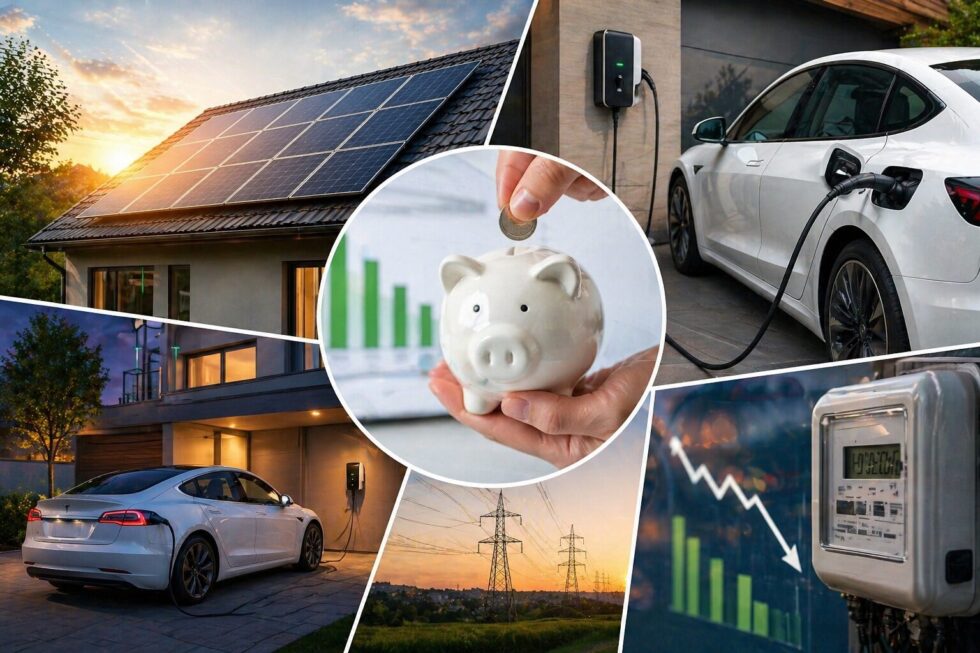
The mass adoption of EVs (and heat pumps) reverses this trend by significantly increasing the total volume of electricity sold. This "volume effect" allows energy providers to spread their infrastructure costs across a much larger base of usage, which, combined with the removal of expensive gas-fired generation, allows the unit price of electricity to fall for the first time in a decade.
Efficiency Comparison: EV vs. Internal Combustion (ICE):
- ICE Thermal Waste: 75% of every pound spent on petrol is lost as heat and friction.
- EV Direct Efficiency: 90% of electricity goes directly to turning the wheels.
- Grid Efficiency: EVs allow renewable plants to run at 100% capacity more often.
- Heat Pump Synergy: EVs and heat pumps together create a stable, all-electric domestic economy.
- Secondary Life: Old EV batteries are being repurposed into stationary grid storage in 2026.
The Psychological Shift: Moving from "Fear of Change" to "Economic Gain"
The narrative around "Net Zero" changed in 2026 from a political burden to an economic opportunity for the working class. High electricity prices previously fueled a "toxic" political debate suggesting that green energy made people poorer, but the reality of 2026 shows the opposite. As transport—a sector where emissions remained stagnant for thirty years—finally decabonizes, it is bringing down the costs of the entire energy ecosystem.
Unlike authoritarian regimes that can mandate technology shifts, Western democracies like the UK rely on the "rational consumer." When a driver realizes that their neighbor is charging their car for free and selling power back to the grid while they are paying £120 to fill a tank of petrol, the market shift happens overnight.
Practical Recommendations for the 2026 Consumer:
- Switch to a Smart Tariff: Do not stay on a flat-rate plan; you are overpaying for "peak" energy.
- Install a Bi-Directional Charger: Ensure your hardware is V2X (Vehicle to Everything) compatible.
- Automate Your Energy: Use AI apps to manage your car's charge/discharge cycles based on market prices.
- Prioritize Battery Size: If you plan to use V2H, a larger battery provides more "buffer" for your home.
- Audit Your Home Energy: Combine your EV strategy with solar panels for total energy independence.
Frequently Asked Questions
Will charging all these cars cause blackouts in the UK?
No. In fact, it's the opposite. EVs act as a buffer. By using "smart charging," cars only draw power when the grid has a surplus, and through V2G, they actually provide power back to the grid to prevent blackouts during peak times.
Is it true that EVs are only cheaper if you have a driveway?
While home charging is the most convenient, 2026 has seen a massive expansion of "smart" lamp-post and hub charging. Many of these offer the same off-peak rates and V2G credits as home chargers.
How much can an average family save by switching to an EV in 2026?
Between fuel savings and V2G income, the average household can save between £1,500 and £2,500 per year compared to running a petrol car and paying standard electricity rates.
Does V2G void my car's battery warranty?
In 2026, most major manufacturers (Nissan, VW, Hyundai) have updated their warranties to specifically include V2G usage, as long as it is managed by certified smart software.
What happens if I need to drive suddenly and my car has discharged to the grid?
Smart apps allow you to set a "minimum reserve" (e.g., 20% or 50 miles). The system will never discharge your battery below that level, ensuring you are never stranded.
Why are electricity prices still high if we have so many EVs?
The transition is still ongoing. As the percentage of V2G-active cars hits the 30–50% mark, the need for expensive gas backup will vanish, leading to the predicted sharp drop in national rates.
Read about the life of Westminster and Pimlico district, London and the world. 24/7 news with fresh and useful updates on culture, business, technology and city life: E.ON Ovo Energy merger: how will German energy group’s deal reshape UK market competition