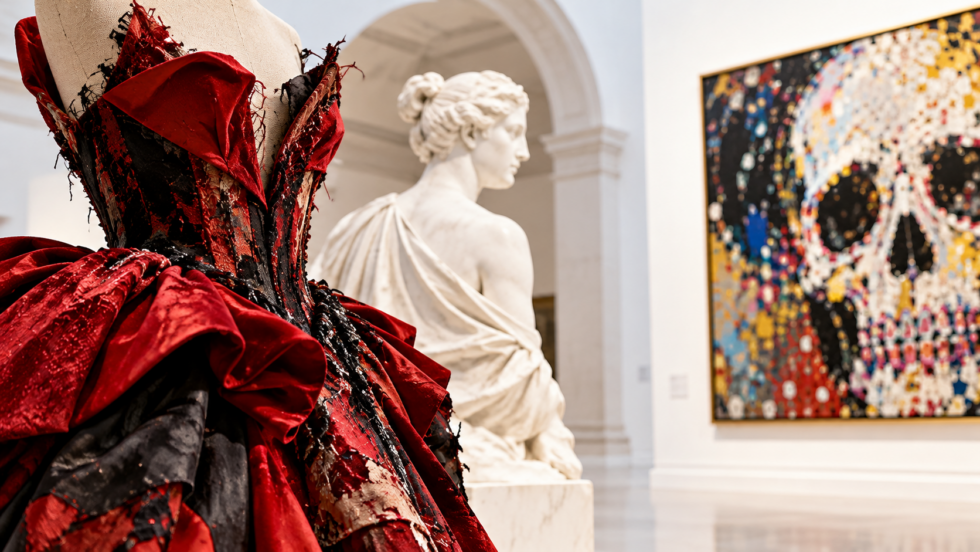
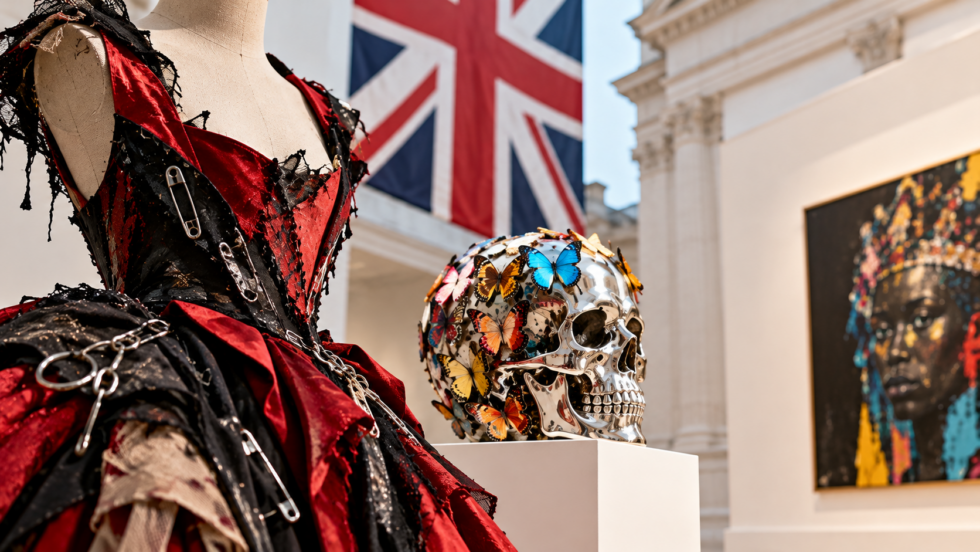
The 90s: Art and Fashion opened at Tate Britain on Millbank in Pimlico on Thursday 8 October and runs until 14 February 2027. Guest-curated by Edward Enninful, the former editor-in-chief of British Vogue, it is the first major exhibition to bring the art, photography and fashion of the 1990s together, with more than 100 photographs, paintings, sculptures, films and garments by nearly 70 artists, photographers and designers. Among them are Alexander McQueen, Vivienne Westwood, John Galliano, Hussein Chalayan, Damien Hirst, Tracey Emin, Sarah Lucas, Chris Ofili, Steve McQueen, Wolfgang Tillmans, Juergen Teller, Corinne Day and Nick Knight. Tickets cost £22, £20 for concessions and £5 for 16- to 25-year-olds through the free Tate Collective scheme, with free entry for Tate Members. The gallery is open daily from 10am to 6pm, The WP Times reports.
The exhibition is arranged in seven rooms that move from the do-it-yourself photography of i-D and Dazed and Confused, through rave and club culture, the body horror and minimalism that followed the Aids crisis, and the rise of Black British artists and designers, to a closing room on national identity at the turn of the millennium. Highlights include Steve McQueen's first major film, Bear (1993); Chris Ofili's Turner Prize-winning painting No Woman, No Cry (1998), a tribute to Doreen and Stephen Lawrence; Mark Leckey's film Fiorucci Made Me Hardcore (1999); Wolfgang Tillmans's Concorde Grid (1997); and the Hussein Chalayan airmail dress worn by Björk on the cover of her album Post. The fashion house McQueen, founded in London in 1992, is the lead supporter. The show is the most significant autumn exhibition in Westminster this year and sits a few minutes' walk from Pimlico station on the Victoria line, which runs normally on the coming weekends when the Circle and District lines close through central London. A season of 1990s films, a podcast recording and a free Late at Tate Britain on 13 November accompany the exhibition.
When is The 90s at Tate Britain and how much are tickets
The 90s: Art and Fashion runs at Tate Britain from Thursday 8 October 2026 to Sunday 14 February 2027. Tate originally listed an opening date of 1 October when it announced its 2026 programme; the official press release and booking pages give 8 October. Tickets are sold through Tate's website and by phone on 020 7887 8888, with timed entry. Standard admission is £22 and concessions £20. Tate Collective, which is free to join for anyone aged 16 to 25, offers £5 tickets to all Tate exhibitions. Tate Members get unlimited free entry. An audio guide, featuring Edward Enninful, Hussein Chalayan, Nick Knight, Normski and Yinka Shonibare, costs £5 and is delivered as a link to the visitor's own phone, so headphones are needed. The rest of Tate Britain, including its free collection displays, remains free to visit.
| Detail | Information |
|---|---|
| Exhibition | The 90s: Art and Fashion |
| Dates | 8 October 2026 to 14 February 2027 |
| Venue | Tate Britain, Millbank, London SW1P 4RG |
| Opening hours | Daily, 10am to 6pm |
| Standard ticket | £22 |
| Concession | £20 |
| Tate Collective (ages 16 to 25) | £5 |
| Tate Members | Free |
| Audio guide | £5 (own phone and headphones) |
| Booking | tate.org.uk or 020 7887 8888 |
| Curator | Edward Enninful OBE |
| Lead supporter | McQueen |
Who curated the exhibition
Edward Enninful became fashion director of i-D magazine at the age of 18, the youngest person to hold that role, and contributed to Italian Vogue from 1998. He was the first Black editor-in-chief of British Vogue, and in 2025 co-founded the media company EE72. His career began in the same London scene the exhibition documents, working with many of the photographers and stylists whose work is on display. He curated the show with Tate's Contemporary British Art team: Jessica Vaughan, Helen Little, Dominique Heyse-Moore and Celeste McEvoy, and Alex Farquharson, Director of Tate Britain. An accompanying book, The 90s: Art and Fashion, edited by Enninful and Heyse-Moore, runs to 240 pages and costs £45 in hardback and £32 in paperback, with contributions from Sonia Boyce, Stella McCartney, Steve McQueen, Wolfgang Tillmans and Gillian Wearing.
What is in The 90s: Art and Fashion
The exhibition is built around the idea that in 1990s Britain the boundaries between art, fashion photography, music and club culture broke down, and that the same small group of artists, photographers, stylists and designers moved between them. It brings together the Young British Artists, the photographers who rejected the glossy style of 1980s fashion magazines, the designers who emerged from London's art schools, and artists who addressed race, sexuality, Aids and national identity. Tate describes it as the first exhibition to explore the art, photography and fashion of the decade together.
Room by room
| Room | Theme | Artists and works |
|---|---|---|
| 1 | Young British Artists and the new photography | Sarah Lucas, including Chicken Knickers (1997); Teenage Precinct Shoppers (1990) |
| 2 | Anti-fashion and grunge | Corinne Day, Juergen Teller, Ellen von Unwerth, Jenny Saville, Gillian Wearing; Eileen Perrier's Afro Hair and Beauty Show photographs |
| 3 | Raves and clubbing | Mark Leckey's Fiorucci Made Me Hardcore (1999); club photography from London and Manchester |
| 4 | Body shock | Alexander McQueen garments; Jake and Dinos Chapman's Great Deeds Against the Dead (1994); Helen Chadwick; Cathy de Monchaux; Hamad Butt |
| 5 | Minimalism | Hussein Chalayan; Damien Hirst; Cerith Wyn Evans; Nick Knight; Rachel Whiteread; Gary Hume; Wolfgang Tillmans's Concorde Grid (1997) |
| 6 | Black British creativity | Ozwald Boateng; Chris Ofili's No Woman, No Cry (1998); Steve McQueen's Bear (1993); Keith Piper |
| 7 | Identity and history | Yinka Shonibare's Diary of a Victorian Dandy and The Swing (after Fragonard) (2001); Maud Sulter; John Galliano; Vivienne Westwood |
The room themes above follow the order described in Tate's press material and in the first published reviews. Tate's own description groups the opening sections around do-it-yourself attitudes, imperfection and anti-fashion grunge; real people as muses; nightlife and subculture, from acid house and jungle to hip-hop, drum and bass, queer club nights, raves and boy racers; and Cool Britannia alongside the voices it left out.
Which works should you not miss
- Steve McQueen, Bear (1993): the Turner Prize-winning artist and Oscar-winning film-maker's first major film, a wordless encounter between two men.
- Chris Ofili, No Woman, No Cry (1998): the painting that helped win Ofili the 1998 Turner Prize, made in tribute to Doreen Lawrence and her son Stephen, murdered in 1993.
- Mark Leckey, Fiorucci Made Me Hardcore (1999): a film assembled from found footage of British dance and club scenes from the 1970s to the 1990s.
- Wolfgang Tillmans, Concorde Grid (1997): a grid of photographs of Concorde in flight.
- Hussein Chalayan's airmail dress: the paper garment worn by Björk on the cover of her 1995 album Post.
- Alexander McQueen garments, including pieces from his Joan collection, alongside Sean Ellis's 1998 portrait of McQueen styled by Isabella Blow.
- Damien Hirst's formaldehyde sculptures, including small sharks.
- Hamad Butt's sculptures, made before the artist's death from an Aids-related illness in 1994.
- Yinka Shonibare's Diary of a Victorian Dandy and The Swing (after Fragonard) (2001).
- Elaine Constantine's Burn up Northampton photographs and Jason Evans's work with the stylist Simon Foxton.
Which artists and designers are in the exhibition
Nearly 70 artists, photographers and designers are represented. The full list published by Tate is below, grouped by the main field each is known for; several worked across more than one.
| Field | Names |
|---|---|
| Fashion designers | Alexander McQueen, Vivienne Westwood, John Galliano, Hussein Chalayan, Stella McCartney, Ozwald Boateng, Joe Casely-Hayford, Philip Treacy |
| Fashion and documentary photographers | Juergen Teller, Corinne Day, Nick Knight, David Sims, Craig McDean, Glen Luchford, Nigel Shafran, Ellen von Unwerth, Steven Meisel, Elaine Constantine, Sean Ellis, Jason Evans, Koto Bolofo, Mark Mattock, Sophy Rickett, Fergus Greer |
| Club, music and street photographers | Normski (Norman Anderson), Eddie Otchere, Ewen Spencer, David Swindells, Des Willie, Jon Shard, Mark McNulty, Vinca Petersen, Seana Gavin, Tim Smith, Tony Davis, Peter J Walsh, Stuart Linden Rhodes, Mischa Haller |
| Young British Artists and contemporaries | Damien Hirst, Tracey Emin, Sarah Lucas, Gillian Wearing, Rachel Whiteread, Gary Hume, Abigail Lane, Jake and Dinos Chapman, Sam Taylor-Johnson, Cerith Wyn Evans, Jenny Saville, Jim Lambie, Mark Leckey, Cathy de Monchaux |
| Artists addressing race, identity and the body | Chris Ofili, Steve McQueen, Yinka Shonibare, Sonia Boyce, Keith Piper, Donald Rodney, Maud Sulter, Barbara Walker, Roshini Kempadoo, Eileen Perrier, Poulomi Desai, Hamad Butt, Helen Chadwick, Mona Hatoum |
| Photographers and artists across fields | Wolfgang Tillmans, Simon Foxton (stylist, with Jason Evans) |
How does the exhibition tell the story of the 1990s
The show starts from magazines. In the early 1990s, i-D, The Face and Dazed and Confused published photographs by Corinne Day, Juergen Teller and Nigel Shafran that used ordinary settings, natural light and unstyled models, in contrast with the polished fashion imagery of the 1980s. Several of the photographers in the exhibition worked for those titles, and Enninful was i-D's fashion director at the time. The exhibition sets their work beside the Young British Artists, many of them graduates of Goldsmiths in south-east London, whose work drew wide public attention through the Sensation exhibition at the Royal Academy in 1997.
The middle rooms deal with club culture and with the Aids crisis. Acid house, rave and jungle are represented through photography of club nights and free parties, and through Mark Leckey's film. The body shock and minimalism rooms place McQueen's early collections, the Chapman brothers' sculpture and Hirst's preserved animals alongside work by Hamad Butt and Helen Chadwick, artists who died in the 1990s. The later rooms focus on Black British creativity and national identity. Ozwald Boateng, the tailor who opened on Savile Row in Mayfair, is shown alongside Chris Ofili and Steve McQueen. Yinka Shonibare's Victorian dandy photographs and his Fragonard sculpture, made with Dutch wax-printed fabric, close the exhibition with questions about empire and Britishness at the end of the century.
What have reviewers said
First reviews were published before the opening. The Glossary's reviewer, Amah-Rose Abrams, singled out Hamad Butt's three sculptures as the most moving works in the show and noted that the rooms have no soundtrack, recommending a playlist before visiting. She also observed that "the context that made this such an exciting time is often left to the visitor to supply" (Amah-Rose Abrams, The Glossary, 6 October 2026). Time Out described it in August as one of the most anticipated exhibitions in London this year. Tate has not published any comment from Enninful in its press materials.
What events are on alongside the exhibition
Tate Britain is running a programme of events linked to the show. A season of 1990s British films is being screened in the Clore Auditorium, the gallery is hosting a live recording of the Talk 90s to Me podcast, and a free 1990s-themed Late at Tate Britain takes place in November.
| Date | Event | Venue |
|---|---|---|
| Saturday 10 October 2026 | Trainspotting (1996) screening | Clore Auditorium, Tate Britain |
| Thursday 22 October 2026 | Talk 90s to Me podcast, live recording | Tate Britain |
| Friday 13 November 2026 | Late at Tate Britain, 1990s theme (free) | Tate Britain |
| Saturday 5 December 2026 | Orlando (1992) screening | Clore Auditorium, Tate Britain |
| Saturday 30 January 2027 | Bhaji on the Beach (1993) screening | Clore Auditorium, Tate Britain |
| Saturday 13 February 2027 | Babymother (1998) screening | Clore Auditorium, Tate Britain |
Event dates are as listed in published previews of the exhibition; check Tate's website for times and tickets, which are sold separately. Tate Britain's next major exhibition, on Vanessa Bell and Duncan Grant, is due to open on 12 November 2026.
Why does the 1990s matter to Tate Britain and Millbank
Tate Britain has a direct connection to the decade the exhibition covers. It opened in 1897 as the National Gallery of British Art on the site of the former Millbank Penitentiary, and for much of the 1990s it was the home of the Turner Prize, which became one of the most widely reported events in British art during that decade. Five of the artists in the exhibition won the prize in the 1990s, and their winning years trace the arrival of the generation the show is about. Rachel Whiteread became the first woman to win, in 1993. Damien Hirst followed in 1995, Gillian Wearing in 1997, Chris Ofili in 1998 and Steve McQueen in 1999. Tate Britain itself took its current name in 2000, when the international modern collection moved to the new Tate Modern at Bankside, the year after the decade ended.
| Year | Turner Prize winner | In The 90s exhibition |
|---|---|---|
| 1993 | Rachel Whiteread | Yes |
| 1995 | Damien Hirst | Yes |
| 1997 | Gillian Wearing | Yes |
| 1998 | Chris Ofili | Yes, including No Woman, No Cry |
| 1999 | Steve McQueen | Yes, including Bear |
From Freeze to Sensation
Many of the Young British Artists in the exhibition first came to public attention through Freeze, a student-organised show in a disused building in London's Docklands in 1988, organised by Damien Hirst while he was studying at Goldsmiths. Through the early 1990s the collector Charles Saatchi bought and exhibited their work, and in 1997 the Royal Academy on Piccadilly staged Sensation, a show of works from his collection. When Sensation travelled to the Brooklyn Museum in New York in 1999, a painting by Chris Ofili prompted a public dispute with the city's mayor. The same years saw the rise of Britpop and the political branding of "Cool Britannia" after the 1997 general election, which the exhibition's later rooms set against the work of artists who addressed race, class and exclusion.
The magazines behind the look
The photographers who dominate the opening rooms built their reputations in a small group of London magazines. i-D, founded in 1980, and The Face, founded the same year, published much of the street and club photography of the late 1980s and early 1990s. Dazed and Confused was launched in 1991 by Jefferson Hack and the photographer Rankin. Corinne Day's photographs of a teenage Kate Moss for The Face in 1990, and Juergen Teller's and Nigel Shafran's work for i-D, are widely cited as the start of the unpolished style later labelled grunge. Edward Enninful worked in that world from the age of 18, when he became fashion director at i-D.
| Title | Founded | Role in the 1990s look |
|---|---|---|
| i-D | 1980 | Street and club photography; Enninful's magazine |
| The Face | 1980 | Corinne Day's 1990 photographs of Kate Moss |
| Dazed and Confused | 1991 | Founded by Jefferson Hack and Rankin |
How do you get to Tate Britain
Tate Britain is on Millbank, on the north bank of the Thames between Lambeth Bridge and Vauxhall Bridge, in Pimlico in the City of Westminster. The nearest Tube station is Pimlico on the Victoria line, about a seven-minute walk; Vauxhall, on the Victoria line and National Rail, is across Vauxhall Bridge. Buses on Millbank and Vauxhall Bridge Road stop close to the gallery. The Tate Boat river service links Millbank Pier, outside Tate Britain, with Bankside Pier for Tate Modern. On the weekends of 10 to 11 and 24 to 25 October, the Circle and District lines are closed through Victoria, St James's Park and Westminster for planned engineering work, but the Victoria line runs as normal, so Pimlico station is the most reliable route.
| Route | Details | Notes on October closures |
|---|---|---|
| Pimlico station | Victoria line; about 7 minutes' walk | Open on all October weekends |
| Vauxhall station | Victoria line and National Rail; cross Vauxhall Bridge | Open on all October weekends |
| Victoria station | 15 to 20 minutes' walk, or change to the Victoria line | Circle and District closed 10 to 11 and 24 to 25 October |
| Westminster station | About 15 minutes' walk along Millbank | Circle and District closed 10 to 11 and 24 to 25 October; Jubilee open |
| River | Tate Boat from Bankside Pier to Millbank Pier | Check timetable |
| Bus | Routes along Millbank and Vauxhall Bridge Road | Possible diversions on Sunday 11 October for the Royal Parks Half Marathon |
When is the best time to visit
Timed tickets help manage numbers, and weekday mornings shortly after the 10am opening are usually the quietest time at major London exhibitions. The final weeks of the run, in late January and February, are typically the busiest. Visitors with Tate Collective or Membership can book in the same way. The exhibition includes images of nudity and references to drug use, Aids and violence, and families may wish to check the content before visiting with younger children; Tate has not published a specific age recommendation on its booking pages.
What else is on near Tate Britain
Tate Britain's free collection displays, which trace British art from the 1500s to the present day and include the Clore Gallery of works by J.M.W. Turner, remain open alongside the paid exhibition. Within a short walk or bus ride in Westminster, the National Portrait Gallery opens Tim Walker's Fairyland: Love and Legends on 9 October, and the National Gallery's Renoir and Love exhibition opens in October. On Sunday 11 October, the Royal Parks Half Marathon closes roads around St James's Park and Westminster from early morning, which will affect buses towards Millbank until lunchtime.
| Exhibition | Venue | Dates |
|---|---|---|
| The 90s: Art and Fashion | Tate Britain, Millbank | 8 October 2026 to 14 February 2027 |
| Tim Walker's Fairyland: Love and Legends | National Portrait Gallery, St Martin's Place | From 9 October 2026 |
| Renoir and Love | National Gallery, Trafalgar Square | From October 2026 to 31 January 2027 |
| Vanessa Bell and Duncan Grant | Tate Britain, Millbank | From 12 November 2026 |
| Light and Magic: The Birth of Art Photography | Tate Modern, Bankside | From 8 October 2026 |
Frequently asked questions
How much are tickets for The 90s at Tate Britain?
Standard tickets cost £22 and concessions £20. Anyone aged 16 to 25 can book for £5 through the free Tate Collective scheme, and Tate Members go free.
When does The 90s: Art and Fashion close?
The exhibition runs until Sunday 14 February 2027.
What are Tate Britain's opening hours?
Tate Britain is open daily from 10am to 6pm.
Who curated The 90s exhibition?
Edward Enninful, former editor-in-chief of British Vogue, with Tate's Contemporary British Art curators.
Which artists are in The 90s at Tate Britain?
Nearly 70, including Alexander McQueen, Vivienne Westwood, Damien Hirst, Tracey Emin, Sarah Lucas, Chris Ofili, Steve McQueen, Wolfgang Tillmans, Juergen Teller, Corinne Day and Nick Knight.
What is the nearest station to Tate Britain?
Pimlico on the Victoria line, about a seven-minute walk. Vauxhall is across the river.
Is there an audio guide?
Yes. It costs £5, features Enninful, Chalayan, Nick Knight, Normski and Shonibare, and plays on your own phone.
Sources used: Tate press release for The 90s: Art and Fashion, Tate exhibition guide, Time Out London, The Glossary review (6 October 2026), Luxury London, Fact Magazine, Londonist, Edward Enninful biography, Transport for London planned closures.
Read about the life of Westminster and Pimlico district, London and the world. 24/7 news with fresh and useful updates on culture, business, technology and city life: What will Ruthin School closure mean after 742 years of teaching in North Wales