Council tax could be increased without the present 5% referendum limit if Britain’s incoming government accepts a cross-party plan to transfer greater control over taxation and public spending from Westminster to English local authorities. The proposal would allow elected councils to determine their own annual increases, while leaving residents to judge the cost and quality of local services at council elections, The WP Times reports.
The recommendation was published on 14 July 2026 by the All-Party Parliamentary Group on Local Government as part of a wider fiscal devolution programme aimed at strengthening council finances, supporting regional economic growth and making local politicians more directly accountable for their tax decisions. It does not itself change council tax bills, and no unrestricted increase has yet been authorised: the current referendum rules remain in force unless ministers introduce and Parliament approves a different framework.
Council tax referendum limit could be removed under fiscal devolution plan
The APPG report calls on the incoming government led by Andy Burnham to abolish the council tax referendum principles that restrict how far most English authorities can increase bills without first obtaining local approval.
Under the rules applying in England for 2026–27, most councils with adult social care responsibilities can raise the core council tax element by up to 3%, together with an additional 2% adult social care precept. An increase reaching 5% or more is normally considered excessive and would require a referendum unless the authority has received a specific government dispensation. For councils without adult social care responsibilities, the standard threshold is generally 3%. Shire district councils can increase their element by up to 3% or £5 on a Band D bill, whichever is higher, while separate cash thresholds apply to bodies such as fire authorities and police and crime commissioners.
The MPs’ proposal would remove that central restriction and allow councils to set the increase they believe is required to finance local services. Authorities would no longer need to organise a referendum merely because their proposed rise exceeded a figure prescribed annually by Whitehall. However, describing the recommendation as an immediate power to impose “unlimited council tax” would be incomplete. Councils would still have to approve their budgets publicly, explain their decisions, comply with wider public law and financial duties, and face voters at local elections. The APPG’s argument is that political accountability should replace the present national referendum threshold.
What would change under the council tax proposal
| Current council tax system | APPG fiscal devolution proposal |
|---|---|
| Central government sets annual referendum principles | Councils would have greater freedom to determine increases |
| Most social care authorities can raise bills by just under 5% without a vote | No standard national percentage ceiling is proposed |
| Larger increases normally require a local referendum | Councillors would approve increases through the ordinary budget process |
| Government can grant selected councils exceptional flexibility | The same tax-setting responsibility would apply more consistently |
| Accountability is divided between councils and ministers | Local voters would hold councillors responsible at elections |
Labour MP Clive Betts, chair of the APPG on Local Government, said councils should be required to defend their tax choices directly to the residents who pay the bills.
“In the end, councils who are elected should be responsible for explaining local tax to local voters. Those voters will decide whether councils behave reasonably for the level of council tax they are levying,” Betts told Sky News on 14 July 2026. His argument is that local authorities already receive exceptional permission to exceed the ordinary limit when their financial position becomes critical. According to the MPs, selectively allowing struggling councils to impose larger rises while withholding the same discretion from financially stable authorities creates an inconsistent system.
Higher council tax rises have already been authorised for some councils
The existing rules are not an absolute ceiling. Ministers can establish different referendum principles for individual authorities through the local government finance settlement.
For 2026–27, official council tax data show that North Somerset Council and Shropshire Council were permitted to increase their council tax by up to 9% without holding a referendum. This consisted of a 7% core increase and a 2% adult social care precept. Such exceptional arrangements are generally provided through government financial support packages when councils face severe budget pressures. The APPG argues that this produces a contradiction: councils assessed as being in financial difficulty may receive permission to charge residents more, while other authorities remain subject to the standard limit. Removing the threshold would not guarantee that every council increased bills sharply. Some authorities could decide that a large rise was politically unacceptable, unnecessary or harmful to residents. Others might argue that a larger increase was the only way to protect adult social care, children’s services, homelessness support, road maintenance, libraries or waste collection.
How much is council tax in England in 2026–27
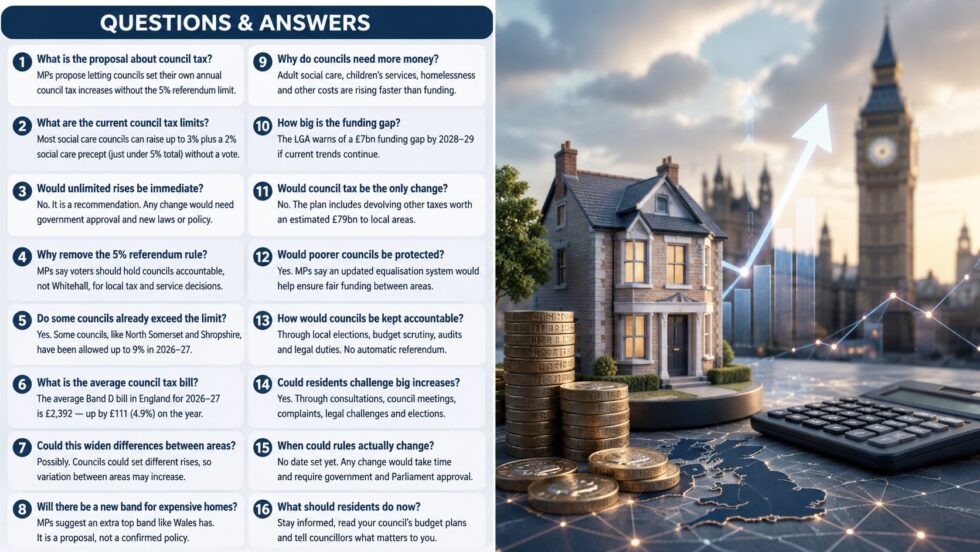
The average Band D council tax bill set by local authorities in England for 2026–27 is £2,392. That represents an annual increase of £111, or 4.9%, compared with 2025–26. The total council tax requirement, including adult social care and parish precepts, has risen to £46.8bn—£2.7bn, or 6.1%, above the previous year. The difference between the percentage rise in average bills and the increase in total revenue reflects factors including new properties, changes to the tax base and local precepts. A 4.9% increase on an illustrative £2,392 annual bill is approximately £117 for a full subsequent year, although the actual change would depend on the authority, property band and individual entitlement to discounts or council tax support. The APPG proposal could create wider variation between areas. A council seeking to preserve services might approve a rise above the present threshold, while a neighbouring authority could keep its increase lower. That would strengthen local discretion but could also intensify the existing postcode differences in council tax charges.
Why council tax bills vary between households
A household’s final bill is affected by several separate factors:
- the property’s council tax valuation band;
- the billing authority’s basic charge;
- county, unitary or metropolitan authority precepts;
- adult social care charges;
- police and fire authority precepts;
- parish or town council charges;
- discounts, exemptions and council tax reduction schemes;
- whether the property is empty, a second home or subject to a premium.
Council tax applies to properties rather than being calculated directly from a household’s current income. In England and Scotland, valuation bands are still based on historic property values from 1991, while Wales uses values from 2003. The APPG report argues that greater local control should be accompanied by broader council tax reform, including systematic revaluation. Its authors consider the present structure outdated and regressive because households in less valuable properties can pay a larger proportion of their property’s value than owners of the most expensive homes.
MPs propose an additional council tax band for expensive homes
The cross-party group also suggests that England could follow Wales by examining an additional upper council tax band for the most expensive residential properties. An extra band would not automatically mean that every higher-value home faced the same increase. Ministers would have to define the valuation threshold, multiplier and implementation date, while councils would need updated property information. No new English band has been enacted as part of the report. It remains a recommendation for the incoming administration, and homeowners should not treat it as a confirmed change to their current liability.
The idea nevertheless places reform of high-value property taxation firmly within the wider debate. Burnham has previously made devolution and the transfer of power away from Westminster central themes of his political platform. He is expected to become Labour leader on 17 July and prime minister on 20 July 2026, following the resignation of Sir Keir Starmer.
Why councils say the present funding model is under pressure
The council tax recommendation has been made against a deteriorating financial background across English local government. Councils have statutory obligations to provide services including adult social care, children’s protection, homelessness assistance and support for children with special educational needs. Demand and costs in these areas have grown more quickly than many authorities’ available income, leaving less money for discretionary services such as libraries, parks, cultural programmes and some forms of public transport. The Local Government Association warned in July 2026 that English councils could face a funding gap of approximately £7bn by 2028–29. Its analysis said additional cost pressures over the three-year period would be equivalent to 22% of current spending merely to maintain existing services.
The LGA identified adult and children’s social care, homelessness, home-to-school transport and new environmental duties among the principal pressures. It warned that residents could face longer waits for care assessments and further reductions in neighbourhood services if councils were unable to close the gap. Separate LGA analysis found that more than two-thirds of shire district councils were facing a real-terms funding reduction in 2026–27. Districts are particularly exposed to rising spending on temporary accommodation, homelessness prevention, planning and environmental services.
Council tax alone cannot close every local authority deficit
Even substantial council tax increases would not affect every authority equally. Councils with large numbers of high-band properties can generate more money from the same percentage increase than councils with a smaller or lower-value tax base. Areas with greater deprivation may therefore have the greatest demand for public services but the weakest capacity to raise revenue locally. This is why the APPG says fiscal devolution must include an automatically updated equalisation system. Without redistribution, greater tax autonomy could widen regional inequalities by allowing affluent areas to raise more money while poorer councils remained dependent on grants. The report proposes a settlement based on three linked principles:
- councils should receive meaningful control over revenue;
- tax-raising powers must be matched by responsibility for services and economic growth;
- resources must be redistributed so that residents can receive essential services regardless of the strength of their local tax base.
The Local Government Information Unit, which provides the APPG’s secretariat, said the inquiry consulted councils, academics and sector specialists on how greater control of taxation could improve services, strengthen accountability and support long-term financial sustainability.
Fiscal devolution could transfer control of £79bn in taxation
Council tax is only one part of the proposals. The APPG also recommends assigning local areas a proportion of revenue raised through national taxes, potentially including income tax and stamp duty land tax. It proposes greater local control over taxes and levies such as landfill tax and the growth and skills levy.
According to the report as described by its authors, the combined reforms could place approximately £79bn of public revenue under stronger local or regional control. That figure should not be read as £79bn of new taxation: it principally concerns the reassignment or devolution of existing revenue streams. The intention is to reduce councils’ dependence on short-term grants negotiated with Whitehall. Local and strategic authorities would instead have a more predictable income base and a stronger financial incentive to support employment, construction, skills development and commercial growth. The report also calls for:
- a statutory roadmap setting out how fiscal powers will be devolved;
- a mixture of revenue sources so areas do not depend on one tax;
- stronger local scrutiny committees;
- clearer accountability from councils to Parliament;
- additional capacity funding for councils and mayoral authorities;
- regular equalisation reviews;
- reform of business rates, fees and local charges.
What unlimited council tax powers could mean for households
For residents, the immediate position has not changed. Council tax bills for 2026–27 have already been set, and the publication of an APPG report does not permit councils to reopen those budgets automatically. Any removal of the referendum principles would require a government decision and changes to the legal or policy framework governing future settlements.
If the proposal were implemented for a later financial year, households could see greater differences between councils. Some authorities might approve increases above 5% to protect services or rebuild reserves. Others could remain below the existing threshold because councillors feared an electoral backlash. Residents would need to assess not only the percentage increase but also how the money was being used. A larger bill accompanied by maintained social care, functioning libraries, cleaner streets and improved homelessness provision would present a different political argument from a comparable increase accompanied by continuing service deterioration. The proposal would therefore transfer a difficult decision rather than remove it. Ministers would surrender part of their ability to restrict local bills, while councillors would lose the argument that Whitehall rules prevented them from raising the money they said was required.
Would residents still be able to challenge a council tax rise?
The APPG’s recommendation would remove the automatic referendum requirement, not ordinary democratic or legal scrutiny. Residents could still:
- examine the council’s draft budget and financial documents;
- contact councillors before the budget vote;
- participate in public consultations;
- attend or follow council meetings;
- challenge unlawful decisions through the courts;
- complain about maladministration through the appropriate ombudsman;
- vote against councillors at the next local election.
Councils would also remain subject to audit requirements and duties to set balanced budgets. Where an authority could not meet its spending commitments from available resources, its chief finance officer could issue a Section 114 report restricting new expenditure. The central political question is whether an election held every several years provides sufficient protection against a sudden annual tax rise. Supporters of reform say councillors should be trusted to make visible local decisions. Critics are likely to argue that the referendum threshold gives households a direct safeguard against excessive increases between elections.
When could the council tax rules actually change
There is currently no confirmed implementation date. Burnham is expected to enter Downing Street on 20 July 2026, but the incoming administration would first have to decide whether to accept the APPG recommendations. The Treasury and the Ministry of Housing, Communities and Local Government would then need to determine how the proposals interacted with national spending plans, council equalisation and the next local government finance settlement.
The existing 2026–27 referendum principles remain official government policy. The three-year settlement also describes a 3% core principle and a 2% adult social care precept for the wider period to 2028–29, although a new government could amend future arrangements. Any serious reform would probably require consultation because the consequences would differ sharply between councils. Questions would include whether all authorities received identical powers, how poorer areas were protected, whether referendums were abolished completely and whether new property bands were introduced alongside revaluation. The APPG also wants fiscal devolution embedded in law so that powers cannot easily be granted or withdrawn by successive governments. Its report argues that stable rules are necessary if councils are expected to plan infrastructure, housing and public services over several years rather than from one annual settlement to the next.
Council tax proposal is a recommendation, not an approved rise
The most important distinction for taxpayers is between a policy recommendation and an enacted tax change. The MPs have proposed allowing English councils to determine their own council tax increases, ending the general requirement for a referendum when rises reach the prescribed threshold. They have also recommended reforming valuation bands, considering a new upper band and transferring a share of national taxation to local areas.
None of those measures altered household bills on 14 July 2026. For now, the average Band D bill in England remains £2,392 for 2026–27, and the standard referendum framework continues to permit most social care authorities to increase their basic council tax and adult social care elements by just under a combined 5% without a vote. The incoming government must now decide whether Burnham’s promised rebalancing of power will include the politically difficult freedom for councils to charge residents more—and whether that freedom can be combined with sufficiently strong protection for lower-income households and councils with weaker tax bases.
Read about the life of Westminster and Pimlico district, London and the world. 24/7 news with fresh and useful updates on culture, business, technology and city life: Why was Heritage Live cancelled and what is known about the Sandringham concerts, line-ups and refunds
Materials used: LGIU, UK Government, Local Government Association, House of Commons Library, Sky News