LEGO smart bricks are driving one of the most significant changes in British children’s play for a generation, after the Lego Group used CES 2026 in Las Vegas to unveil its first fully connected system of interactive Lego bricks — designed to bring physical builds to life without putting screens into children’s hands.
For the UK toy industry, this is not a marginal update but a strategic inflection point. Lego remains Britain’s most culturally embedded toy brand, shaping everything from Christmas gift lists to classroom learning and family leisure. What the company is introducing with lego smart bricks is not simply another product line, but a new connected play platform that could redefine how physical toys compete with digital entertainment, as reported by The WP Times following Lego’s CES 2026 announcement.
At first glance, the new bricks look identical to traditional Lego: the familiar 2×4 studded block that has barely changed in decades. Inside, however, sits a compact computer. Each brick contains its own processor, motion and colour sensors, LED lighting, a miniature speaker and wireless connectivity, allowing Lego builds to detect how they are being played with and respond in real time.
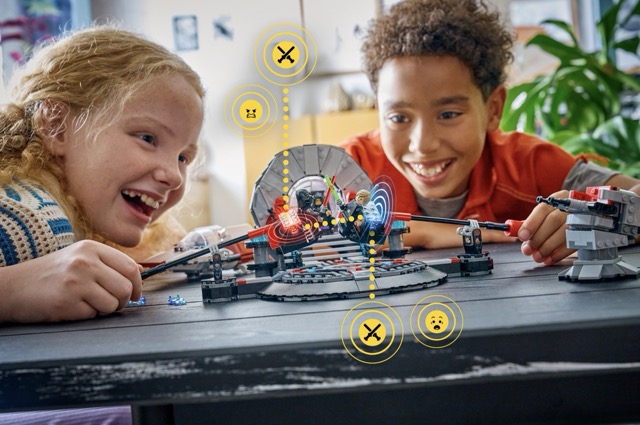
In practice, that means a Lego duck can quack when lifted, a starfighter can light up and fire as it closes in on another craft, and a minifigure can trigger lightsaber sounds when it confronts Darth Vader. Crucially, the system works through physical movement and spatial interaction, so children do not need phones, tablets or apps to activate the technology.
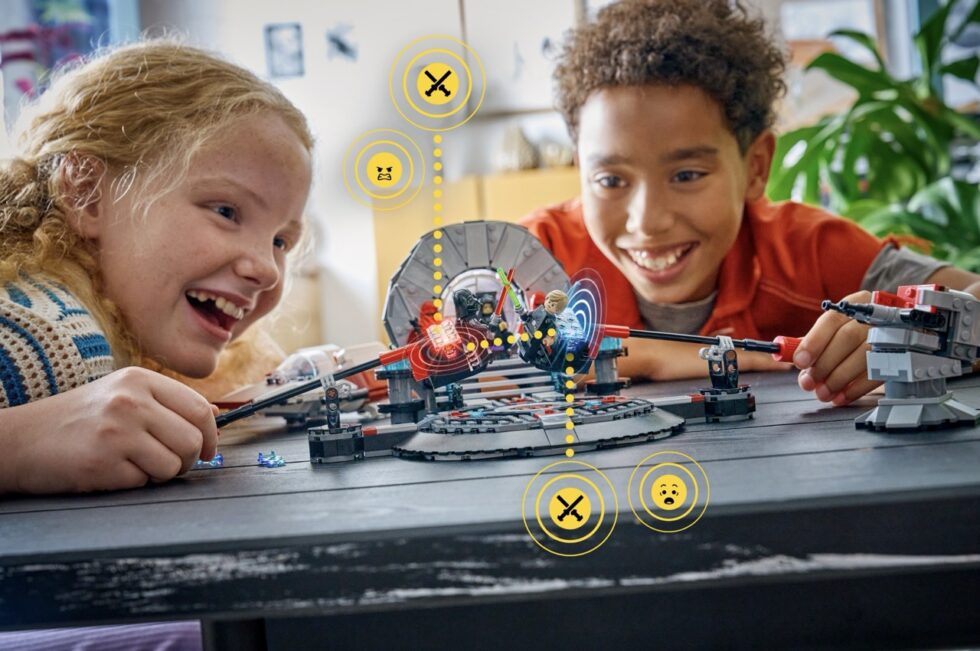
That design philosophy is especially important in Britain, where concern over screen time, attention spans and digital dependency has fuelled demand for screen-free educational toys. Lego says its smart bricks provide the responsiveness and immersion of digital play while keeping children grounded in hands-on, creative building.
Star Wars will launch the smart-brick era
The first wave of LEGO smart bricks will arrive through the Lego Star Wars range in March 2026, with the company deliberately using one of its strongest British franchises to introduce the technology.
Three flagship sets have been announced for the UK market:
| Set | Pieces | Smart components | UK price |
|---|---|---|---|
| Darth Vader’s TIE Fighter | 470 | 1 Smart Brick, 1 Smart Minifigure, 1 Smart Tag | £59.99 |
| Luke Skywalker’s X-Wing | 584 | 1 Smart Brick, 2 Smart Minifigures, 5 Smart Tags | £79.99 |
| Throne Room Duel & A-Wing | 962 | 2 Smart Bricks, 3 Smart Minifigures, 5 Smart Tags | £139.99 |
The prices place the new sets well above standard Lego kits, reflecting the electronics built into each box. Lego is betting, however, that families will see long-term value in a system where the same smart bricks can be reused across multiple sets and years of play.
How the technology works
At the heart of every LEGO smart brick sits a custom-designed Lego microchip running the company’s own embedded software. Hidden inside what looks like an ordinary 2×4 brick is a network of sensors and electronics that allow Lego models to respond to how they are being played with in real time. Each smart brick is able to:
- recognise the colours of nearby Lego pieces
- detect movement, tilt and shaking
- identify which Smart Minifigures or Smart Tags are close
- measure distance and spatial relationships between objects
- generate sound, music and lighting effects
- communicate wirelessly with other smart bricks
Unlike Lego’s earlier robotics and coding kits, no apps or programming are required. Children simply build, move and interact with their models, and the bricks react instantly — turning physical play into a responsive, living system.
Multiple smart bricks can also be linked together, allowing large constructions to behave as a single connected network. That opens the door to everything from starships that respond to one another in flight to race tracks that trigger sound and light as vehicles pass — or entirely new games and worlds invented by children themselves.
Why this matters for British families
In the UK, Lego occupies a unique position at the crossroads of education, play and child development. At a time when British parents and schools are increasingly concerned about excessive screen use, declining attention spans and digital overstimulation, demand is growing for toys that can support STEM learning, creativity and problem-solving without pushing children deeper into tablets and phones.
LEGO smart bricks are designed to meet that demand. By embedding sensors, sound and logic inside physical bricks, the system allows children to explore cause and effect, basic physics, spatial reasoning and storytelling while remaining fully engaged in hands-on building. Education specialists say this kind of “tangible tech” is likely to become more prominent in UK classrooms, coding clubs and after-school programmes, where Lego is already widely used as a learning tool rather than just a toy.
When will LEGO smart bricks be available in the UK
British consumers will be able to buy LEGO smart bricks from 1 March 2026, with pre-orders opening on 9 January, according to the Lego Group’s CES 2026 launch schedule. The first wave of sets will be available through LEGO.co.uk, Lego’s own UK retail stores, and major high-street and online retailers including John Lewis, Smyths Toys, Argos and Amazon UK.
Lego has also confirmed that replacement Smart Bricks, Smart Tags and wireless charging mats will be sold separately later in 2026, allowing families to expand their interactive builds without having to buy full sets each time — a move that positions the system as a long-term play platform rather than a one-off toy line.
Lego’s longer-term strategy
For the Lego Group, lego smart bricks are not simply a new toy range but a long-term strategic move to future-proof its core business as children grow up in a world dominated by AI, gaming platforms and digital interfaces. Instead of competing with screens, Lego is embedding digital intelligence directly into physical bricks, preserving the iconic LEGO System-in-Play while giving it the responsiveness of modern technology.
From a commercial perspective, LEGO SMART Play™ creates an entirely new ecosystem. Smart Bricks, Smart Tags and Smart Minifigures can be reused across multiple sets, encouraging families to invest in the platform over time rather than buying one-off toys. That approach mirrors how gaming consoles and software platforms work — but translated into physical play.
The bricks are designed to recharge wirelessly and to survive years of handling, but durability will be closely watched. Traditional Lego bricks last for generations; embedded electronics rarely do. British parents, schools and retailers will be keen to see whether lego smart bricks can match the legendary lifespan of classic Lego while delivering advanced interactive features.
Star Wars is only the starting point. Industry analysts expect the smart-brick system to expand into Lego City, educational STEM kits, robotics-style builds and classroom products, turning LEGO SMART Play™ into a cross-range technology layer rather than a niche feature. If successful, Lego will have achieved something few toy companies have managed: making advanced technology feel invisible, hidden inside a yellow brick that still clicks together exactly as it always has.
Read about the life of Westminster and Pimlico district, London and the world. 24/7 news with fresh and useful updates on culture, business, technology and city life: LEGO presents largest ever Star Wars set in London: Death Star UCS 2025 with 9,023 pieces
Photo: LEGO Group