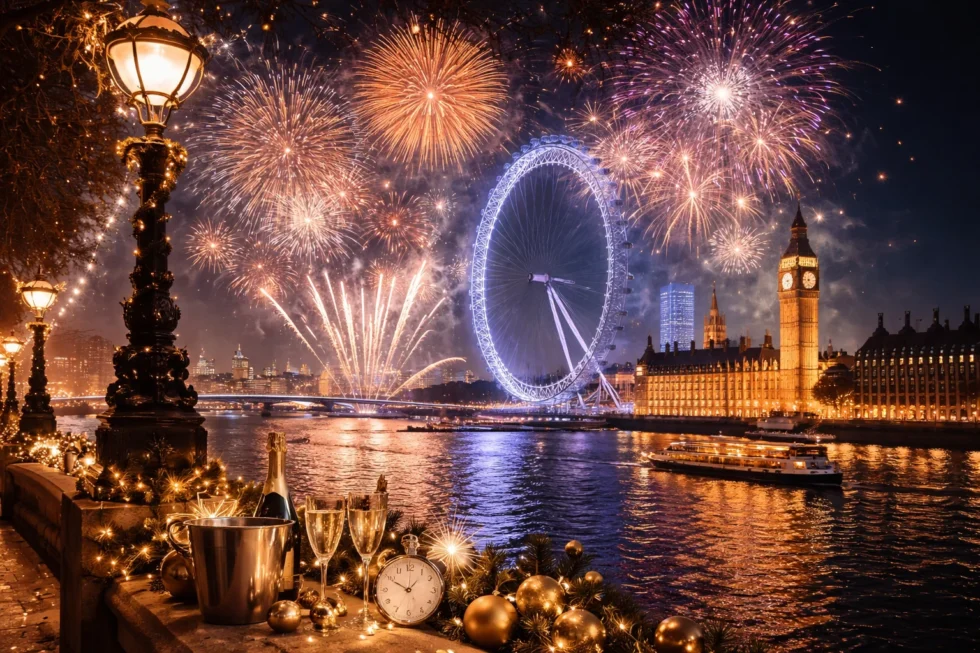
London New Year’s Eve 2025 will once again place central London under one of the strictest public-order and transport regimes in Europe. As The WP Times reports, citing official guidance from London.gov.uk, access to the Thames fireworks will be restricted to ticket holders only, while bridges, streets and transport hubs across Westminster, Waterloo and the South Bank are brought under extensive police and traffic control.
The Mayor of London’s fireworks display runs from 8:00 pm on 31 December 2025 to 12:30 am on 1 January 2026, but the operational lockdown begins hours earlier. For residents, commuters and visitors alike, this means that crossing the Thames, reaching Underground stations or even moving through large parts of central London without careful planning will be difficult — and in many cases impossible.
Who is allowed into the fireworks area
For London New Year’s Eve 2025, the entire riverside viewing zone is divided into ticket-only areas. Entry is impossible without a valid Ticketmaster ticket, and police officers and stewards will check tickets at every access gate.
There are six official viewing areas:
| Zone | Location | Crowd level |
|---|---|---|
| Red | Westminster riverside | Very high |
| Blue | Victoria Embankment | High |
| Pink | Waterloo riverside | High |
| Green | South Bank | High |
| White | East Embankment | High |
| Orange (accessible) | Albert Embankment, St Thomas’ Hospital | Low |
Each ticket is linked to one numbered gate. People cannot move between zones, even if friends or family are in a different area. Anyone without a valid ticket will be stopped before reaching the river.
What happens if you try to enter without a ticketPolice enforcement, fines and what happens if you try to enter without a ticket
During London New Year’s Eve 2025, the Metropolitan Police Service (MPS) will operate a secure event perimeteracross Westminster, Lambeth and Southwark, turning the entire Thames riverside into a legally controlled zone.
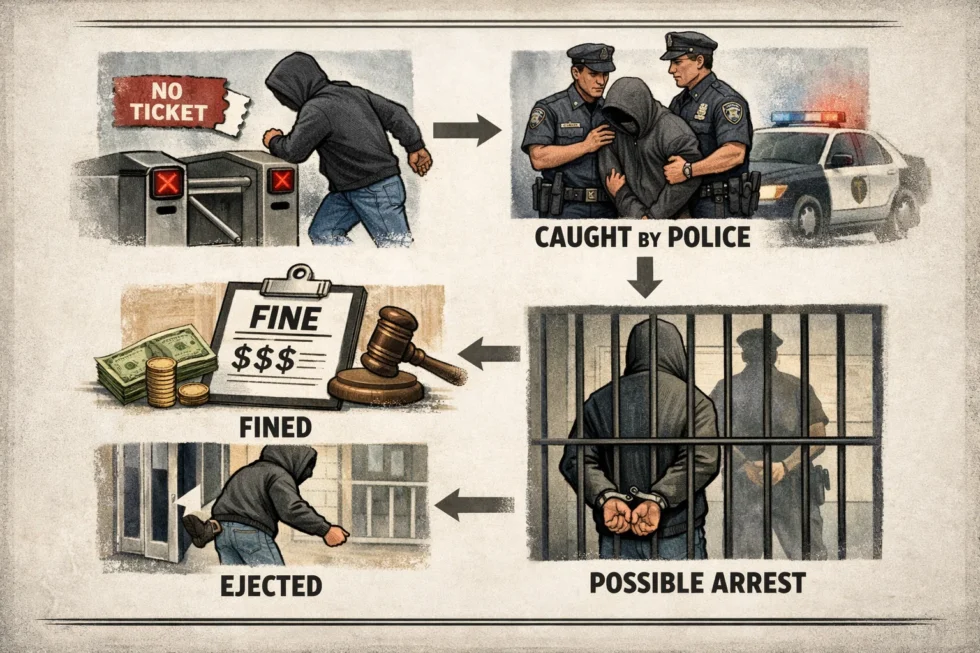
This is not just a barrier along the river. It is a city-wide system of closed streets, blocked bridges, police checkpoints and stewarded access routes. Anyone without a valid Ticketmaster ticket for the correct viewing area will not be able to reach the fireworks.
People who attempt to enter anyway will be intercepted long before they reach the river.
If you try to enter without a ticket, you can expect:
- Immediate refusal of entry at police and steward checkpoints
- No access across closed bridges, including Westminster, Waterloo and Blackfriars
- Forced redirection away from the Thames into unrestricted streets
- Street-by-street movement control, preventing you from approaching the river from another angle
- Fixed Penalty Notices (on-the-spot fines) for breaching crowd-control rules
- Physical removal from the area if you persist
Typical fines applied during major London events
| Offence | Usual penalty |
|---|---|
| Entering a restricted road, footway or bridge | £60–£100 |
| Ignoring a police or steward instruction | £100 |
| Obstructing crowd-management routes | £100–£200 |
| Disorderly behaviour inside the controlled zone | £90–£150 |
Failure to pay a Fixed Penalty Notice can lead to prosecution and a higher fine.
What happens after you are stopped
Once turned away, you are not allowed to try another gate. Officers and stewards have powers to:
- escort you out of the controlled zone
- block further attempts to approach the river
- direct you several kilometres away to open streets or transport hubs
Many people who approach from the wrong side of the Thames end up walking 3 to 5 kilometres to find an open station.
What happened in previous years
In recent London New Year’s Eve operations:
- hundreds of people were turned away at police cordons
- dozens received on-the-spot fines
- several bridges had to be temporarily locked due to crowd pressure
- multiple Tube stations were forced to close entrances for safety
This is why London New Year’s Eve 2025 will again be enforced with full police powers — the fireworks are treated as a high-security, ticketed city event rather than an open street celebration.
Road closures and bridge bans in central London
To safeguard crowds during London New Year’s Eve 2025, City Hall and the Metropolitan Police will implement one of the largest coordinated traffic and pedestrian shutdowns of the year, effectively sealing off large parts of central London around the Thames. The operation is designed to prevent dangerous overcrowding, keep emergency routes clear and allow security teams to manage the hundreds of thousands of people expected to gather along the river for the midnight fireworks.
From the afternoon of 31 December until the early hours of 1 January, streets, bridges and transport corridors across Westminster, Waterloo and the South Bank will be placed under special event controls, turning the heart of the capital into a tightly regulated security zone.
Bridge closures, vehicle bans and the lockdown of central London
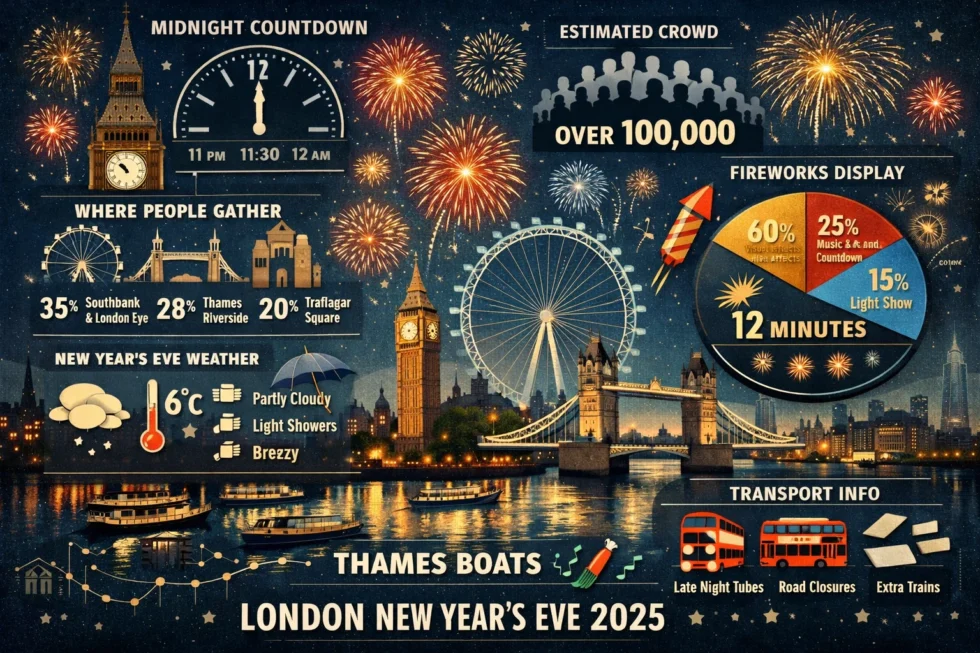
For London New Year’s Eve 2025, City Hall and the Metropolitan Police Service will place central London under a full-scale security and transport lockdown, transforming the Thames corridor into a controlled event zone for more than 12 hours.
From the afternoon of 31 December until the early hours of 1 January, all major river crossings in the event perimeter will be closed to pedestrians, cyclists and vehicles alike. The closures will effectively split Westminster from the South Bank, with no public crossings available through the central zone.
The bridges affected are:
- Westminster Bridge
- Waterloo Bridge
- Golden Jubilee Footbridge
- Lambeth Bridge
- Blackfriars Bridge
Once the lockdown is in force, it will not be possible to cross the Thames in central London by any means until the event is over.
A complete vehicle exclusion zone
A blanket traffic ban will be enforced across Westminster, Lambeth and Southwark, covering both main roads and residential streets inside the perimeter. The restrictions apply to:
- private cars and taxis
- buses and coaches
- motorcycles and mopeds
- bicycles and e-bikes
- delivery vans and heavy goods vehicles
This includes ride-hailing services, hotel transfers and courier traffic.
Parking suspension and enforcement
All parking bays and on-street parking inside the restricted zone will be suspended. Vehicles left within closed streets after enforcement begins may be ticketed, clamped or removed by enforcement teams working alongside the police. Drivers who fail to relocate their vehicles in time risk having them impounded until after New Year’s Day.
When enforcement begins
Police vehicle controls will come into force from 2 pm on 31 December, with powers to activate earlier — from 12 pm— in high-risk locations around Westminster, the South Bank and major transport hubs.
From that point, access into the controlled zone will be limited to emergency services, accredited event staff and residents with authorised permits only.
How London transport will run on New Year’s Eve
Transport for London warns that stations around the Thames will be extremely crowded after midnight. Some station entrances and exits will close temporarily to manage safety.
People attending the fireworks should:
- decide in advance which side of the river they will leave from
- follow the station routes printed on their ticket
- expect up to 2 km of walking after leaving the viewing area
Although parts of the Underground will run overnight, not all routes will operate normally.
Accessible Orange viewing area
The Orange Zone is the dedicated accessible viewing area for London New Year’s Eve 2025, designed for people who require step-free access, reduced crowd density or vehicle drop-off facilities. It is located on Albert Embankment, directly opposite the Houses of Parliament and St Thomas’ Hospital, placing it within the main fireworks perimeter but away from the heaviest crowds on the South Bank and Westminster Bridge. This area has been designed to provide a safer and more manageable environment for visitors with access needs.
What the Orange Zone provides
- Vehicle drop-off access until 8 pm, using kerb-level routes suitable for wheelchairs
- Significantly lower crowd density compared with other viewing zones
- Step-free, wheelchair-friendly surfaces throughout the area
- Accessible toilets, including Changing Places facilities, and on-site medical staff
- Seating areas, with the option to bring fold-up chairs
- Hearing loop systems to support visitors using hearing aids
The nearest public transport hub is around two kilometres away, so most visitors are advised to arrive before road closures come fully into force.
The fireworks are viewed from a partial side angle, rather than directly face-on to the London Eye, but the full display remains clearly visible. City Hall says the Orange Zone is intended for those who need a quieter, safer environment rather than a prime front-row vantage point.
How tickets and resales work
All tickets are sold via Ticketmaster only.
- Resales are allowed only through Ticketmaster Fan-to-Fan
- Tickets can only be resold at face value
- No refunds are available
- Tickets from unofficial sellers are invalid
Most tickets are sold out, but official resales may appear in the days before the event.
Why London enforces such strict rules
London hosts one of the largest New Year’s Eve crowds in Europe, with hundreds of thousands of people converging on a relatively narrow stretch of river between Westminster and the City. Without strict controls, that volume of people would overwhelm pavements, bridges and emergency access routes within minutes. According to City Hall and Metropolitan Police briefings, the introduction of ticketed viewing zones, bridge closures and controlled street access has cut crowd-related injuries, medical incidents and dangerous overcrowding by more than 40 per cent compared with the years when the event was open to the public without restriction.
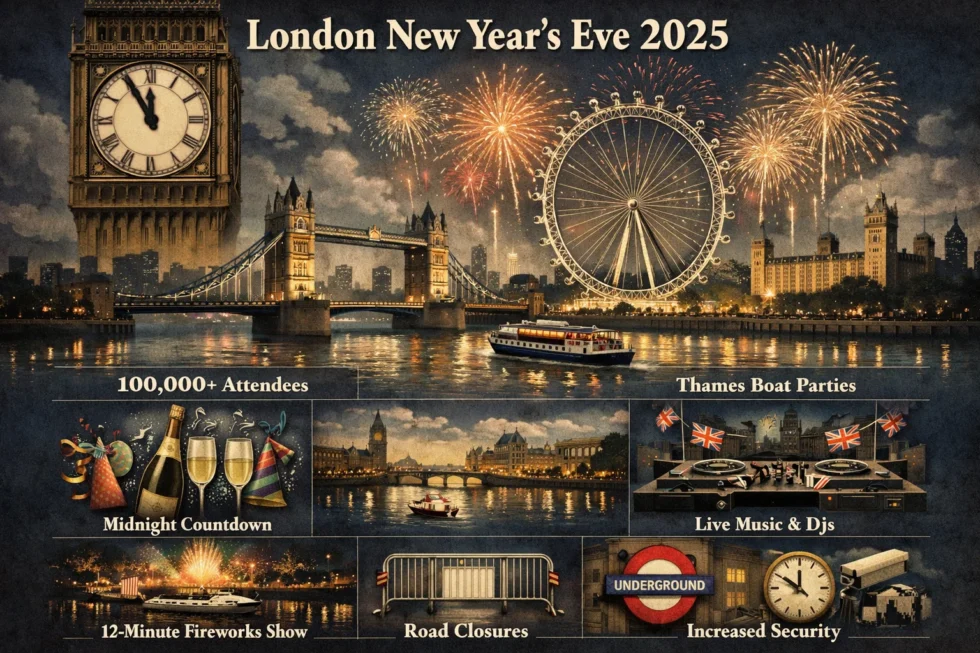
Emergency services now have guaranteed access corridors, stewards can regulate crowd density in real time, and police can prevent dangerous surges towards the river at midnight. This is why London New Year’s Eve 2025 is operated not as an open street party but as a major international event, with airport-style security perimeters, transport shutdowns and strictly controlled entry across central London.
Read about the life of Westminster and Pimlico district, London and the world. 24/7 news with fresh and useful updates on culture, business, technology and city life: Stratford station safety: how a 72-year-old was struck 7 times by 4 Jubilee line trains on the London Underground