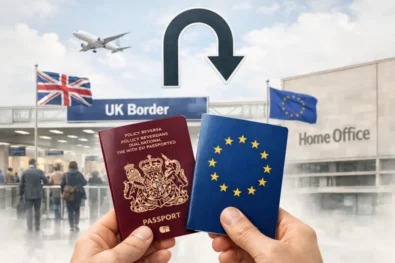
UK EU Erasmus+ 2027 agreement was formally signed on Wednesday, 15 April 2026, in Brussels, confirming that Britain will rejoin the EU’s flagship education and mobility programme from 2027, five years after Brexit ended its participation. The deal, agreed between the UK government and the European Commission, is expected to restore structured access to study, work placements and cultural exchanges for students, apprentices and young people across Europe, with more than 100,000 participants projected in the first year alone, The WP Times reports.
The agreement includes a negotiated UK contribution of £570 million for 2027, representing what ministers describe as a 30% discount on the standard participation rate, while guaranteeing full programme access. Officials say the move forms part of a broader UK-EU “reset” under Prime Minister Keir Starmer, aimed at rebuilding cooperation in education, economy and mobility after years of post-Brexit fragmentation.
What the Erasmus+ 2027 agreement includes
The Erasmus+ programme extends far beyond traditional university exchanges, operating as a multi-layered mobility and development framework across education, training and youth sectors. Its reinstatement for the UK restores access to a coordinated European system that integrates study, work experience and institutional collaboration under a single regulatory structure. Under the 2027 agreement, participation is deliberately broad-based, reflecting the programme’s role in workforce development as much as academic exchange.
Eligible UK participants will include:
- University students undertaking semester or full-year placements abroad
- Apprentices and vocational trainees entering EU-based work environments
- School pupils participating in structured exchange programmes
- Youth organisations and non-governmental bodies engaged in cross-border initiatives
- Educators, trainers and academic staff involved in teaching and research mobility
Crucially, placements will not be limited to academic institutions. The UK government has confirmed access to leading European companies, research centres and cultural organisations, restoring pathways that were significantly reduced after 2020. This expands Erasmus+ into a direct bridge between education and employment, rather than a purely academic scheme.
Skills Minister Jacqui Smith framed the programme in practical terms:
“From learning a language to building confidence and work experience, Erasmus+ offers transformative opportunities to enhance young people’s life chances” (Department for Education, London, April 2026).
Scale, funding and expected impact
The financial architecture of the UK EU Erasmus+ 2027 agreement indicates full operational reintegration rather than a symbolic return. The scale of participation, combined with negotiated financial terms, positions the UK as an active contributor within the system rather than a peripheral partner.
| Category | Details |
|---|---|
| Start year | 2027 |
| UK contribution | £570 million |
| Discount secured | ~30% below default EU rate |
| Expected participants (year one) | 100,000+ |
| Programme scope | Study, work, training, exchanges |
| UK national agency | British Council |
The reappointment of the British Council as the UK’s national agency is a central operational component. Between 2014 and 2020, it administered more than 8,000 Erasmus+ projects, engaging over 580,000 participants and allocating approximately €1.1 billion to UK organisations — a track record that underpins confidence in delivery capacity.
Chief Executive Scott McDonald emphasised the programme’s long-term value:
“Erasmus+ has a proven track record in changing lives, opening up learning experiences and nurturing global citizenship” (British Council statement, April 2026).
Why the agreement matters for students and the labour market
The impact of Erasmus+ extends well beyond education into measurable labour market outcomes. Evidence across multiple European cohorts shows that international mobility programmes correlate strongly with improved employability and earnings potential. Participants typically demonstrate:
- Higher employment rates compared with non-mobile peers
- Stronger long-term earning trajectories
- Advanced language proficiency and intercultural competence
- Faster transition into skilled and professional roles
The UK government has highlighted that students from less advantaged backgrounds benefit disproportionately, as international exposure can offset structural barriers to career progression and expand access to global opportunities. From an employer perspective, the programme reintroduces a critical pipeline of internationally experienced talent at a time of persistent skills shortages. Key advantages for employers include:

- Access to cross-border talent networks
- Apprentices with practical experience in EU markets
- Graduates with multilingual and culturally adaptive skillsets
These outcomes align directly with UK economic priorities, particularly in high-demand sectors such as technology, engineering, healthcare and the creative industries, where global competence is increasingly a baseline requirement.
Political context: post-Brexit reset in practice
The Erasmus+ agreement represents one of the most tangible outcomes of the UK’s post-Brexit recalibration of relations with the European Union. It follows commitments made during a UK–EU summit in 2025, where both sides identified priority areas for renewed cooperation. These include:
- Education and research collaboration
- Energy and emissions trading frameworks
- Food, agriculture and trade standards
- Security and defence coordination
European Commission President Ursula von der Leyen positioned the agreement within a longer historical context:
“Europe and the UK have enjoyed mutually beneficial educational ties for centuries. Strengthening those ties further makes perfect sense” (European Commission, Brussels, April 2026). For the UK government, the deal carries both strategic and symbolic weight. It demonstrates that targeted cooperation with the EU can deliver concrete economic and social benefits, while maintaining political autonomy outside the bloc’s formal structures. In practical terms, Erasmus+ becomes a working model for how post-Brexit UK–EU relations may evolve — not through wholesale reintegration, but through selective alignment in sectors where shared interests are strongest and outcomes are measurable.
What changes for UK students from 2027
For students across the UK, the return to Erasmus+ marks a structural shift in how international education and mobility will function after years of fragmentation following Brexit. From 2027, British participants will no longer rely solely on domestic alternatives but will re-enter a fully integrated European system, restoring predictable pathways into universities, training schemes and cross-border work placements.
The difference is not cosmetic — it is systemic. Where the Turing Scheme operated as a one-way funding mechanism, Erasmus+ reinstates reciprocal access, shared standards and institutional alignment across Europe. In practical terms, this means UK students will once again compete, collaborate and move within the same framework as their EU counterparts, significantly expanding both opportunity and recognition.
Key changes include:
- Direct access to EU universities without the need for complex bilateral agreements
- Structured and predictable funding streams tied to EU-wide programme rules
- Simplified administration through a centralised framework
- Full inclusion in a unified European education and mobility network
Crucially, Erasmus+ operates as a reciprocal system. EU students will return to UK institutions in parallel, increasing competition but also significantly strengthening academic exchange, diversity and institutional quality across British universities. This two-way flow is widely seen by policymakers as essential to restoring the UK’s position within the European education ecosystem.
Practical steps: how to access Erasmus+ opportunities
With the first funding cycle scheduled for 2027, early preparation will be decisive. Demand is expected to be high, particularly in the first year when pent-up interest meets limited initial capacity. Students, universities and organisations should already be moving into a preparation phase — not waiting for formal launch.
What to do now:
- Register interest via the British Council Erasmus+ platform
- Track official funding calls expected in 2027
- Build or renew partnerships with EU universities and institutions
- Identify target destinations, courses or companies for placements
- Begin or strengthen language preparation where required
Institutions that move early will have a strategic advantage, particularly those able to secure partnerships before demand peaks. For individuals, preparation will increasingly differentiate successful applicants from those entering the system late.
Broader implications for UK–EU relations and mobility
The UK EU Erasmus+ 2027 agreement goes beyond education policy. It reflects a broader recalibration in relations between London and Brussels — one based on selective reintegration where mutual economic and social value is clear.
In operational terms, the agreement delivers several immediate structural effects:
- Reopens large-scale, structured mobility between the UK and EU
- Reinforces soft power through education, culture and youth exchange
- Supports labour market flexibility via internationally experienced graduates
- Strengthens long-term competitiveness through skills development
Politically, the deal aligns with the wider EU “reset” strategy under Prime Minister Keir Starmer, signalling that cooperation with Europe can be expanded without reversing Brexit itself.
It also creates a framework for future agreements — particularly in research, innovation and workforce mobility — where alignment offers clear advantages on both sides.
For a generation of young people, the return of Erasmus+ restores something more intangible but equally significant: the ability to move across Europe within a shared system rather than navigating fragmented national schemes.
As the first UK participants prepare for 2027, the programme is not simply reopening — it is redefining the UK’s place within the European education and mobility landscape, with implications that will extend well beyond the classroom into careers, industries and long-term cross-border cooperation.
Read about the life of Westminster and Pimlico district, London and the world. 24/7 news with fresh and useful updates on culture, business, technology and city life: What is the new East West Rail line and how will it connect Oxford, Milton Keynes, Bedford and Cambridge