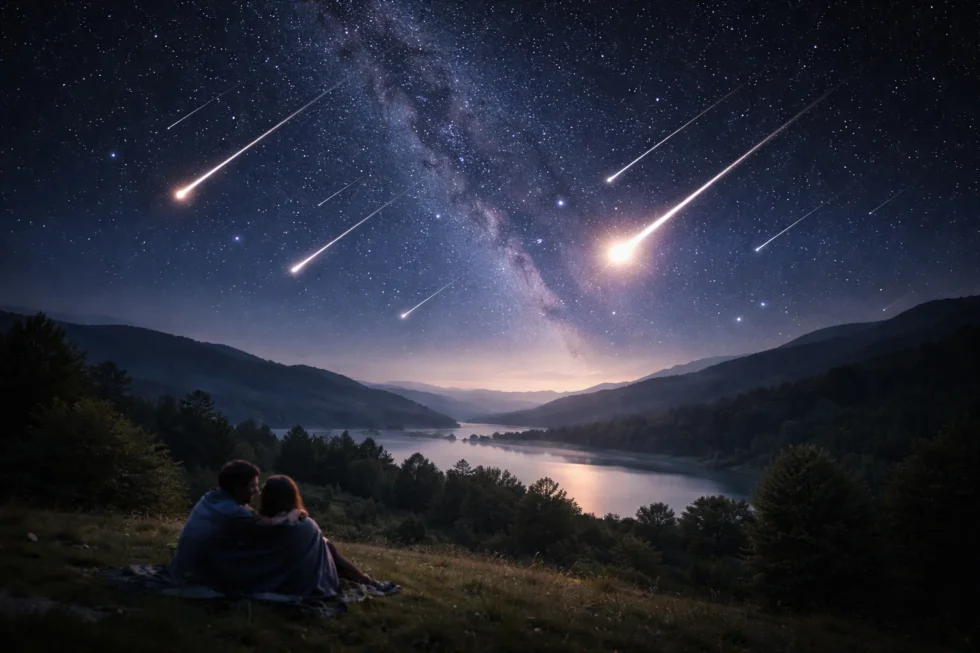
The lyrid meteor shower UK 2026 will light up skies across England, Scotland, Wales and Northern Ireland between 16 April and 22 April, with a defined peak forecast for the evening of 22 April around 21:00 BST (20:00 UTC) and strongest visibility expected during pre-dawn hours (04:00–05:00 BST) when the radiant in Lyra rises high in the northeast. The annual event, generated by debris from Comet Thatcher (C/1861 G1), is projected to deliver 10–15 meteors per hour under clear, dark conditions, with documented bursts historically reaching significantly higher rates, as Earth intersects a concentrated dust stream travelling at roughly 48 km/s through the upper atmosphere, producing visible ionisation trails and occasional high-intensity fireballs.
Visibility conditions in 2026 are considered above seasonal average, with reduced lunar interference following the new moon on 17 April, while regional forecasts indicate the clearest early windows in northern UK regions and improving nationwide conditions into the weekend observation period. The shower, first recorded in 687 BCE, remains one of the oldest continuously observed meteor events and is characterised by fast, bright streaks and unpredictable fireball activity, making timing, location and sky clarity critical for observation, The WP Times reports, citing specialist astronomy briefings and skywatching media analysis.

lyrid meteor shower UK 2026 peak times, rates and visibility explained
The structure of the lyrid meteor shower UK 2026 is defined by both predictable peak timing and variable meteor rates, with short bursts known to produce significantly higher activity. While average hourly rates remain moderate compared to larger showers, the unpredictability of Lyrid surges continues to make it a high-interest event for astronomers and skywatchers.
At peak, meteors enter Earth’s atmosphere at speeds of approximately 48 km per second, burning up as they interact with atmospheric particles and creating visible streaks of light. Smaller particles generate faint trails, while larger fragments can produce bright fireballs, occasionally outshining planets such as Venus. Key viewing data for the UK:
- Active period: 16–22 April 2026
- Peak timing: 22 April around 21:00 BST (20:00 UTC)
- Best viewing windows: early mornings (4:00–5:00 BST) and late evening post-sunset
- Average rate: 10–15 meteors per hour
- Potential surge: up to 100 meteors per hour (rare bursts)
- Radiant point: constellation Lyra (near Vega)
- Visibility conditions: best in dark rural areas away from light pollution
The peak timing falling during daylight hours in parts of Europe means observers should prioritise the nights before and after 22 April, where activity remains strong enough to produce visible meteors under clear conditions.
what makes lyrid meteors unique: fireballs, colours and history
The Lyrids are scientifically notable not only for their longevity but also for their visual characteristics. First recorded in 687 BCE by Chinese astronomers, the shower is among the oldest documented celestial events still observed today. Their distinct appearance is driven by particle composition and size variation:
- Small dust grains create faint, fast streaks
- Larger fragments produce fireballs with visible trails (“trains”)
- Ionisation processes generate colours, including white, blue and green tones
Unlike many modern meteor streams, the Lyrids originate from a long-period comet. Comet Thatcher completes an orbit of the Sun roughly every 415 years, and will not return until 2283, yet its debris continues to intersect Earth’s orbit annually. These characteristics result in a meteor shower that is less dense but more visually dramatic, particularly during peak bursts when fireballs become more frequent.
how to watch the lyrid meteor shower UK: practical viewing tips
Observing the lyrid meteor shower UK 2026 does not require specialist equipment, but conditions and preparation significantly influence visibility. Telescopes are not recommended, as meteors move quickly across large sections of the sky. Best practice for UK observers:
- Choose dark locations away from city lights
- Look towards the northeast, but scan the entire sky
- Allow 20–30 minutes for night vision adjustment
- Avoid using phones or bright screens
- Dress for cold conditions during early morning hours
Optional for photography:
| Setting | Recommendation |
|---|---|
| Lens | Wide-angle (14–24mm) |
| Exposure | 20–30 seconds |
| ISO | 800–1600 |
| Mode | Continuous shooting |
| Format | RAW |
Patience remains critical. Meteor visibility is irregular, and even during peak periods, long intervals without activity are common.
eta aquarids and overlapping meteor activity in april 2026
The Lyrids are not the only meteor event visible during this period. The Eta Aquarid meteor shower, linked to Halley’s Comet, is also active from 9 April to 28 May 2026, peaking in early May. While less visible from northern latitudes compared to the southern hemisphere, UK observers may still detect up to 10–20 meteors per hour during favourable conditions. This overlap increases the probability of sightings during late April nights, particularly under clear skies.
Comparison of April meteor showers
| Meteor shower | Peak date | Origin comet | Avg rate (UK) |
|---|---|---|---|
| Lyrids | 22 April | Comet Thatcher | 10–15/hour |
| Eta Aquarids | 6 May | Halley’s Comet | 10–20/hour |
The dual activity window makes late April one of the most active stargazing periods of spring in the UK calendar.
expert observations on meteor visibility and unpredictability
Meteor visibility during the lyrid meteor shower UK 2026 is driven by a combination of fixed astronomical mechanics and highly variable observational factors, meaning peak forecasts do not guarantee continuous activity. While orbital modelling defines when Earth intersects the densest debris stream, actual meteor counts fluctuate minute-by-minute, influenced by local sky clarity, light pollution, atmospheric transparency and the observer’s field of view.
“Meteor showers are about persistence, but also luck — the brightest fireballs often appear unexpectedly and last only seconds,” noted skywatching contributors analysing recent Lyrid activity (UK-based observations, April 2025–2026). These short-lived high-energy events are typically produced by larger fragments within the stream and cannot be predicted with precision, even during peak windows.
In practical terms, short viewing sessions significantly reduce detection probability, whereas continuous observation across multiple hours—particularly in the pre-dawn peak window—materially increases the likelihood of capturing both standard meteors and rare fireballs. For UK observers, the most effective strategy is to treat the event as a time-distribution phenomenon rather than a fixed moment, where exposure duration and sky conditions determine outcome more than nominal peak timing.
Read about the life of Westminster and Pimlico district, London and the world. 24/7 news with fresh and useful updates on culture, business, technology and city life: Was the UK green fireball a meteorite? CCTV captures bizarre flashes over Durham in April 2026