Extreme high temperature warning measures are now affecting trains across England and Wales as Network Rail and several operators reduce services, impose speed restrictions and ask passengers to check train times before travelling between Tuesday 23 June and Friday 26 June. The disruption follows rare red and amber heat warnings, with London and parts of southern and central England facing exceptional heat, infrastructure risk and health pressure, while rail operators warn that extreme weather train delays UK passengers face could include cancellations, slower journeys, crowding and last-minute timetable changes, The WP Times reports.
The warning is not a routine summer travel notice. By Tuesday evening, 23 June, the focus had shifted from ordinary hot weather travel advice to a national transport-risk situation, with Network Rail saying passengers travelling to, from or within extreme heat zones should only travel if absolutely necessary. The Met Office warning for London includes a red extreme heat alert from Wednesday morning to Thursday evening, while current weather London today conditions reached around 32C, with highs forecast in the low to mid-30s before even hotter conditions later in the week.
Extreme heat warning and train delays: what passengers need to know now
The core message for passengers is simple: check before travelling, allow extra time and avoid non-essential journeys in the worst-hit zones on Wednesday 24 and Thursday 25 June. Network Rail says extreme heat can affect rails, overhead power lines and the ground beneath the track, which is why speed restrictions and timetable reductions are being used before the system fails. This means a train may still be running, but not at its normal speed, not at its usual frequency and not always at the time printed in an earlier timetable. Northern Rail has already introduced a reduced timetable from Tuesday 23 to Thursday 25 June, with temporary speed restrictions on some routes. LNER is strongly advising customers not to travel on Wednesday 24 and Thursday 25 June because of the red extreme heat warning. Great Western Railway has also warned of essential travel only on Wednesday and Thursday, while c2c says disruption is expected from Tuesday 23 to Friday 26 June and that passengers should only travel if absolutely necessary on Wednesday and Thursday.
| Operator / body | Current advice | Dates affected | Main risk for passengers |
|---|---|---|---|
| Network Rail | Only travel if absolutely necessary in extreme heat zones | 23–26 June | Delays, cancellations, slower trains |
| Northern Rail | Reduced timetable and speed restrictions | 23–25 June | Fewer trains and busier services |
| LNER | Do not travel on Wednesday and Thursday if possible | 24–25 June | Long-distance disruption |
| Great Western Railway | Essential travel only in red warning period | 22–25 June | Amended services and delays |
| c2c | Avoid travel unless necessary on peak heat days | 23–26 June | Planned cancellations and short-notice disruption |
| East Midlands Railway | Only travel if absolutely necessary on hottest days | 23–27 June | Reduced reliability and heat-related delays |
How Network Rail says heat damages the railway
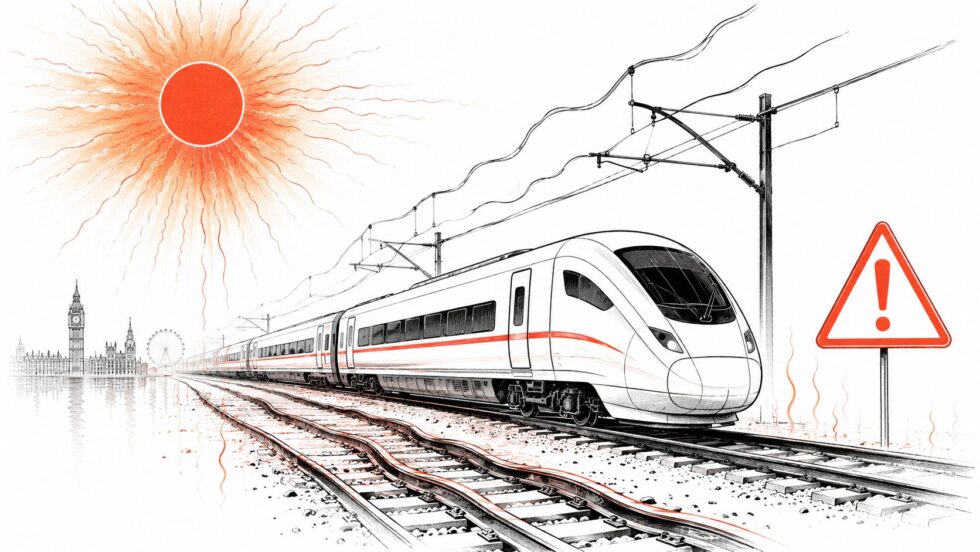
Network Rail’s warning is based on the physical effect of heat on railway infrastructure. Steel rails expand in high temperatures, overhead electric wires can sag, trackside equipment can overheat and dry vegetation can increase the risk of lineside fires. These risks are especially serious during a red weather warning because the railway is not only carrying passengers through heat, but also operating heavy infrastructure under stress.
Speed restrictions are one of the main tools used to reduce the risk of rail buckling and equipment failure. They keep trains moving more safely, but they also create slower journeys, missed connections and timetable changes. This is why passengers may see a train service listed as operating while still facing major disruption.
The problem is worse where long-distance services, commuter routes and airport transfer journeys overlap. A passenger heading to Heathrow, Gatwick, Manchester Airport or Birmingham Airport may not only need one train, but also a connection, a local service and enough time to reach security. In hot weather, one delay can quickly turn into a missed flight or a much longer journey.
Northern Rail, LNER, GWR, c2c and EMR: which services are affected?
Northern Rail says high temperatures are forecast throughout the UK this week and may affect how its trains operate. To keep services reliable, Northern is running fewer trains on some routes from Tuesday 23 to Thursday 25 June and has introduced temporary speed restrictions. The operator says passengers should check before travelling, allow extra time, travel earlier where possible, bring water and avoid boarding if they feel unwell.
The affected Northern routes include Manchester Piccadilly to Alderley Edge, Wilmslow to Crewe, Southport to Manchester, Manchester Piccadilly to Manchester Airport, Warrington Central to Liverpool Lime Street, York to Leeds via Harrogate, Leeds to Manchester Victoria and Leeds to Skipton, Ilkley and Bradford Forster Square. The Yorkshire Flyer fast service between Sheffield and Leeds has been cancelled, although stopping services are still running.
LNER is giving stronger advice for Wednesday and Thursday. The operator says customers booked to travel on 24 and 25 June should not travel if possible, with the hottest temperatures expected during that period. For Tuesday 23 June, customers were advised to travel before midday where possible and to use earlier services when conditions were cooler.
Great Western Railway is also operating an amended service during the extreme heat period. The operator has warned passengers that, because of the rare red extreme heat warning, only essential journeys should be made on Wednesday and Thursday. This is particularly important for passengers travelling through London Paddington, the Thames Valley, the West Country and Wales, where long-distance and commuter flows can be heavily affected by slow-running services.
c2c has published hot weather advice for Tuesday 23 to Friday 26 June and has cancelled some peak services to reduce disruption. The operator says passengers travelling on Wednesday 24 or Thursday 25 June should only travel if absolutely necessary. East Midlands Railway has also warned that hot weather is expected until at least Saturday 27 June and that passengers should only travel if absolutely necessary on the highest-risk days.
Red weather warning UK map and health alerts: why this is more than transport disruption
The red weather warning UK map matters because it marks areas where the risk is not limited to vulnerable people. In a red heat warning, the wider population may experience health impacts, and serious illness or danger to life becomes a realistic concern. The UK Health Security Agency has issued red heat-health alerts for several regions, including London, the East Midlands, West Midlands, South East, South West and East of England, while amber alerts remain in other areas.
The health risk directly affects transport. A delayed train in extreme heat is not just inconvenient; it can become a welfare issue if passengers are stuck in crowded carriages, on exposed platforms or without enough water. Operators are therefore asking people to carry water, wear light clothing, wait in shade where possible and seek help from railway staff if they feel unwell.
UK extreme heat ambulance warnings are also relevant because pressure can rise quickly when heat exhaustion, dehydration, fainting and cardiac stress increase across a large population. The practical advice is not dramatic, but it is serious: avoid unnecessary journeys during the hottest hours, check on older or vulnerable people, do not travel while already unwell and call NHS 111 if there is concern about heat-related illness.
Temperature today and weather London today: what the forecast means for commuters
Weather London today conditions were already severe by Tuesday evening, with temperatures around 32C and a daily high near 34C. The warning period then intensifies from Wednesday 24 June, when a red Met Office extreme heat warning applies to Greater London from 09:00 BST until 21:00 BST on Thursday 25 June. Forecast highs remain above 30C, with the risk of very warm nights making recovery harder for people without cooling at home.
For commuters, the timing is critical. Morning services may be less exposed than afternoon and evening services, when rails, overhead wires, stations and trains have absorbed heat for hours. That is why several operators are advising passengers to travel earlier in the day where possible.
The same logic applies to airport transfer journeys. Anyone heading to Heathrow, Gatwick, Stansted, Luton, Manchester or Birmingham should check the full route, not only the main train. A working airport train does not guarantee a smooth journey if the connecting operator is running a reduced timetable or if local disruption creates platform crowding.
Heritage railway and leisure travel: why non-essential trips should be reconsidered
Heritage railway trips, day visits and leisure journeys are likely to be among the easiest travel plans to postpone during the warning period. Many heritage railway services use older rolling stock, open stations and rural routes where shade, cooling and alternative transport may be limited. Even when a heritage railway remains open, passengers should check directly with the operator before travelling and consider whether the journey is necessary during a red heat warning.
The same applies to coastal trips, lake visits and rural walks. The Met Office warning notes that more people may travel to water and coastal areas during extreme heat, increasing the risk of water-safety incidents. This is why a cancelled leisure trip may be the safer decision, especially for families, older passengers and anyone with a medical condition.
For those who must travel, planning should be more conservative than usual. Passengers should carry water, avoid tight connections, keep phones charged, check live updates and understand refund or ticket-easement rules before leaving home. If the journey is not essential, Friday 26 June may offer more flexibility on some operators, but passengers still need to check live train times.
Ticket easements, refunds and Delay Repay: what passengers can do
Several operators have introduced ticket flexibility because the disruption is weather-related and partly planned. Northern says customers with tickets dated Tuesday 23, Wednesday 24 or Thursday 25 June can travel earlier on the same day at no extra cost, or use their Northern ticket on Monday 22 or Friday 26 June. c2c says passengers with tickets dated 23, 24 or 25 June can use them on any c2c service on Friday 26 June.
LNER has also offered flexibility, including the option for customers with tickets dated Tuesday 23 June to use LNER services up to and including Tuesday 30 June. Passengers should always check the exact rule for their own operator because ticket easements do not automatically transfer across every company or every connecting journey. Refund rules are also important. If passengers decide not to travel, operators are telling customers to claim from the original retailer, often before 23:59 on the day before the ticket is valid. If a train is delayed by 15 minutes or more, Delay Repay may apply depending on the operator and the ticket.
Passenger checklist before travelling in extreme heat
- Check live train times immediately before leaving.
- Check every connection, not only the first train.
- Avoid Wednesday 24 and Thursday 25 June in red warning zones unless travel is essential.
- Travel before midday if the operator recommends it.
- Carry water and keep a charged phone.
- Wear light clothing and wait in shade where possible.
- Do not board if already feeling unwell.
- Check refund and ticket-easement rules before cancelling.
- Leave extra time for airport transfer journeys.
- Avoid unnecessary heritage railway and leisure journeys during the red warning.
What happens next for UK trains during the heat warning
The next 48 hours will be decisive for the railway. If temperatures rise into the upper 30s in London, the South East, the Midlands and parts of Wales, operators may make further short-notice timetable changes. That means passengers should not rely on screenshots, printed timetables or earlier journey plans.
The safest assumption is that train services will be less reliable than usual until the red warning ends and infrastructure has cooled. Even where trains continue running, they may be slower, more crowded and more vulnerable to sudden cancellation. The practical message from Network Rail and the operators is consistent: check before you travel, avoid non-essential journeys in the red warning zone, and treat extreme heat as a serious travel risk rather than a normal summer inconvenience.
Read about the life of Westminster and Pimlico district, London and the world. 24/7 news with fresh and useful updates on culture, business, technology and city life: Amazon Prime Day 2026: best early deals before the four-day UK sale starts