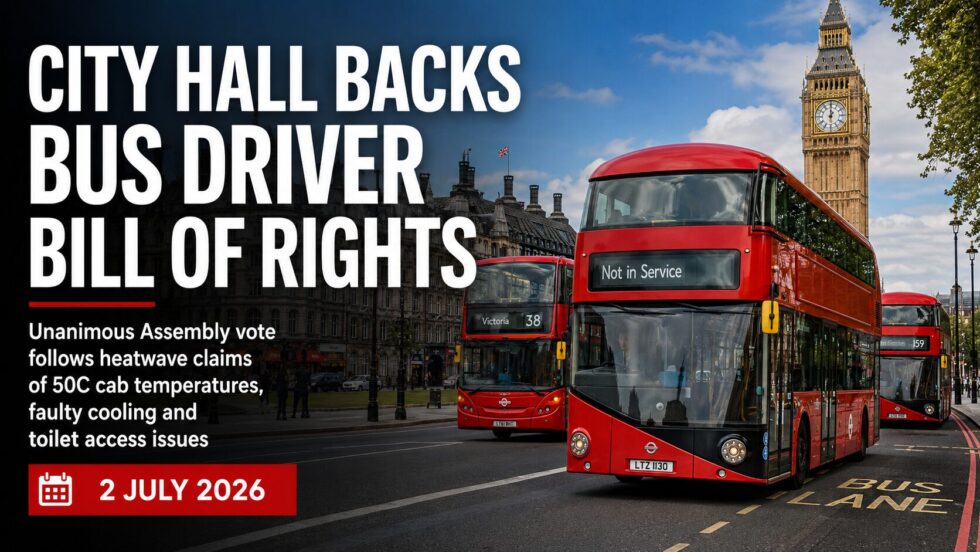
City Hall has backed a Bus Driver Bill of Rights after London’s heatwave exposed a wider dispute over cab temperatures, rest breaks, toilet access and driver safety across the capital’s bus network, The WP Times reports. The London Assembly vote followed claims that some drivers faced cab temperatures of up to 50C during recent extreme heat, with unions warning that faulty cooling systems and fatigue could put both staff and passengers at risk.
The motion, tabled by Reform UK Assembly Member Keith Prince on Thursday, 2 July 2026, was supported unanimously by all 21 Assembly Members in attendance. It calls on the Mayor of London and Transport for London to formally recognise a set of basic protections for bus drivers, including safe schedules, no forced overtime, proper rest breaks, access to toilets on routes, working heating and cooling, and protection for staff who report safety concerns.
What the London Bus Driver Bill of Rights demands
The proposed Bill of Rights is not only about hot weather. It is a broader attempt to set minimum expectations for how London bus drivers should be treated while operating one of the busiest urban transport systems in Europe.
The central demands include:
| Issue | What the motion calls for |
|---|---|
| Working hours | Safe schedules without forced overtime or loss of pay |
| Rest | Decent and proper rest breaks during the working day |
| Toilets | Clean, serviced toilet and rest facilities on all routes |
| Vehicles | Safe, well-maintained buses with working heating and cooling |
| Reporting | The right to raise safety concerns without fear of punishment |
| Training | Relevant and timely safety training |
| Respect | Dignity from employers, TfL and the public |
The London Assembly’s own summary also lists protections against being pressured back to work while seriously ill and covered by a doctor’s note, plus the right not to answer radio messages or texts from controllers while the bus is moving.
Why London bus driver heatwave conditions became a political issue
The vote came after a period of severe heat in London, when drivers and unions said conditions inside some bus cabs became unbearable. Unite said many Arriva North London buses use air-cooling rather than full air-conditioning, and that drivers reported only limited reductions in cab temperature during hot weather. Keith Prince told the Assembly that drivers had been left without proper welfare conditions. He said drivers had been seen working with shirts off and without reliable toilet access, arguing that fatigue and poor conditions could lead to human error.
Green Assembly Member Caroline Russell linked the issue to her earlier Bus Drivers Bill of Rights petition, submitted in February 2025. She said the demands were “basic rights” for the people who keep London moving, and warned that extreme heat was pushing drivers to their limits.
What TfL and Arriva say about driver safety
TfL’s director of buses, Lorna Murphy, said bus drivers play an essential role in keeping London moving and that TfL and operators take their safety and welfare seriously. TfL says it is working with operators on measures to improve working conditions, health and wellbeing, and says reports from drivers should be investigated rather than punished. Arriva London said its London buses are fitted with cab air-cooling systems, but added that cooling technology has changed over the life of the fleet and that retrofitting newer systems is not straightforward. The company said it is working with manufacturers to explore improvements and that driver safety remains a priority.
Could London bus drivers go on strike
The political vote also comes as more than 1,900 Arriva bus drivers across ten north and east London depots are being balloted for potential strike action over hot working conditions. Unite says the ballot opened on 1 July and closes on 29 July, with any strike likely to cause major delays and cancellations. The garages named in the dispute include Barking, Clapton, Dartford, Edmonton, Enfield, Grays, Palmers Green, Stamford Hill, Tottenham and Wood Green. That means any walkout would not be a symbolic protest only; it could affect commuters, school journeys, shift workers and passengers across large parts of north and east London.
For passengers, the immediate position is unchanged: the Assembly motion does not itself create a strike, cancel routes or change timetables. But politically, it increases pressure on the Mayor, TfL and operators to show that driver welfare is being treated as part of passenger safety, not as a separate workplace complaint. The motion now puts the issue formally before the Mayor and TfL. The key question is whether the Bill of Rights remains a political statement or becomes a practical standard built into contracts, enforcement, vehicle checks and operator expectations. For drivers, the most important tests will be practical: whether cooling systems work during heatwaves, whether route planning includes toilet access, whether rest breaks are protected, and whether staff can refuse unsafe conditions without fear of discipline.
For Londoners, the issue is also about reliability. A bus network cannot run safely or consistently if the people driving it are exhausted, overheated or unable to access basic facilities. That is why the City Hall vote matters: it turns a summer heatwave row into a wider debate about how London treats the workers who keep its buses moving.
Read about the life of Westminster and Pimlico district, London and the world. 24/7 news with fresh and useful updates on culture, business, technology and city life: When will Oasis 2027 tour dates be announced and could 12 Etihad nights define Manchester next summer