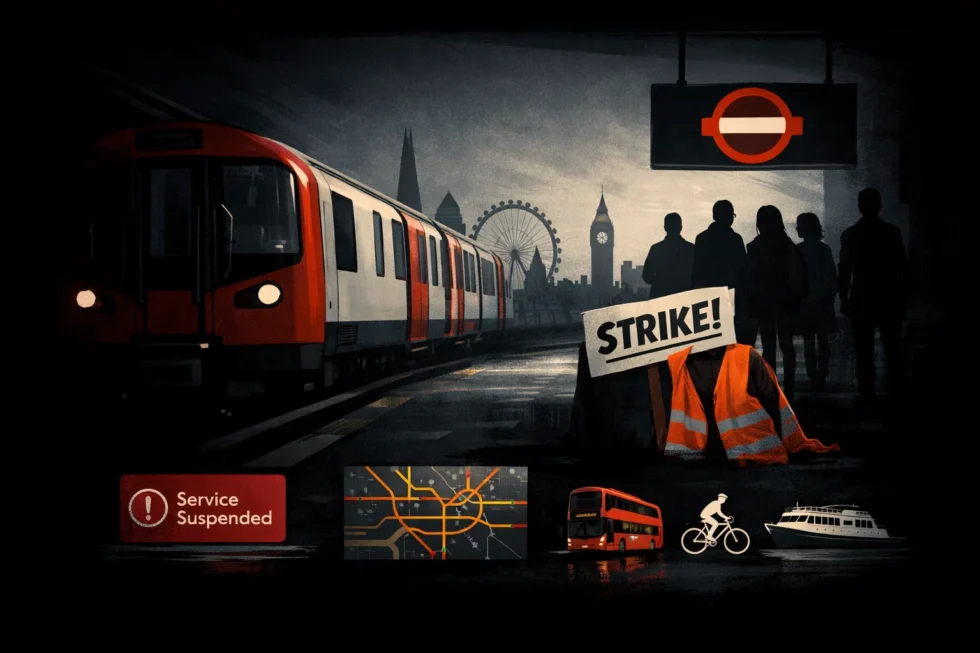
London’s transport network is entering a new phase of disruption as tube strikes 2026 action moves from cancelled March walkouts into confirmed industrial action across April, May and June, with the first stoppages beginning next week and affecting services network-wide. Drivers affiliated with the National Union of Rail, Maritime and Transport Workers(RMT) are set to walk out in rolling 24-hour periods, creating reduced services, delayed recovery times and significant pressure on alternative transport across the capital, particularly during peak commuting hours, The WP Times reports.
The tube strikes april 2026 schedule places immediate pressure on weekday travel patterns, with disruption expected to build from midday closures into evening service gaps and carry over into following mornings as Transport for London(TfL) works to restore operations. While not a full shutdown scenario, the strike model is designed to fragment service reliability rather than halt it entirely, meaning passengers will face inconsistent line availability, extended journey times and overcrowding across unaffected routes including the Elizabeth line and Overground.
Tube strikes April 2026: exact dates and how disruption will unfold
The first phase of tube strike london action is structured around staggered 24-hour walkouts, beginning midday and extending into the following day. This timing is critical, as it disrupts both afternoon and next-day morning peaks. Confirmed strike schedule:
| Date | Time window | Expected impact |
|---|---|---|
| 21–22 April 2026 | 12:00 Tue – 11:59 Wed | Gradual shutdown from midday, peak disruption evening & next morning |
| 23–24 April 2026 | 12:00 Thu – 11:59 Fri | Repeat pattern, extended delays into Friday commute |
| 19–20 May 2026 | 12:00 Tue – 11:59 Wed | Network strain midweek |
| 21–22 May 2026 | 12:00 Thu – 11:59 Fri | Compounded disruption |
| 16–17 June 2026 | 12:00 Tue – 11:59 Wed | Early summer peak travel impact |
| 18–19 June 2026 | 12:00 Thu – 11:59 Fri | Final scheduled phase |
Although all london tube strikes phases are expected to affect the full Underground network, TfL indicates that a reduced service will still operate on most lines, distinguishing this action from previous full shutdown strikes. Operational pattern passengers should expect:
- Normal service until late morning on strike days
- Progressive line suspensions from midday
- Severe evening disruption across central zones
- Limited early-morning service next day
- Gradual recovery by midday following strike end
This rolling impact means disruption extends beyond the official strike window, effectively creating 36-hour travel instability periods.
TfL tube strikes: what is behind the dispute and why it matters now
The tfl tube strikes dispute centres on a proposed shift in driver working patterns on the Transport for London network, specifically plans to compress a standard working week into four longer days. The proposal has been rejected by the National Union of Rail, Maritime and Transport Workers (RMT), which argues the changes were pushed forward despite internal opposition from drivers and unresolved concerns over safety and fatigue.
In a formal statement published by the union in March 2026, RMT said the proposals raised “serious concerns around fatigue, safety and work-life balance”, with General Secretary Eddie Dempsey warning that longer, compressed shifts could increase operational risk across a high-frequency metro system (RMT press release, London, 10 March 2026). The union’s position is not framed as a pay dispute, but as a structural issue affecting how the Underground is staffed and operated day-to-day. The concerns outlined by union representatives are specific and operational rather than abstract:
- Longer shifts increasing cumulative fatigue across the week
- Reduced recovery time between early and late duties
- Greater strain on peak-hour concentration and signalling precision
- Potential knock-on risks for safety on dense, high-frequency lines
TfL has not publicly adopted the same framing. Instead, the authority presents the changes as part of broader efficiency and workforce modernisation, while focusing its public messaging on service continuity rather than internal staffing models. This gap in positioning explains why the dispute has escalated: the two sides are effectively arguing about different definitions of the problem — safety versus system design. A transport industry source involved in discussions described the conflict in structural terms rather than short-term disagreement:
“This is not simply about pay or schedules — it is about how the network operates in the long term and how staffing adapts to changing demand patterns” (transport industry source, London, April 2026).
The fact that planned March strikes were suspended after late-stage talks shows that negotiation channels remain open. However, the confirmation of April, May and June action indicates that no settlement has been reached. In practical terms, that leaves the situation fluid: strike dates are real, but not fixed until they happen, and can still be withdrawn or escalated depending on progress in negotiations.
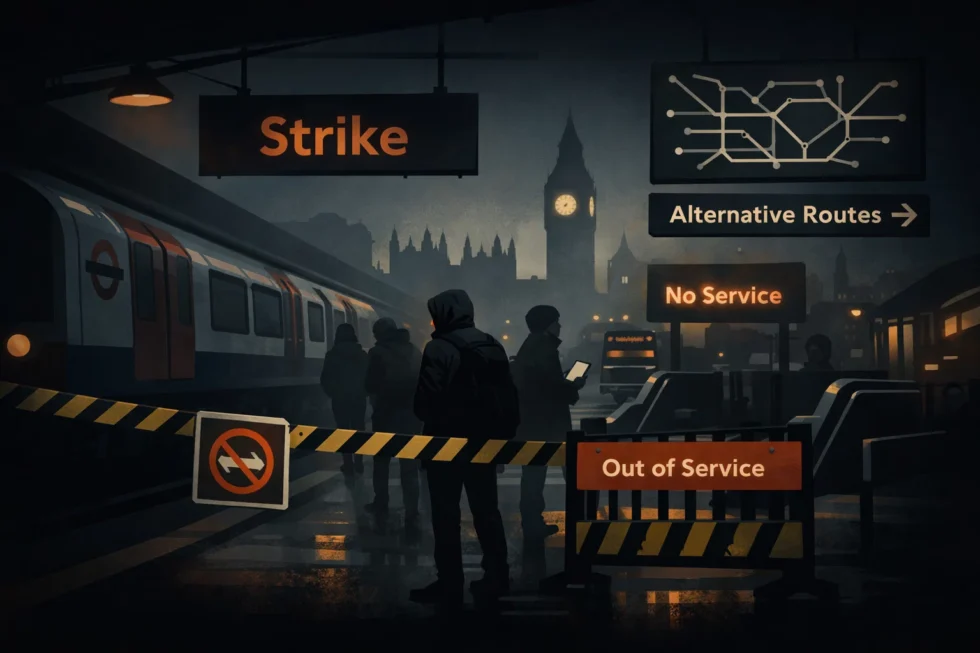
London tube strikes: alternative routes and how to travel during disruption
Despite the scale of the tube strike london disruption, Transport for London expects much of the wider network to remain operational. On its official travel guidance pages, TfL states that while the Underground will run a reduced service across most lines, several key transport modes will continue to operate normally. Services expected to run as normal:
- Elizabeth line — primary cross-London high-capacity route
- Docklands Light Railway (DLR) — key for east and south-east London
- London Overground — orbital routes bypassing central congestion
- London Trams — south London coverage
- Bus network — full operation, subject to demand pressure
TfL has warned that all of these services will be “very busy”, particularly at interchanges and during peak commuting hours, as displaced Underground passengers move onto alternative routes.
The most effective strategy is not to replicate a Tube journey step-by-step, but to replace it with a single-mode alternative where possible. Routes that depend on multiple interchanges are significantly more vulnerable to delay and overcrowding. Practical travel strategy during strikes:
- Use the Elizabeth line for direct east–west travel across central London
- Switch to London Overground to avoid Zone 1 bottlenecks
- Use DLR for Canary Wharf, Docklands and connected corridors
- Avoid interchange-heavy journeys wherever possible
- Travel outside peak hours where flexibility exists
- Allow significantly longer journey times (minimum +30–60 minutes)
- Consider walking or cycling for short central journeys
In central London, walking becomes a realistic alternative. Once queuing, access restrictions and platform crowding are factored in, a 20–40 minute walk between major stations can often match or outperform disrupted Underground routes.
What commuters should do now as Tube strikes 2026 begin
With tube strikes 2026 entering an active phase, the key issue for passengers is not complete shutdown, but loss of predictability. Services will run, but not consistently — with conditions changing across the day as strike action begins, peaks and then recovers. TfL advises passengers to check live updates before travelling and to plan journeys using official tools such as TfL Go and Journey Planner, reflecting the dynamic nature of the disruption.
Key actions for commuters:
- Check TfL live status before departure and before return journeys
- Build in at least 30–60 minutes of buffer time
- Avoid routes requiring multiple Underground interchanges
- Prepare at least one alternative route in advance
- Monitor last-minute updates from TfL and RMT
- Consider remote work or flexible hours where possible
The structure of these strikes — midday start, overnight impact and gradual recovery — means two journeys on the same day can face completely different conditions. A morning commute may run normally, while an afternoon return may face severe disruption.
What happens next in the London Underground strike timeline
The continuation of London tube strikes into May and June points to a prolonged negotiation process rather than a short-term dispute. Confirmed dates across multiple months indicate that both sides are preparing for sustained pressure rather than immediate resolution. At the same time, previous developments show that outcomes can still shift quickly. March strike action was called off following progress in talks, demonstrating that agreements can be reached even at a late stage. A TfL-linked source said discussions remain ongoing:
“Progress has been made previously, and further discussions are ongoing. Nothing is fixed until the final hours” (transport source, London, April 2026).
For now, the April strikes act as a pressure point for both sides — testing operational resilience for TfL and public tolerance for disruption. For passengers, the conclusion is straightforward: the disruption is real, the timeline is active, but the outcome remains unresolved and subject to change.
Read about the life of Westminster and Pimlico district, London and the world. 24/7 news with fresh and useful updates on culture, business, technology and city life: What is the new East West Rail line and how will it connect Oxford, Milton Keynes, Bedford and Cambridge