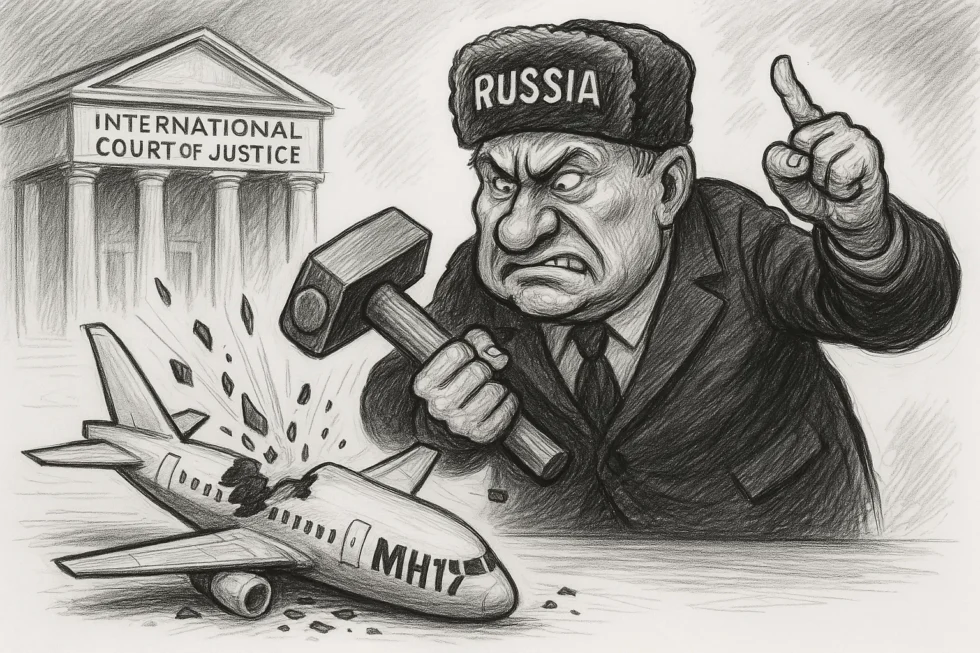
On 18 September 2025, Russia contested its responsibility for the downing of Malaysia Airlines Flight MH17 before the UN’s International Court of Justice. Moscow’s appeal challenges a ruling by the International Civil Aviation Organization (ICAO), which had attributed blame to Russia for the tragedy that killed 298 people in July 2014. This was reported by The WP Times, citing statements from the Russian Foreign Ministry.
On 17 July 2014, Malaysia Airlines Flight MH17 was shot down over eastern Ukraine while en route from Amsterdam to Kuala Lumpur. All 298 passengers and crew on board were killed. More than a decade later, the case continues to haunt international politics and diplomacy. On 18 September 2025, Russia formally contested its responsibility before the UN’s International Court of Justice (ICJ), rejecting a ruling by the International Civil Aviation Organization (ICAO) that had attributed blame to Moscow. Russia described the ICAO decision as “groundless” and driven by “political motives.”
According to a statement from the Russian Foreign Ministry, Moscow argued that the ICAO Council had relied on “highly dubious results of technical and criminal investigations” conducted under the leadership of the Netherlands, one of the parties directly affected. Russia also accused Ukraine of providing what it called “manipulated facts” to the investigation. By contesting the ruling, Russia seeks to reverse the decision that has strengthened international recognition of its role in the tragedy.
Earlier this year, in May 2025, the ICAO Council confirmed Russia’s responsibility for the downing of MH17. The vote was passed with overwhelming support, reinforcing earlier legal findings that linked Moscow to the missile strike. Russia, however, has consistently rejected the conclusions, framing them as politically motivated measures orchestrated by Western powers and Ukraine.
The MH17 case
The destruction of Flight MH17 shocked the world. The Boeing 777, flying at cruising altitude, was struck by a Russian-made Buk surface-to-air missile launched from territory held by pro-Russian separatists in Donbas. The Joint Investigation Team (JIT), established within weeks of the disaster, brought together investigators from the Netherlands, Malaysia, Australia, Belgium and Ukraine. Their coordinated work concluded that the missile system had been transported from Russia into eastern Ukraine and later returned to Russian territory.
Russia has repeatedly denied supplying the weapon or controlling the separatist forces. Yet, in November 2022, The Hague District Court ruled that Russia bore responsibility for the incident. The court found three men guilty: Igor Girkin (also known as Strelkov), a former Russian intelligence officer; Sergei Dubinsky, a Russian national; and Leonid Kharchenko, a Ukrainian citizen. All three were sentenced to life imprisonment in absentia. The court also ordered Russia to pay over €16 million in compensation to the victims’ families.
Russia’s political argument
By taking its appeal to the UN Court, Moscow is not only challenging ICAO’s technical judgment but also seeking to reshape the narrative of the MH17 case. Russian officials claim that the proceedings have been manipulated and weaponised for political purposes. They argue that the Netherlands and Ukraine had vested interests in directing blame towards Russia while ignoring alternative theories.
However, most international observers view Moscow’s latest move as part of its broader strategy to avoid accountability. Legal experts note that while the ICJ may hear Russia’s objections, the overwhelming body of evidence, including radar data, intercepted communications, and forensic analysis of missile fragments, makes it unlikely that the verdict of history will shift.
International response
The downing of MH17 has had profound diplomatic consequences. It triggered global outrage and deepened Russia’s isolation from the West. The European Union and the United States imposed sanctions following the tragedy, measures that remain in place and have since expanded due to subsequent conflicts. For the victims’ families, the legal proceedings are about justice and recognition of responsibility rather than politics.
In The Hague’s 2022 ruling, the court explicitly stated that Russia exercised control over the self-proclaimed “Donetsk People’s Republic” from at least May 2014. This finding directly undermined Moscow’s repeated denials. For many relatives of the victims, Russia’s current appeal before the ICJ is seen as another attempt to delay closure.
Looking ahead
The ICJ’s review of Russia’s challenge is expected to be lengthy, involving hearings, legal arguments, and the presentation of evidence already examined in earlier proceedings. Legal analysts suggest that while Moscow may hope to weaken the symbolic weight of the ICAO decision, the international community is unlikely to reverse its overall stance on the case.
For now, the families of the 298 victims continue to live with the consequences of the disaster. The downing of Flight MH17 remains one of the darkest chapters of modern aviation history, symbolising the devastating intersection of civilian life and geopolitical conflict.
Read about the life of Westminster and Pimlico district, London and the world. 24/7 news with fresh and useful updates on culture, business, technology and city life: Ukrainian Men in Canada Facing New Requirement for Permanent Residency