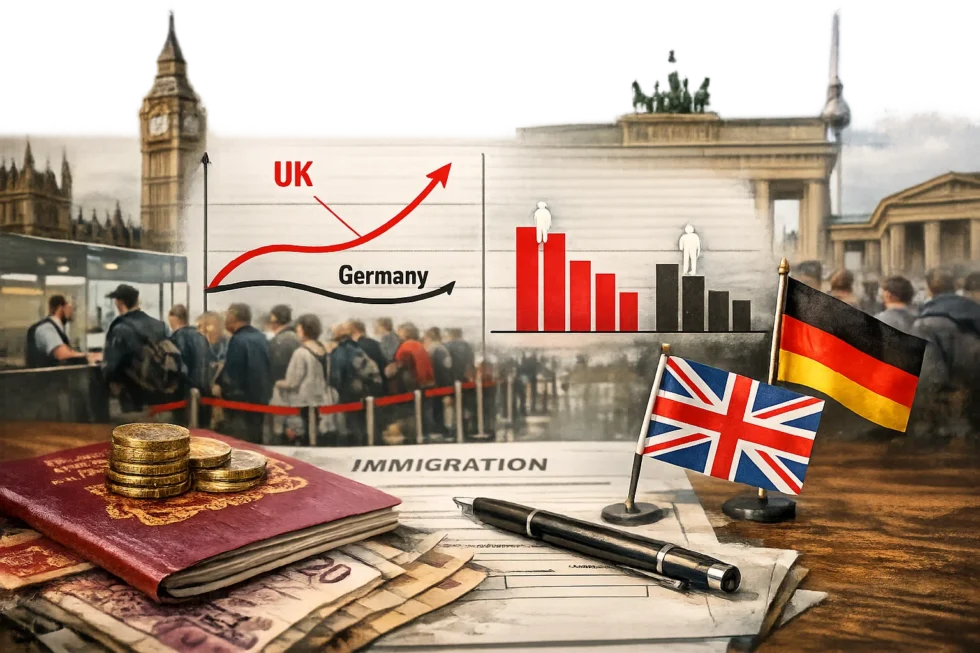
LONDON, Friday 3 January 2026 —UK immigration did not fall after Brexit. It was re-engineered — and for several years it surged to levels higher than in Germany, Europe’s largest economy still operating inside the EU’s free-movement system. A new comparative analysis published today by CEPR’s VoxEU shows that Britain experienced a sustained rise in net migration after both the 2016 referendum and the 2021 end of free movement, despite political promises to reduce inflows.
The data, based on UK Office for National Statistics and Germany’s Federal Statistical Office, reveal a structural shift: EU labour mobility collapsed, but was replaced by much larger non-EU inflows under the post-Brexit points-based visa regime, particularly in health care, skilled work and international students.
As The WP Times reports, citing the VoxEU study released on 3 January 2026, Brexit did not close Britain’s borders — it redirected migration from Europe to the rest of the world, producing higher overall numbers and a more skill-selective, but far larger, immigration system.
The core finding: two shocks, two very different migration channels
The VoxEU study treats Brexit not as a single event, but as two separate institutional shocks, each producing a distinct and measurable effect on Britain’s migration system.
First shock: the 2016 referendum
The vote to leave the European Union triggered a wave of uncertainty long before any laws changed. Employers delayed hiring, migrants reassessed their plans, and thousands of EU citizens already in Britain rushed to secure their legal status.
The immediate statistical effect was not a collapse in arrivals, but a sharp fall in emigration from the UK relative to Germany. Fewer people left Britain than expected, while inflows only softened modestly. The result was counter-intuitive but decisive: net migration rose, not because Britain suddenly became more open, but because far fewer residents — especially EU nationals — chose to leave.
In other words, the referendum acted as a migration stabiliser, locking existing populations in place while the labour market continued to pull in workers.
Second shock: the 2021 end of free movement
When free movement finally ended, the migration regime itself was redesigned. The UK replaced EU mobility with a global points-based visa system that prioritised skills, employer sponsorship and educational routes.
This produced a much more dramatic shift: EU inflows collapsed, but they were replaced by larger volumes of non-EU migrants, particularly in health care, technology, higher education and family-linked routes.
The outcome was not lower migration, but a fundamental reallocation of who comes to Britain — from European workers moving freely to non-European migrants selected through visas, sponsorships and salary thresholds.
Why Germany matters
Germany serves as the control case because it did not experience this institutional rupture. It remained inside the EU’s free-movement framework and continued to admit EU workers alongside refugees and skilled non-EU migrants under stable rules.
As a result, changes in German migration were driven mainly by external shocks — such as the Ukraine war or global humanitarian flows — rather than by a domestic redesign of the system.
By comparing Britain to Germany, the VoxEU analysis isolates what Brexit really did: it did not reduce migration pressure; it changed the architecture of how migration enters the economy.
What the official UK data says about the post-Brexit “high-water mark”
To understand why the Brexit–migration paradox now dominates British politics, it is necessary to return to the most politically explosive statistic of the decade: net migration reached record levels in the immediate post-pandemic, post-Brexit period before later falling back. According to provisional figures from the UK Office for National Statistics, in the year ending June 2023:
- Total long-term immigration reached 1.2 million
- Emigration stood at 508,000
- Net migration therefore rose to 672,000
- Non-EU nationals accounted for 968,000 of all arrivals
These numbers became the defining headline of post-Brexit Britain: they were higher than anything recorded under EU free movement.
Subsequent revisions and later data showed that this was a peak rather than a permanent plateau. The Migration Observatory at the University of Oxford reported that non-EU immigration fell in the year ending June 2025, reflecting tighter visa rules and cooling labour demand. The House of Commons Library also published revised estimates showing net migration down to around 345,000 by the year ending December 2024.
But politically, the damage had already been done. The crucial point is not whether one specific figure stands forever, but that the post-2021 system created a pipeline for large-scale non-EU inflows that replaced EU free movement rather than reducing overall migration.
What changed after 2021: visas, dependants and the care-sector surge
The UK’s points-based system is often debated in abstract terms. The reality is visible in the visa data. Home Office immigration statistics for the year ending December 2023 show:
- 337,240 work visas issued to main applicants (up 26% on 2022)
- Skilled Worker – Health and Care visas almost doubled to 146,477
- Care workers and home carers accounted for 89,236 of those grants
These were not marginal flows. They became one of the central pillars of Britain’s post-Brexit labour market.
ONS data also reveals another multiplier effect that transformed the headline numbers: dependants.
In the year ending December 2023, non-EU dependants arriving alongside work-visa holders accounted for 52% of all non-EU work-related migration — around 219,000 people. Most were linked to the health and care route.
This is why the public debate so often feels disconnected from the policy language. The post-Brexit increase was not driven by a single “open borders” decision. It was the combined result of:
- chronic labour shortages, especially in health and social care
- visa design (salary thresholds, sponsorship and eligibility rules)
- and family-reunion provisions that multiply each work visa into several arrivals
UK vs Germany: the comparison that cuts through
Germany runs a large migration system too — but under very different institutional rules. According to Germany’s Migration Report 2023, published by the Federal Office for Migration and Refugees (BAMF):
- Net migration in 2023 was +662,964
- Arrivals totalled 1,932,509
- Departures stood at 1,269,545
The report also notes that the decline from 2022 was driven mainly by fewer refugees from Ukraine, not by structural policy change.
| Metric (headline year) | United Kingdom | Germany |
|---|---|---|
| Net migration | 672,000 (YE June 2023, provisional) | +662,964 (2023) |
| Main driver | Non-EU work, study and dependants | EU mobility + humanitarian flows |
| System shock | Brexit + end of free movement (2021) | None |
This comparison does not show that one country is “better” than the other. It shows why Germany is the ideal benchmark: it demonstrates what migration looks like inside EU free movement, while Britain shows what happens when it is replaced by a global visa regime.
The Brexit paradox, in plain terms
The core conclusion of the VoxEU analysis is difficult to escape. Brexit was marketed as a mechanism to reduce immigration. In practice, it replaced a European labour market with a global recruitment system — one that is more bureaucratic, more selective and, crucially, capable of producing higher volumes.
Under EU free movement, Britain drew heavily on nearby European workers who tended to be young, mobile and often temporary. Under the post-2021 points-based regime, Britain now recruits globally — through employer sponsorship, health-care visas, student routes and family-linked migration. These channels are designed to meet labour shortages, not to cap numbers.
The economic forces that pull migrants into Britain did not weaken when the country left the European Union. Demand for labour in health care, higher education, technology, logistics and hospitality remained structurally embedded in the economy. What changed after 2021 was the architecture through which that demand was met.
The points-based system replaced free movement with a global recruitment framework based on sponsorship, eligibility thresholds and dependants. It offered policymakers greater administrative control, but it did not constrain the volume of labour the economy required — it simply delivered that labour through more complex and often higher-volume legal routes. Post-Brexit Britain therefore controls the process of entry, but not the scale of migration generated by its own economic model.
What this means in practical terms
The migration debate in Britain now turns on a structural contradiction. The country wants tighter borders, but it also wants functioning public services, a competitive economy and growing universities. Those goals pull in opposite directions.
The post-Brexit system solved one political problem — ending free movement — by creating a new economic one: a high-volume, visa-driven migration model that is harder to explain to voters and harder to unwind without damaging key sectors.
The comparison with Germany makes this visible. Germany absorbed labour needs largely through Europe’s internal market. Britain chose a global visa architecture instead. The outcome was not less migration, but a more complex, more permanent and more politically volatile form of it. That is why, in 2026, the migration question remains unresolved. Britain changed the system. It did not change the underlying forces that drive people to come.
Read about the life of Westminster and Pimlico district, London and the world. 24/7 news with fresh and useful updates on culture, business, technology and city life: UK Bank Holidays 2026 confirmed as Boxing Day moves to December 28