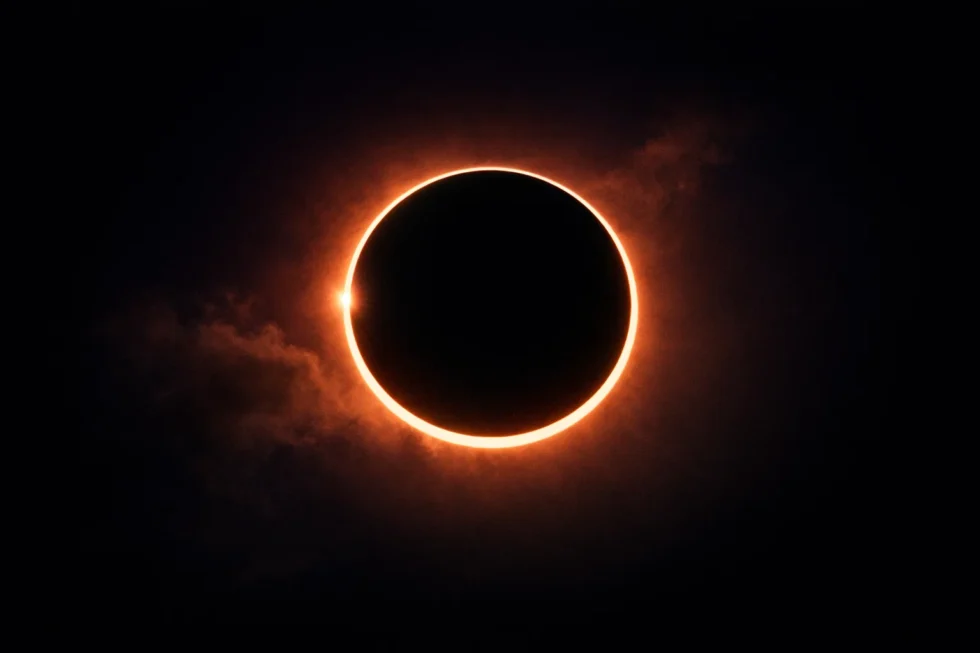
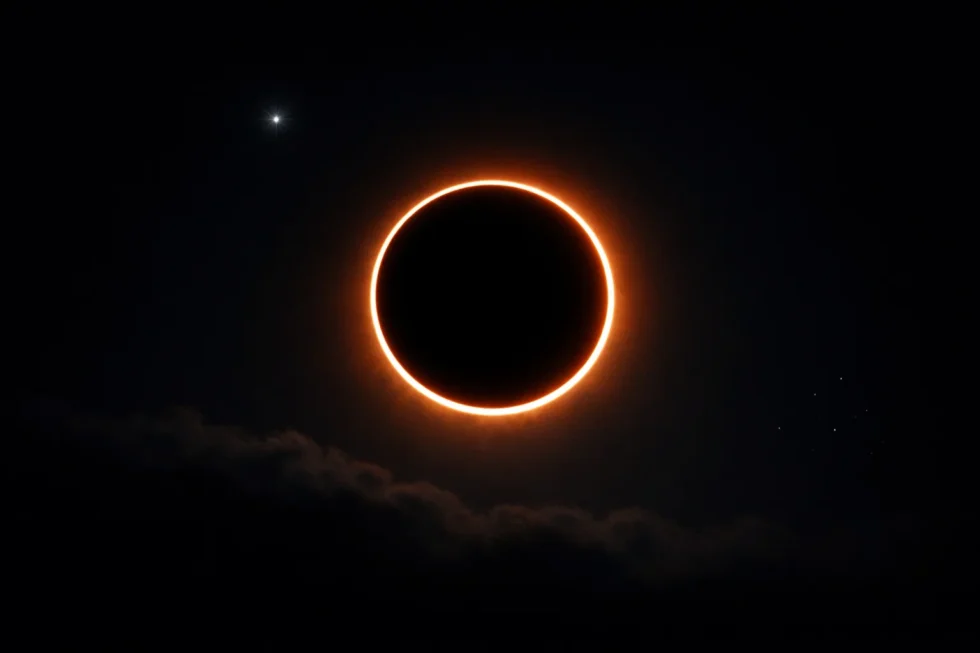
On Tuesday 17 February 2026, an annular solar eclipse will occur — a comparatively rare astronomical event in which the Moon moves across the face of the Sun but does not fully obscure it, leaving a narrow, luminous ring of sunlight visible around the lunar disc. This so-called Ring of Fire effect happens when the Moon is close to its apogee, the most distant point in its orbit from Earth, causing it to appear slightly smaller than the Sun. Unlike total solar eclipses, annular eclipses never produce full darkness and occur only a few times each decade worldwide, which makes them scientifically important even when their visibility is geographically limited, reports The WP Times.
For audiences in the United Kingdom, however, the practical answer to the most frequently searched question — whether it will be visible and at what time — is unequivocal. The annular solar eclipse on 17 February will not be visible anywhere in the UK, either in full or in partial form. The entire event unfolds while the Sun remains below the British horizon, leaving no dimming of daylight, no change in sky conditions and no safe viewing window for UK observers.
Search interest in queries such as what time is the eclipse in the UK typically increases sharply in the days leading up to major celestial events. In this case, however, the eclipse has no UK timing at all. Visibility is confined to the Southern Hemisphere, with the path of annularity passing over Antarctica and only limited partial phases visible across remote areas of the southern Atlantic and Indian Oceans. Europe, including the UK, lies entirely outside the eclipse’s visibility zone, placing this event firmly beyond the reach of British skies.
Where the annular solar eclipse will be visible — and why the UK is excluded
| Region | Visibility | What observers will see | Approximate local timing |
|---|---|---|---|
| United Kingdom | Not visible | No eclipse of any kind | Sun below horizon |
| Europe | Not visible | No partial phase | Below horizon |
| Antarctica | Full annular eclipse | “Ring of Fire” around the Sun | Late morning to early afternoon |
| Southern Atlantic & Indian Ocean | Partial eclipse | Sun partially obscured | Varies by location |
| Southern Africa (limited areas) | Partial eclipse | Shallow partial phase | Afternoon |
For UK readers asking where the annular solar eclipse can be seen, the answer is unequivocal. Britain lies entirely outside the eclipse’s visibility zone. The orbital geometry of the event places the Sun below the UK horizon for the full duration of the eclipse, which means there will be no annular phase, no partial eclipse and no detectable reduction in daylight at any point on 17 February. Even locations in southern England fall well beyond the edge of the Moon’s shadow, ruling out the possibility of a marginal or grazing partial phase.
The next solar eclipse visible from the UK will be the partial solar eclipse on 12 August 2026. This event is expected to be observable across large parts of England, Wales and southern Scotland, with the Moon covering a noticeable portion of the Sun during daylight hours. As a result, it is likely to become the next major skywatching moment for British audiences, provided weather conditions allow for clear views.
Why an unseen eclipse still matters
From an editorial and analytical standpoint, solar eclipses are not evaluated purely by what can be seen from a particular location. They are treated as temporal markers — points that coincide with shifts in attention, priorities and decision-making, often becoming clear only in hindsight. The 17 February 2026 eclipse occurs in Aquarius, a sign traditionally linked to:
- systems and institutions
- technology and infrastructure
- collective responsibility
- long-term planning and reform
Historically, solar eclipses in Aquarius are associated less with sudden public rupture and more with systemic realignment. They tend to coincide with periods in which the underlying frameworks of daily life are quietly reworked — how organisations function, how labour is structured, how authority is distributed, and where the balance between independence and collective responsibility is reset. Rather than triggering immediate, visible events, Aquarius eclipses often mark the moment when decisions are taken behind the scenes, setting changes in motion that only become apparent weeks or even months later.
In that sense, this is not an eclipse of spectacle or interruption. It is an eclipse of reorientation — one that signals a shift in direction rather than a single turning point. For UK audiences, the fact that the eclipse is not visible in the sky does not reduce its relevance within the broader eclipse cycle. Instead, it sharpens the focus on context, continuity and consequence, emphasising how gradual adjustments, once set, reshape systems more durably than any dramatic moment of visibility.
What to do – and what not to do – on an annular solar eclipse day
An annular solar eclipse does not bring sudden darkness, but it does signal a period in which perspective is subtly distorted. Historically, eclipse days coincide with moments when information is incomplete, assumptions are unreliable and the consequences of decisions unfold later than expected. For that reason, eclipses are best understood not as catalysts for action, but as pauses for reassessment.The guidance below is behavioural rather than predictive. It focuses on how to reduce risk, preserve clarity and make better decisions during a compressed and uncertain window.
Aries
Recommended approach:
Restrain the instinct to lead from the front. Use the day to question direction, not to accelerate it.
Best avoided:
Initiating confrontations, issuing ultimatums or forcing progress where resistance is already present.
Taurus
Recommended approach:
Re-examine professional structures, responsibilities and long-term security with realism rather than attachment.
Best avoided:
Defending existing arrangements purely because they feel stable or familiar.
Gemini
Recommended approach:
Slow down communication. Review documents, messages and plans carefully before moving forward.
Best avoided:
Finalising agreements, signing contracts or relying on informal assurances.
Cancer
Recommended approach:
Clarify practical boundaries around shared resources, finances and obligations.
Best avoided:
Letting emotional history influence decisions that require neutrality and proportion.
Leo
Recommended approach:
Reassess partnerships and power dynamics with attention to balance and accountability.
Best avoided:
Turning negotiations into questions of pride, status or personal authority.
Virgo
Recommended approach:
Focus on refining systems, routines and processes rather than outcomes.
Best avoided:
Over-controlling details that depend on external variables.
Libra
Recommended approach:
Reconnect with personal priorities before making relational or creative commitments.
Best avoided:
Agreeing to terms simply to preserve harmony or avoid discomfort.
Scorpio
Recommended approach:
Make deliberate, strategic adjustments within domestic or family structures where necessary.
Best avoided:
Reopening unresolved emotional conflicts without a clear path to resolution.
Sagittarius
Recommended approach:
Check assumptions, timelines and facts. Precision matters more than momentum.
Best avoided:
Public statements or commitments made before consequences are fully assessed.
Capricorn
Recommended approach:
Review long-term financial planning and resource allocation with a measured, strategic lens.
Best avoided:
Decisions driven by short-term fear or pressure.
Aquarius
Recommended approach:
Reconsider autonomy, direction and responsibility within wider systems and networks.
Best avoided:
Resisting structural changes that are already unfolding.
Pisces
Recommended approach:
Create deliberate space for observation and reflection, particularly where situations feel emotionally charged or unclear. For Pisces, perspective improves once immediate pressure is reduced and reactions are allowed to settle.
Best avoided:
Withdrawing in a way that delays or sidesteps necessary practical decisions. Reflection is useful; avoidance is not.
Eclipse days are not optimal for launching major initiatives or making irreversible decisions. Their influence is rarely immediate. Instead, it tends to unfold gradually, with consequences becoming clearer four to six weeks later, once perspective stabilises and missing information emerges. From a professional and editorial standpoint, the most productive way to approach an eclipse day is to prioritise assessment over action:
- observe which issues repeatedly demand attention
- note where doubt, pressure or hesitation keeps resurfacing
- allow time for reassessment before committing to a fixed course
This approach reduces the risk of decisions taken under distorted timing and incomplete context. Even though the annular solar eclipse on 17 February is not visible in the UK, its timing coincides with a broader period of recalibration, particularly around systems, responsibilities and long-term planning. These are the kinds of shifts that rarely announce themselves dramatically but tend to reshape direction quietly and persistently. For British audiences, the sky may remain unchanged. The adjustment, however, is more likely to register in priorities rather than in spectacle, revealing its impact over time rather than in a single visible moment.
Questions readers often ask
Major astronomical events tend to raise practical questions, particularly when they are widely discussed but not directly visible. Below are clear, evidence-based answers to the most common questions readers ask about eclipse timing, impact and decision-making — focused on what matters in practice rather than speculation.
Does an eclipse have any effect if it cannot be seen in the UK?
Yes. Astronomical visibility and eclipse timing are not the same thing. An eclipse marks a specific alignment between the Earth, Moon and Sun, and its timing is global, even if the event is not visible from a particular location. Historically, eclipses tend to coincide with decision points, delays, revisions or shifts in direction, especially in areas already under pressure. These effects are usually indirect and become apparent only later.
Is an eclipse day a bad day for decisions?
Not necessarily, but it is poorly suited to irreversible decisions. Launches, final sign-offs, binding commitments and public announcements made on eclipse days often require revision. By contrast, activities such as review, planning, information-gathering and risk assessment tend to be more productive.
When do eclipse-related changes usually become clear?
In most cases, four to six weeks after the eclipse, once additional information emerges and circumstances stabilise. This delay is why eclipses are often understood as starting points rather than endpoints.
Why do eclipses affect timing rather than events?
Because eclipses temporarily distort perspective. Key details may be hidden, misunderstood or underestimated at the time decisions are taken. What feels settled on the day often requires adjustment once normal context returns.
Read about the life of Westminster and Pimlico district, London and the world. 24/7 news with fresh and useful updates on culture, business, technology and city life: Nasa Artemis II launch pad rollout begins as historic round-the-moon mission nears February launch