
Easter 2026 also matters in a religiously diverse Britain. While the UK follows the Western Christian calendar for public holidays, the country is home to a substantial Orthodox Christian population, estimated at 500,000 to 700,000 people. This includes long-established Greek communities as well as large Romanian, Ukrainian, Russian and Serbian diasporas, many of which are concentrated in major cities such as London. For Orthodox Christians, Easter is often celebrated on a different date, calculated according to the Julian calendar rather than the Gregorian system used in Western Christianity. This means that families may observe Easter weeks apart, employers may receive overlapping holiday requests, and schools and public services in multicultural urban areas must navigate parallel calendars within the same season.
This divergence does not create tension, but it does add practical and organisational complexity. In urban Britain, Easter increasingly operates on more than one timetable — religiously, socially and logistically — making the date relevant not only for faith communities but also for workplaces, educators and local authorities, reports The WP Times.
When is Easter in 2026 in the UK
Easter in the UK is not a single-day event but a structured national period that combines religious observances with legally defined public holidays. In 2026, Easter spans late March and early April, affecting work schedules, retail operations, school timetables and transport planning across the country. Easter 2026: key dates and public status in the UK
| Day | Date | Status in the UK |
|---|---|---|
| Palm Sunday | 29 March 2026 | Church observance (no public holiday) |
| Maundy Thursday | 2 April 2026 | Normal working day |
| Good Friday | 3 April 2026 | Bank holiday (UK-wide) |
| Holy Saturday | 4 April 2026 | Normal Saturday |
| Easter Sunday | 5 April 2026 | Sunday trading rules apply |
| Easter Monday | 6 April 2026 | Bank holiday (except Scotland) |
This sequence defines what is commonly referred to as the Easter bank holiday period in the UK, even though only two of these days are statutory holidays.
Why Easter dates and bank holidays matter in everyday UK life
Easter bank holidays affect the working patterns of more than 30 million people across the United Kingdom. For employers, schools, transport providers and public services, Easter represents one of the most complex long weekends in the calendar. In practical terms, Easter 2026 will influence:
- Employment and payroll planning
Many sectors operate on reduced staffing levels on Good Friday and Easter Monday, while others — particularly retail, hospitality and transport — experience increased demand. - Transport capacity and congestion
Easter consistently produces some of the highest short-break travel volumes of the year, especially on the Thursday evening before Good Friday and on Easter Monday afternoon. - Retail opening hours and consumer behaviour
Easter Sunday trading rules restrict large shops in England and Wales, while supermarkets typically operate reduced hours on Good Friday. - Public services and healthcare access
GP surgeries and many local authority services are closed on bank holidays, increasing reliance on NHS 111 and urgent care services.
London-specific impact
In London, Easter is consistently one of the busiest short-break periods of the year. The combination of school holidays, domestic tourism and international visitors places additional pressure on:
- public transport networks operating on holiday timetables
- central parks and outdoor spaces during favourable weather
- museums, galleries and family attractions
- hospitality venues, particularly in tourist-heavy areas
For Londoners, Easter often marks the first major seasonal shift in how the city functions after winter, both socially and economically.
Why does the date of Easter change every year
Unlike Christmas, Easter does not have a fixed calendar date. Its timing follows a calculation system established in early Christianity and still used today by Western churches, including those in the United Kingdom. As a result, Easter moves each year, reshaping public holidays, school breaks and economic planning cycles across the country.
Easter is celebrated on the first Sunday after the first full moon following the spring equinox. For the purpose of this calculation, the Church fixes the spring equinox as 21 March, regardless of astronomical variation. This rule creates a moving window in which Easter Sunday can fall anytime between 22 March and 25 April. In 2026, the Paschal full moon occurs in early April, placing Easter Sunday on 5 April. In the UK calendar, this is considered a late Easter, with tangible consequences for travel patterns, retail demand and seasonal behaviour.
How Easter is calculated: the rule behind the moving date
| Element | Fixed or variable | Practical effect |
|---|---|---|
| Spring equinox | Fixed (21 March) | Starting reference point |
| Paschal full moon | Calculated | Determines the eligible Sunday |
| Easter Sunday | Variable | Always falls on a Sunday |
This method explains why Easter can appear to “move unpredictably” from year to year, even though the underlying rule remains unchanged.
Why a late Easter matters in the UK
In Britain, the timing of Easter has practical and economic consequences that extend well beyond religious observance. A later Easter, such as in 2026, typically aligns with

- milder spring weather, increasing outdoor activity
- higher domestic travel volumes, especially for short breaks
- increased footfall in parks, high streets and city centres
- stronger performance in retail, hospitality and tourism sectors
For businesses, Easter is often the first major seasonal revenue peak after winter. For local authorities and transport providers, it signals a shift toward spring demand patterns, including increased leisure travel and pressure on public spaces. In cities like London, a late Easter frequently coincides with the reopening of outdoor attractions, higher visitor numbers and the start of the spring tourism cycle.
Easter as a planning marker, not just a religious date
In the UK, Easter’s moving date matters because it synchronises national activity. Employers plan staffing around bank holidays, schools align term breaks, retailers schedule seasonal promotions and transport operators adjust capacity — all based on where Easter falls in the calendar. For this reason, when Easter occurs is not a symbolic question but a logistical one, especially in years like 2026 when the holiday arrives later and overlaps with increased spring mobility.
What does Easter mean in Christianity — and why it still matters in Britain
Easter commemorates the resurrection of Jesus Christ and represents the central event of Christian belief. Theologically, it symbolises renewal, hope and the triumph of life over death — themes that historically shaped European culture, ethics and calendar structures. In contemporary Britain, however, Easter’s relevance extends far beyond theology. While regular church attendance has declined steadily over recent decades, Easter remains the most significant Christian date of the year in terms of participation, visibility and public recognition.
Church data consistently shows that attendance during Easter services is two to three times higher than on an average Sunday. Major cathedrals across England record their highest annual visitor numbers during Holy Week, attracting not only practising Christians but also cultural visitors, tourists and families who attend Easter services as part of tradition rather than belief. For many people in the UK, Easter now functions less as a doctrinal event and more as a cultural and temporal marker— a moment that signals transition, pause and renewal within the year. It marks the psychological end of winter, the start of spring routines and a reset point for work, family life and consumption patterns.
Holy Week explained: religious meaning and public relevance
Holy Week forms the core of the Easter period, combining religious observance with varying degrees of public impact.
| Day | Religious meaning | Public relevance in the UK |
|---|---|---|
| Palm Sunday | Entry of Jesus into Jerusalem | Minimal outside churches |
| Maundy Thursday | The Last Supper | Church-based observance |
| Good Friday | Crucifixion | Bank holiday, nationwide impact |
| Easter Sunday | Resurrection | Cultural and religious significance |
Among these days, Good Friday holds the greatest public importance in Britain due to its status as a statutory bank holiday. Easter Sunday, while not a bank holiday, remains symbolically central and shapes trading rules, transport schedules and family routines.
Easter as a public holiday in the UK
Easter is one of the few religious festivals that directly shape the UK’s statutory holiday calendar. The bank holidays surrounding Easter influence employment contracts, retail operations, public services and national logistics.
Bank holiday differences across the UK
| Nation | Good Friday | Easter Monday |
|---|---|---|
| England | Yes | Yes |
| Wales | Yes | Yes |
| Scotland | Yes | No |
| Northern Ireland | Yes | Yes |
These differences are more than symbolic. For UK-wide employers, delivery companies and transport operators, variations between nations require separate staffing models and schedules. Scotland’s absence of an Easter Monday bank holiday is a recurring source of confusion in cross-border operations and national planning. In practical terms, Easter creates a non-uniform holiday landscape, where public services and business availability vary depending on location.
Despite declining religiosity, Easter continues to organise British life because it synchronises time at a national level. Schools align term breaks around Easter, employers plan staffing around bank holidays, retailers schedule seasonal campaigns and transport providers adjust capacity — all based on where Easter falls in the calendar. This makes Easter one of the most influential non-fixed dates in the UK system, comparable in practical impact to Christmas, but without a single universal day of closure.
The economic scale of Easter in Britain
Easter is not a minor seasonal event. It is one of the most economically significant periods of the UK calendar outside Christmas, triggering measurable shifts in consumer behaviour and mobility.
| Sector | Typical impact |
|---|---|
| Retail | £1.5–£2 billion in turnover |
| Domestic tourism | 20–30% increase in demand |
| Hospitality | Start of the spring peak |
| Transport | Holiday schedules and congestion |
For retailers, Easter often rivals Valentine’s Day and Mother’s Day combined in terms of seasonal sales. For tourism and hospitality, it marks the beginning of sustained spring activity, particularly for short domestic trips and city breaks. In large urban centres such as London, Easter coincides with increased museum attendance, higher restaurant bookings and the reopening of outdoor attractions, reinforcing its role as both an economic and social turning point.
Easter in Britain: belief, habit and structure
Easter endures in Britain not because religious belief is universal, but because the holiday has become structural rather than doctrinal. It creates a predictable pause in the year, aligns family and work schedules, and signals a seasonal shift that remains meaningful regardless of faith.
In an increasingly secular society, Easter functions as a time organiser. It marks the point at which winter routines loosen, spring travel resumes and public life becomes more outward-facing. This is why Easter continues to matter socially, economically and psychologically, even as personal belief varies widely. Rather than enforcing observance, Easter in the UK quietly shapes behaviour — through school holidays, bank holidays, trading rules and transport patterns — embedding itself into everyday life without requiring religious participation.
Easter school holidays and family movement
One of the most tangible effects of Easter in Britain is its impact on the school calendar. Most UK schools close for one to two weeks around Easter, with exact dates determined by local authorities and academy trusts.
Typical Easter school holiday patterns
| Area | Likely break period |
|---|---|
| London | Late March – mid April |
| South East England | Similar to London |
| Wales | Aligned with England |
| Scotland | Shorter and earlier |
In London, where more than two million school-age children live across Greater London, Easter school holidays significantly reshape daytime activity. Weekday footfall in museums, shopping centres and leisure attractions rises sharply, while public transport patterns often resemble weekend travel throughout the holiday period. For families, Easter represents the first major opportunity for travel and shared time after winter, driving short domestic trips and increased use of cultural venues.
How Easter is celebrated in modern Britain
Easter in the UK today is best described as a hybrid of tradition and convenience. It is quieter than Christmas and less socially intense, but more structured than most other religious dates. Common Easter practices include:
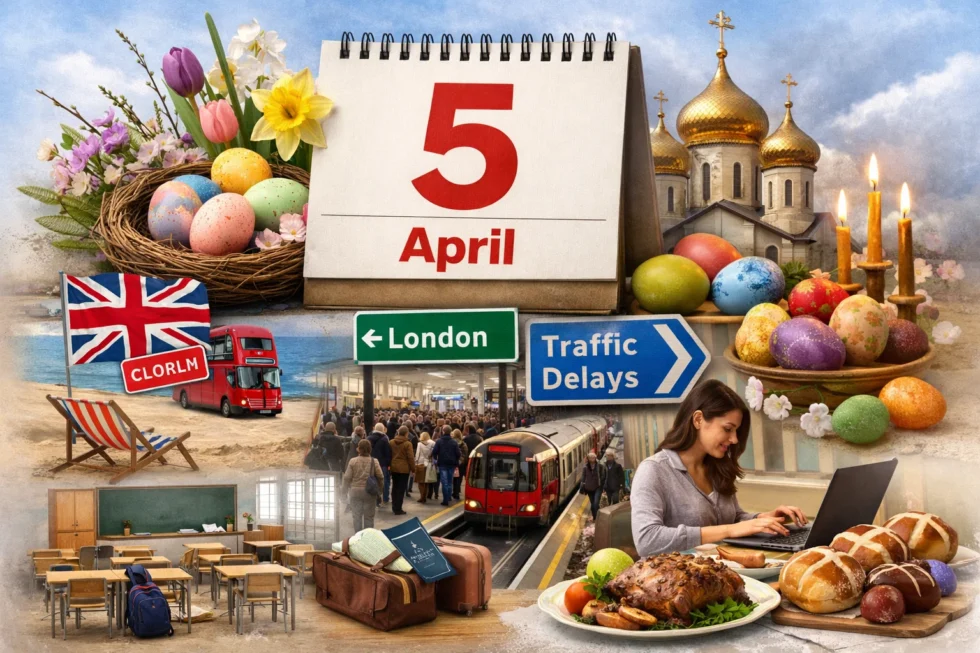
- exchanging chocolate Easter eggs
- family lunches or traditional roasts
- outdoor activities and short trips
- occasional church attendance, often seasonal rather than regular
Participation patterns
| Activity | Participation level |
|---|---|
| Chocolate Easter eggs | Very high |
| Family meals | High |
| Church services | Moderate |
| Outdoor leisure | Weather-dependent |
Easter in Britain is primarily a daytime-focused holiday, with an emphasis on shared meals, outdoor activity and family routines rather than evening celebrations or nightlife.
Easter eggs and the UK retail cycle
Chocolate Easter eggs dominate the British Easter landscape, despite having no direct religious origin. Historically, eggs symbolised new life and renewal; chocolate eggs became popular in the UK in the late nineteenth century as industrial chocolate production expanded.
Easter chocolate market in the UK
| Indicator | Estimate |
|---|---|
| Eggs sold annually | ~80 million |
| Average household spend | £25–£35 |
| Promotions begin | January |
| Sales peak | 10–14 days before Easter |
For supermarkets, Easter is a core seasonal sales driver, often rivaling Valentine’s Day and Mother’s Day combined. Dedicated Easter aisles typically appear shortly after Christmas, with pricing strategies and promotions planned months in advance.
Good Friday in Britain: what actually changes
Good Friday is a statutory bank holiday across the UK, but it is not observed through religious restrictions on everyday behaviour. Instead, it functions as a low-intensity public holiday, where essential services continue to operate while parts of the economy slow down.
In practice, Good Friday brings reduced availability rather than full closure. Large retailers shorten opening hours, many GP surgeries close, and public transport switches to holiday timetables. At the same time, cafés, restaurants, museums and leisure venues typically remain open, particularly in urban areas. For most residents, Good Friday feels calmer than a regular weekday, but far from dormant — reflecting Britain’s secular approach to religious holidays and its emphasis on continuity rather than interruption.
| Area | What to expect |
|---|---|
| Supermarkets | Reduced opening hours |
| Small shops | Often closed |
| Pubs and cafés | Usually open |
| Public transport | Holiday timetable |
| GP surgeries | Closed |
| Museums | Often open |
In major cities, Good Friday is generally calm rather than solemn. Leisure activities continue largely as normal, with reduced weekday intensity rather than full closure.
Easter Sunday in London: how the capital functions
Easter Sunday in London follows a distinct rhythm. The city does not shut down, but it operates at a noticeably slower pace.
| Aspect | Reality |
|---|---|
| Churches | Full services with international attendance |
| Parks | High footfall in good weather |
| Restaurants | Open from late morning |
| Transport | Sunday and holiday schedules |
| Tourism | Effective start of spring season |
London’s Easter is international, practical and understated, reflecting the city’s diverse population and economic priorities rather than uniform religious observance.
Is Easter still religious in the UK
Easter in Britain occupies a space between faith and habit. Its meaning depends largely on personal background and cultural context. Survey data consistently indicates that:
- practising Christians view Easter as a core religious event
- cultural Christians treat it primarily as tradition
- non-religious households see it as family time and a public holiday
Meaning of Easter by group
| Group | Primary meaning |
|---|---|
| Practising Christians | Core religious event |
| Cultural Christians | Tradition |
| Non-religious households | Public holiday |
| Immigrant communities | Varies widely |
Easter persists not because belief is uniform, but because it organises national time in a way few other movable dates do.
Practical planning for Easter 2026 in the UK
Easter 2026 is a logistical break that affects everyday life across the UK. Bank holidays, school closures and reduced opening hours reshape travel, access to services and family routines, particularly in large cities such as London. Planning ahead helps residents avoid disruption, manage travel and make effective use of the holiday period, whether staying local or travelling within the UK.What UK residents should plan for

| Area | Practical advice |
|---|---|
| Travel | Expect congestion before 3 April |
| Shopping | Check local opening hours |
| Healthcare | Use NHS 111 on bank holidays |
| Childcare | Confirm arrangements early |
| Tourism | Higher prices and increased demand |
For Londoners, Easter often marks the first significant break in routine after winter, both psychologically and socially.
Why Easter still matters in Britain — psychologically and socially
Easter remains important in Britain not because it commands belief, but because it marks a shared psychological turning point. It arrives at the moment when winter routines loosen, daylight lengthens and public life begins to shift outward again. Even in a secular society, this transition retains emotional weight. Psychologically, Easter functions as a collective reset. It is the first nationally recognised pause after winter — a break that is not associated with endings, but with resumption. Unlike Christmas, which closes a year, Easter opens a season. It encourages movement, planning and re-engagement with work, travel and social life.
Socially, Easter synchronises behaviour across the country. Schools close, workplaces adjust schedules, families align time off and cities experience a temporary rebalancing between work and leisure. This coordination matters. In a society where time is increasingly fragmented, Easter remains one of the few moments when large parts of the population slow down simultaneously. Easter also plays a stabilising role. Because its timing is predictable yet movable, it allows institutions — from employers to transport providers — to recalibrate without disruption. That balance between flexibility and structure is precisely what keeps Easter relevant in modern Britain. In this sense, Easter is neither enforced nor symbolic. It is embedded. It shapes how Britain pauses, transitions and restarts — quietly influencing how the country moves through the year, both practically and emotionally.
Read about the life of Westminster and Pimlico district, London and the world. 24/7 news with fresh and useful updates on culture, business, technology and city life: UK public holidays in March 2026: no bank holidays – what’s open, closed and running as normal in London