
Air conditioning London flats has become a practical summer search because many UK homes were built to retain warmth, not release it, and thousands of apartments now overheat during June and July nights. In London, the question is more complicated than simply buying a unit: renters, leaseholders and owners must consider balcony access, external walls, freeholder consent, F-Gas rules, noise, running costs and whether a fully internal air conditioning system is possible, reported The WP Times.
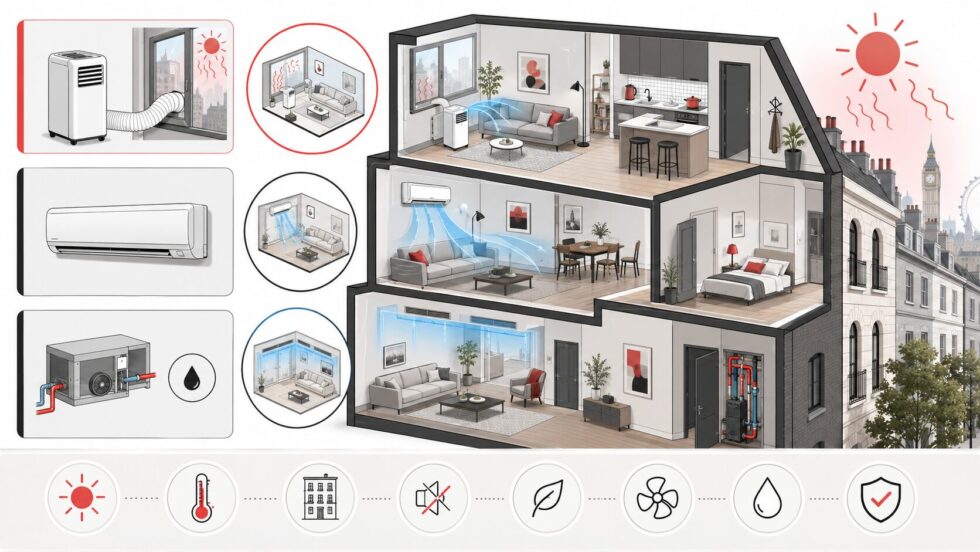
The most realistic choices are clear. A portable air conditioner can cool one room quickly and costs far less upfront, but it needs a window hose and can be noisy. A split air conditioning system is quieter and stronger, but normally needs an outdoor condenser and professional installation. A fully internal air conditioning unit or internal water cooled air conditioning system can work for apartments with no balcony or no external unit permission, but it usually costs more and needs careful technical checks before ordering.
Do flats in London have AC
Most flats in London do not have built-in air conditioning as standard. Older mansion blocks, Victorian conversions, council blocks, new-build flats and many leasehold apartments were designed around heating, insulation and ventilation rather than active cooling. Some high-end developments, serviced apartments, hotels and newer luxury blocks have comfort cooling or integrated systems, but ordinary flats usually rely on fans, open windows, blinds or portable AC units. The problem is strongest in south-facing flats, top-floor apartments, loft conversions, glass-heavy new builds and homes with poor cross-ventilation. In dense parts of London, night-time cooling can be weak because brick, concrete and roads retain heat. This means a bedroom can remain uncomfortable even after the outside temperature drops.
For buyers and tenants, “has AC” should be checked directly before signing. Ask whether the flat has fixed air conditioning, comfort cooling, mechanical ventilation, or only a fan system. These are not the same. Comfort cooling may not perform like full air conditioning, and some systems may be centrally controlled by the building.
Can I install air conditioning in my flat in the UK
Yes, it can be possible to install air conditioning in a UK flat, but it depends on the building, lease, unit type and planning position. The hardest part is usually not the indoor unit; it is the outdoor condenser, drilling, pipe route, condensate drainage and permission from the freeholder or management company. In a leasehold flat, the external wall, balcony, roof space and communal areas are often controlled by the freeholder. That means a leaseholder may need written consent before installing anything outside. If the building is listed, in a conservation area, or has strict façade rules, external air conditioning can become difficult or impossible.
A renter normally needs landlord consent before installing anything fixed. For renters, the safer route is usually a portable air conditioner with a window kit, or a non-fixed cooling solution that does not alter the building. A fixed split system should not be installed without written permission.
What to check before installing AC in a London flat
Check the lease first. Then ask the freeholder or managing agent whether external condensers are allowed. Confirm whether the building is listed or in a conservation area. Ask a qualified installer where the outdoor unit would go, where the pipework would run and how condensate water would drain. Check likely noise impact on neighbours. Get all consent in writing before paying a deposit.
Air conditioning apartment no balcony: what are the options
For an apartment with no balcony, no garden and no easy external wall position, the options are narrower but not impossible. The first option is a portable air conditioner vented through a window. The second is a split system if the installer can position the outdoor unit on a roof, wall, lightwell or approved external area. The third is fully internal air conditioning, including water-cooled systems that do not need a conventional outdoor condenser.
A portable AC is the fastest and cheapest route. It can be useful for a bedroom during heatwaves, but the hose must be vented properly. A badly sealed window lets hot air back in and reduces performance. In bedrooms, noise is the main problem. A fully internal system is more discreet and can suit premium flats, listed buildings and homes where external units are banned. These systems still need installation, ventilation or water connections depending on the model. They are not a casual DIY purchase and should be assessed by a specialist.
Fully internal air conditioning: when it makes sense in London
Fully internal air conditioning is designed for properties where a normal outside condenser is not suitable. This can include apartments with no balcony, listed buildings, conservation-area homes, high-rise flats, luxury developments with façade restrictions and leasehold blocks where the management company refuses external units. The benefit is obvious: there is no visible outdoor condenser on the façade. That can reduce planning, aesthetic and neighbour issues. The drawback is cost, complexity and the need for the right property conditions. Some systems use water cooling; others use different internal arrangements. They may need plumbing, drainage, plant space or specific building access. This route is strongest for owners who plan to stay in the flat, have a serious overheating problem and cannot get permission for a standard split system. It is usually too expensive for short-term renters.
Internal water cooled air conditioning: what it is and what to ask
Internal water cooled air conditioning uses water to remove heat instead of a normal external condenser. This can make it attractive for London apartments where external units are blocked by lease, planning or lack of outdoor space. It is often marketed for apartments, listed buildings and discreet cooling projects.
Before choosing it, ask three questions. First, is the building suitable for the water demand and plumbing route? Second, what are the running costs, including water and electricity? Third, what maintenance is required? A water-cooled system can solve the external-unit problem, but it does not remove the need for technical design. Ask the installer for a written explanation of water use, electrical load, drainage, noise, maintenance and warranty. Also ask whether the system is reversible for heating, whether it cools one room or several rooms, and what happens if the building water pressure changes.
Portable air conditioner: the quickest option for renters and one-room cooling
A portable air conditioner is the quickest answer for a London flat during a heatwave. It can usually be bought for roughly a few hundred pounds, depending on brand, BTU rating and features. It is best for one room, especially a bedroom or home office. The main rule is simple: the hot air must go outside. A window kit matters more than many people think. If the hose is loose, too long or badly sealed, the unit works harder and the room cools more slowly. Portable units also create noise, so the quietest-looking model on paper may still disturb sleep.
For renters, portable AC is usually the safest legal and practical option because it does not require permanent alteration. For owners, it can be a stop-gap before deciding whether to install a split or internal system.
London air conditioning installation: how much does it cost?
For UK homes, a single-room split system is commonly quoted around £1,500 to £3,000 fully installed, depending on property and specification. In London, a simple single split is often around £1,200 to £2,500, while multi-split systems can move into £2,500 to £6,500 or more. Ducted or whole-home systems can reach £8,000 to £15,000+ depending on the project.
For a flat, the cost can rise because access is harder. Scaffolding, long pipe runs, roof access, specialist brackets, condensate pumps, electrical upgrades and management-company conditions can add to the bill. A “cheap” quote may not include all of these.
Typical UK and London AC cost guide
| System | Typical UK/London cost | Best for | Notes |
|---|---|---|---|
| Portable air conditioner | £250–£700+ | Renters, bedrooms, emergency cooling | No fixed install, needs window hose |
| Single split AC | £1,500–£3,000 | One bedroom or office | Usually needs outdoor condenser |
| London single split | £1,200–£2,500+ | Simple London jobs | Access can raise price |
| Multi-split AC | £3,500–£6,500+ | 2–4 rooms | One outdoor unit, several indoor units |
| Ducted AC | £8,000–£15,000+ | Renovations, premium homes | Discreet but expensive |
| Fully internal / water-cooled AC | Often higher quote-based pricing | Flats with no external unit option | Needs specialist survey |
How much to install air conditioning in a flat in the UK
For one room in a UK flat, the realistic installed range is usually about £1,500 to £3,000 for a standard split system where permission, access and pipe runs are straightforward. In London, the same job can sit around £1,200 to £2,500 at the simple end, but many apartment projects cost more once access, leasehold conditions and external-unit placement are included.
For two to four rooms, expect a multi-split quote to move towards £3,500 to £6,500+. If the flat cannot have an external condenser and needs a fully internal or water-cooled system, pricing becomes more bespoke and should be checked by survey rather than guessed online. The key point for buyers is that “flat” is not one category. A ground-floor flat with a private garden is easier than a tenth-floor apartment with no balcony. A top-floor leasehold flat with roof access may be possible but needs written building approval. A listed conversion may need a discreet or internal solution.
What is the $5000 rule for AC
The $5000 rule for AC is not a UK installation rule and not a London planning rule. It is mainly a US-style rule of thumb used when deciding whether to repair or replace an existing HVAC system. The basic formula is: multiply the age of the unit by the repair cost. If the result is more than 5,000, replacement may be more sensible than repair.
Example: if a 10-year-old AC system needs a $600 repair, 10 x 600 = 6,000, so replacement may be considered. But this is only a rough consumer shortcut. It does not apply directly to UK flats buying new air conditioning, and it does not answer leasehold, F-Gas or installation questions in London. For UK buyers, the better rule is different: if the room overheats every summer, the property allows installation, and a fixed system will be used for sleep or work, a properly installed split or internal system may justify the higher upfront cost. If the problem is only a few nights a year, a portable AC may be enough.
Discreet air conditioning: best choices for premium and leasehold flats
Discreet air conditioning matters in London because many buildings do not allow visible external equipment. The most discreet options are ducted systems, concealed indoor units, low-profile wall units, fully internal systems and carefully positioned condensers hidden from public view. For premium apartments, the visual question is often as important as cooling capacity. A visible white indoor unit above a doorway may be acceptable in a rental bedroom but not in a high-end living room. Ducted systems can be cleaner visually, but they usually need ceiling voids, renovation work and a larger budget. For leasehold flats, discretion also means paperwork. A unit may be technically quiet and visually small, but still breach the lease if installed without consent. Always check before work begins.
Air conditioning installation London: how to choose a qualified engineer
For fixed air conditioning, use an installer who can show F-Gas qualifications and proper company certification for work involving refrigerants. Ask for insurance, a written quote, a commissioning certificate, warranty details and a clear installation plan. A good London installer should ask about the room size, window direction, insulation, ceiling height, electrical supply, outdoor unit position, condensate drainage and building permissions. If someone gives a fixed price without seeing photos or asking about access, treat it carefully.
Questions to ask before booking
Ask: Are you F-Gas certified? Is the company certified? Does the quote include electrical work? Where will the outdoor unit go? What is the noise rating? Where does the condensate drain? Is a pump needed? Do I need freeholder consent? Does the system heat as well as cool? What is the annual service cost? What is the warranty on parts and labour?
Planning permission and leasehold rules for London flats
Houses and flats are treated differently, and permitted development rules are not a universal free pass. A house may have more flexibility for an air-source heat pump or combined heating-and-cooling unit, but flats, listed buildings and conservation areas often need extra checks.
In London flats, the lease is usually the first barrier. The freeholder may control external walls, roof areas, balconies and shared spaces. Even when the council position looks manageable, the management company may still refuse an outdoor unit because of appearance, noise or building rules. For fully internal air conditioning, the planning issue may be easier because there is no standard outdoor condenser. But building approval, plumbing, drainage, electrical load and lease terms still matter.
Air conditioning myths UK homeowners should ignore
Myth 1: Air conditioning always makes people ill
It does not automatically make people ill. Poor maintenance, dirty filters, extreme temperature settings and direct cold airflow cause many of the complaints. A clean system used at a moderate temperature can cool a room safely.
Myth 2: Portable AC is useless
Portable AC is not as efficient or quiet as a split system, but it can work well for one room if the hose is short, the window is sealed and the room is closed. It is often the most realistic choice for renters.
Myth 3: A bigger AC unit is always better
Oversized AC can be noisy, inefficient and uncomfortable. The correct unit depends on room size, sun exposure, insulation, window area, ceiling height and how the room is used.
Myth 4: Fans cool the room
Fans cool people, not rooms. They move air across the skin and can help in moderate heat. During extreme heat, especially in a bedroom that remains hot at night, a fan may not solve the problem.
Myth 5: London only has a few hot days, so AC is pointless
That depends on the flat. A shaded ground-floor room may not need AC. A top-floor south-facing bedroom can become unbearable during heatwaves. The decision should be based on indoor temperature, sleep disruption and how often the room overheats.
June and July heat background: why London air conditioning demand is rising in the UK
London air conditioning demand rose sharply in late June 2026 after record-breaking heat hit England and the South East, with London under an orange extreme-heat warning and daytime temperatures reaching about 30C on Saturday, 27 June. The pressure was felt most in top-floor flats, south-facing bedrooms, nurseries, home offices and older buildings where heat remains trapped after sunset.
The issue for July is not whether every day will be dangerously hot. It is whether the next heat spell makes ordinary flats difficult to sleep, work or live in. When indoor temperatures stay high after midnight, cooling becomes a practical health and comfort issue rather than a luxury upgrade. That is why more London households are comparing portable air conditioners, split air conditioning installation, discreet fully internal air conditioning and internal water-cooled air conditioning before the next peak demand period.
| Date | London weather outlook | High / Low | What it means for AC demand |
|---|---|---|---|
| Saturday, 27 June | Changeable and hot; orange extreme-heat warning in force | 30C / 18C | Strong demand for portable AC, fans, window kits and same-week cooling advice |
| Sunday, 28 June | Cooler, clouds and sun | 25C / 14C | Better day to compare prices and avoid panic-buying the wrong unit |
| Monday, 29 June | Sunny, warm and pleasant | 25C / 16C | Good window for installer calls, quotes and leasehold permission checks |
| Tuesday, 30 June | Sun and some cloud, still warm | 24C / 15C | Lower immediate pressure, but top-floor flats may still retain heat |
| Wednesday, 1 July | Warm, cloud early, brighter later | 25C / 16C | Bedroom cooling remains relevant if indoor heat builds through the week |
| Thursday, 2 July | Sunny and warm | 25C / 15C | Portable AC and discreet AC searches likely to continue |
| Friday, 3 July | Sunny and warmer again | 27C / 15C | Demand may rise before the next hotter weekend or heatwave signal |
For London flats, the practical advice is to plan before the next spike. During peak heat, portable air conditioners can sell out, installation slots become limited, and quotes are harder to compare. Owners and leaseholders should check freeholder consent, outdoor-unit rules and F-Gas installer credentials early, while renters may be better served by a portable air conditioner with a properly sealed window kit.
Do flats in London have AC?
Some London flats have air conditioning, but it is still not standard in most ordinary apartments. Fixed AC is more common in premium new-builds, serviced apartments, luxury rental blocks and some converted office-to-residential schemes. Most older London flats rely on fans, open windows, blinds or portable air conditioners.
The highest-risk homes are top-floor flats, south-facing bedrooms, loft conversions, glass-heavy new builds and apartments with no cross-ventilation. In these homes, heat can remain trapped after midnight, which makes cooling a sleep and health issue rather than only a comfort upgrade.
Can I install air conditioning in my flat in the UK?
Yes, but not automatically. In a UK flat, the first check is the lease, not the shop price. If the system needs an outdoor condenser, drilling through an external wall, roof access, balcony placement or condensate drainage, the freeholder or management company may need to approve it in writing.
For fixed air conditioning, the installer must be properly qualified for work involving refrigerants. In practice, UK buyers should ask for F-Gas certification, company certification, public liability insurance, a written quote, a warranty and a clear plan for the outdoor unit, pipework and drainage before paying a deposit.
How much to install air conditioning in a flat in the UK?
A single split air conditioning system for one room in a UK flat is often around £1,500 to £3,000 fully installed. In London, simple jobs can start around £1,200 to £2,500, but flats often become more expensive because of access, long pipe runs, roof work, condensate pumps, electrical checks or leasehold conditions.
A multi-split system for two to four rooms can cost about £3,500 to £6,500+. Ducted or discreet whole-flat systems can move towards £8,000 to £15,000+, especially if the work is part of a renovation. Fully internal or water-cooled air conditioning is usually quote-based because the price depends on plumbing, space, drainage and the building layout.
What if my apartment has no balcony?
If the apartment has no balcony, the fastest option is usually a portable air conditioner vented through a window. It is not as quiet or efficient as a split system, but it can cool one bedroom or home office during a heatwave without permanent installation.
If you own the flat, the next options are: ask permission for an outdoor unit on a roof, wall, lightwell or approved service area; choose a discreet split system if the building allows it; or consider fully internal / internal water-cooled air conditioning if an external condenser is not allowed.
What is fully internal air conditioning?
Fully internal air conditioning is an AC option designed for homes where a normal outdoor condenser is not suitable. It is often considered for London apartments, listed buildings, conservation-area properties, premium flats and homes where the freeholder does not allow visible external units.
It can be more discreet, but it is not a cheap plug-in solution. It normally needs a specialist survey, technical design, space for equipment, drainage or water checks, and a clear explanation of running costs.
What is internal water cooled air conditioning?
Internal water cooled air conditioning removes heat using water rather than a conventional outdoor condenser. It can work for flats with no balcony or no external unit permission, but it must be assessed carefully.
Before ordering, ask the installer about water use, electrical load, drainage, maintenance, noise, warranty and whether the system can cool only one room or several rooms. It can be a strong option for difficult London flats, but it is usually more expensive than a portable AC or a simple single split system.
Is portable AC enough for a London bedroom?
Often yes, if the bedroom is small or medium-sized, the window hose is properly sealed and the unit is not too noisy for sleep. For small bedrooms, around 7,000 to 9,000 BTU is usually the entry range. For larger bedrooms, living rooms or open-plan spaces, buyers often look at 12,000 BTU or more.
The biggest mistake is buying only by BTU. Check the room size in square metres, hose length, window kit, noise level, weight, energy rating, dehumidifier mode and whether the unit can be returned if it is too loud for the bedroom.
Which portable air conditioner models can UK buyers compare?
For a London flat, buyers usually compare budget, mid-range and stronger portable AC models. Prices change during heatwaves, and stock can disappear quickly, so the table should be treated as a buyer’s guide rather than a fixed price list.
| Model / type | Typical price | Best for | What to check before buying |
|---|---|---|---|
| Igenix 9000 BTU 3-in-1 Portable AC | about £249 | Small bedrooms, home offices, budget buyers | Room size, hose kit, noise, two-speed limit |
| Daewoo 9000 BTU Portable AC | about £249 | Budget cooling for one room | Window sealing, noise, weight, delivery stock |
| MeacoCool MC Series Pro 8000–9000 BTU | about £380–£500 | Bedrooms and medium rooms | Noise level, window kit, app controls, stock |
| Bush 9K / 12K Air Conditioner | about £350–£450 | Bedrooms or larger rooms on a budget | Weight, hose length, heat function if needed |
| Meaco Cirro 12000 BTU Portable AC and Heater | about £539.99 | Larger bedrooms and living rooms | 1350W power, size, noise, online stock |
| Meaco Cirro 14000 BTU Smart Portable AC | about £629.99 | Larger rooms needing stronger cooling | Stock, running power, room size, storage space |
| electriQ EcoSilent 10000–12000 BTU | about £699–£750 | Buyers wanting quieter smart portable AC | Noise claim, warranty, delivery time |
| Midea PortaSplit 12000 BTU | higher portable/split-style price | Renters needing stronger cooling without full fixed install | Window/balcony setup, weight, plug socket, suitability |
Where can I buy portable air conditioners in the UK?
UK buyers can compare portable air conditioners at Currys, Argos, John Lewis, Appliances Direct, Amazon UK, B&Q, Screwfix and AO. During heatwaves, the best-value models often sell out first, so it is worth checking stock, delivery date, return policy and whether the window-sealing kit is included.
Currys and Argos are useful for fast collection or delivery. John Lewis is often stronger for warranty and service. Appliances Direct has a wider specialist range, including portable, split-style and wall-mounted options. Amazon UK can be fast, but buyers should check seller reputation, warranty and whether the model is genuinely UK-spec.
Who should install fixed AC in London?
Fixed AC should be installed by a qualified F-Gas engineer or certified air conditioning company. For London flats, choose someone with experience in leasehold buildings, no-balcony apartments, roof access, discreet air conditioning and condensate drainage.
A good quote should include the unit, installation, pipework, wall bracket or mounting, electrical connection, commissioning, warranty and VAT position. It should also explain where the outdoor unit goes, how loud it is, where water drains and what annual servicing costs.
What should I buy first: portable AC, split AC or internal AC?
For renters, start with a portable air conditioner and a proper window kit. For leaseholders with one very hot bedroom, a single split system may be the best long-term option if permission is possible. For apartments with no balcony and no external-unit permission, fully internal or internal water-cooled air conditioning may be the specialist route.
The practical rule is simple: buy portable AC for quick one-room relief, install split AC for quieter long-term cooling, and consider fully internal AC only when a normal outdoor condenser is not possible.
Read about the life of Westminster and Pimlico district, London and the world. 24/7 news with fresh and useful updates on culture, business, technology and city life: Amazon Prime Day 2026: best early deals before the four-day UK sale starts