Boxing Day is not a secondary Christmas holiday in Britain, but a functional transition day built into the country’s social and economic rhythm. Observed on 26 December, it marks the shift from private, family-centred celebration to public life, movement and controlled reopening. Unlike Christmas Day, traditionally defined by stillness, closure and ritual, Boxing Day is characterised by activity: walking, travelling, shopping, watching sport and re-entering shared space. This contrast is deliberate and historically embedded rather than accidental, reflecting how Britain balances tradition with practicality instead of spectacle.
The day has been formally recognised in Britain since at least the 19th century, when it became associated with service, charity and the redistribution of Christmas surplus to workers and the poor. Over time, that social function evolved into a nationwide public holiday — now one of the most stable fixtures in the UK calendar. As noted by the editors of The WP Times, Boxing Day became a defining part of Britain’s post-Christmas rhythm precisely because it allowed the country to reopen without pressure, obligation or symbolic overload.
In practical terms, Boxing Day is when Britain reopens cautiously. Shops unlock doors later than usual, public transport resumes after the complete shutdown of Christmas Day, and museums, parks and retail districts return to use without the demands of a full working day. Trains and buses run partial services, offices remain closed, and footfall concentrates in specific zones rather than across entire cities. The atmosphere is informal but purposeful, particularly in London, where the day functions as a soft reset rather than a return to normality.
For readers and visitors, understanding Boxing Day is essential to understanding how Britain actually works after Christmas. It explains why London feels unusually walkable, why retail peaks before midday, why sport dominates the schedule, and why the country values moderation over excess. The sections that follow set out how Boxing Day is celebrated across Britain, how London differs, what is open, what to expect in 2025, and how to plan the day realistically — not as a festive event, but as a uniquely British transition.
Is Boxing Day a bank holiday in 2025
Yes. Boxing Day is a bank holiday across the UK in 2025, and because 26 December falls on a Friday, it is observed on the date itself rather than substituted. This applies in England, Wales and Northern Ireland, while Scotland also treats the day as a public holiday under its own framework.
What this means in practice is important. Core state functions pause, but the private sector selectively resumes activity. For employees, whether the day is fully off often depends on industry rather than law. Retail, hospitality and transport operate, but with reduced staffing and limited timetables, especially outside city centres.
Key implications of the 2025 calendar
- Government offices remain closed
- Most banks and corporate headquarters shut
- Retail opens later, often between 9:00–10:00
- Public transport runs holiday schedules
Why is it called Boxing Day
The term “Boxing Day” comes from Christmas boxes, not from boxing as a sport. Historically, 26 December was the day when servants, apprentices, postmen and tradespeople received gifts from employers or clients in recognition of a year’s service. These gifts were often practical: money, food, clothing or household goods, packed in boxes for transport home.
Another origin lies in the Church. Collection boxes were traditionally opened on 26 December, and their contents distributed as alms to poorer parishioners. In many large households, servants were also allowed to take leftover food from Christmas Day celebrations, packed into boxes to share with their families.
These practices evolved rather than disappeared. Modern Christmas hampers, now commonly distributed by large employers in early or mid-December, are the contemporary expression of the same idea: acknowledging labour and dependency rather than indulgence.

Boxing Day traditions that still shape behaviour
Several traditions continue to influence how Boxing Day is spent, even if their origins are no longer consciously recognised. The emphasis is on movement, visibility and fairness, rather than festivity.
Core Boxing Day traditions in Britain
- Outdoor walks in parks, countryside or coastal areas
- Watching or attending football matches
- Visiting extended family or friends not seen on Christmas Day
- Casual pub lunches rather than formal meals
- Gift exchanges with neighbours, service staff or carers
Tourism data consistently shows that around 40% of Britons leave the house for a walk on Boxing Day, making it one of the most active days of the festive period. This habit cuts across class and region, reinforcing the day’s outward-facing character.
Is Boxing Day the 26th or the 27th
Boxing Day is always 26 December. Confusion arises because the bank holiday observance can move when the date falls on a weekend. In such cases, the day off work may be granted on the following Monday, but the historical and cultural date remains unchanged.
This distinction matters for employment contracts, especially in retail and transport, where staffing obligations depend on whether the day is treated as a holiday or a trading day. In London, many firms resume limited operations on 27 December regardless, blurring the boundary further.
Official Boxing Day observance: dates and consistency
The table below shows Boxing Day dates and weekdays over a decade. While the date itself never changes, official treatment can vary depending on how weekends fall.
| Year | Weekday | Date | Holiday name | Type |
|---|---|---|---|---|
| 2020 | Saturday | 26 Dec | Boxing Day | Bank holiday |
| 2021 | Sunday | 26 Dec | Boxing Day | Bank holiday |
| 2022 | Monday | 26 Dec | Boxing Day | Bank holiday |
| 2023 | Tuesday | 26 Dec | Boxing Day | Bank holiday |
| 2024 | Thursday | 26 Dec | Boxing Day | Bank holiday |
| 2025 | Friday | 26 Dec | Boxing Day | Bank holiday |
| 2026 | Saturday | 26 Dec | Boxing Day | Bank holiday |
| 2027 | Sunday | 26 Dec | Boxing Day | Bank holiday |
| 2028 | Tuesday | 26 Dec | Boxing Day | Bank holiday |
| 2029 | Wednesday | 26 Dec | Boxing Day | Bank holiday |
| 2030 | Thursday | 26 Dec | Boxing Day | Bank holiday |
London on Boxing Day: a city in half-mode
On 26 December 2025, London once again operates in what can best be described as half-mode — neither closed nor fully reopened. After the complete shutdown of public transport on Christmas Day, services resume on Boxing Day, but on reduced timetables, with later start times and lower frequency, particularly on suburban rail and bus routes. The Underground typically begins operating mid-morning, while some National Rail services remain limited well into the afternoon. For the city, Boxing Day is not about efficiency but about controlled re-entry into movement.
Footfall concentrates sharply in specific zones rather than spreading evenly across the city. Retail districts such as Oxford Street, Covent Garden and Westfield London dominate pedestrian traffic, driven by post-Christmas sales and tourism. Museums and cultural institutions reopen selectively, often between late morning and early evening, while residential neighbourhoods remain unusually quiet due to the near-absence of commuting. This uneven geography is what defines London’s Boxing Day experience.
For visitors, this creates a rare opportunity. Central London becomes walkable, queues are shorter than during peak tourist days, and the pressure of a normal working city is absent. For residents, the day is typically reserved for errands, long walks, informal meetings and recovery before the working week resumes.
What is actually open in London on Boxing Day 2025
Below is a practical overview of typical Boxing Day openings. Exact times may vary, but patterns are consistent year to year.
| Category | What to expect on 26 December |
|---|---|
| Public transport | Tube and buses run from late morning; reduced frequency |
| Major shops | Open, usually 9:00–18:00 |
| Museums | Open with shortened hours (often 11:00–17:00) |
| Restaurants & pubs | Many open, often on limited menus |
| Offices & banks | Closed |
| Residential areas | Quiet, minimal traffic |
Boxing Day walks and outdoor tradition in London
Walking remains one of the most persistent Boxing Day habits, and London’s parks play a central role. Large open spaces fill steadily from late morning, particularly after retail hours peak.
Popular Boxing Day walking areas
- Hyde Park – long circular walks, informal gatherings
- Hampstead Heath – panoramic views, winter walks
- Greenwich Park – quieter, family-oriented atmosphere
- Regent’s Canal – low-pressure urban walking route
These walks reflect Boxing Day’s original function: movement after stillness, without obligation or schedule.
Seasonal events and attractions on Boxing Day 2025
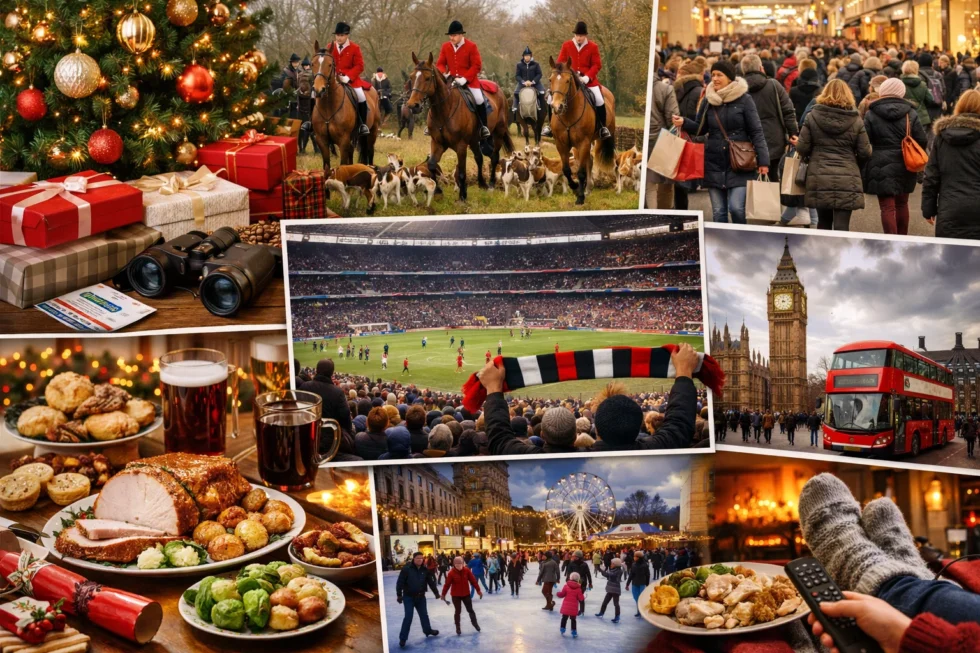
While Boxing Day is not an event-heavy date, several seasonal fixtures reliably operate.
| Event | Date | Location | Notes |
|---|---|---|---|
| Winter Wonderland | Until early Jan | Hyde Park, W2 | Reduced hours, high footfall |
| Museum re-openings | 26 Dec | Central London | Shorter opening windows |
| Boxing Day sales | 26 Dec | Citywide | Peak activity before midday |
| Premier League fixtures | 26 Dec | Various stadiums | Strong TV audiences |
Unlike New Year’s Eve or Christmas markets, Boxing Day events are integrated into routine, not marketed as spectacles. This reinforces the day’s practical character.
Sport and the wider meaning of Boxing Day
Sport has become one of the most visible modern expressions of Boxing Day. Domestic football dominates British schedules, with full league programmes that attract large television audiences. Horse racing remains significant, particularly traditional meetings that have run for decades.
Internationally, Boxing Day has acquired a second sporting identity through the Boxing Day Test, traditionally played on 26 December in Melbourne. While not British, it reinforces the idea of Boxing Day as a global marker of post-Christmas transition, not merely a local custom.
Why Boxing Day still matters
Boxing Day continues to matter in Britain because it performs a function no modern substitute has managed to replace: it restarts public life without forcing productivity. Positioned on 26 December, it acts as a buffer between a fully closed Christmas Day and the abrupt return to work that would otherwise follow. Offices remain shut, but shops reopen; transport resumes, but on reduced schedules; sport dominates the airwaves, but without the pressure of a working week. This calibrated reopening reflects a specifically British approach to time, labour and social balance.
The day also preserves an older idea of acknowledging work without celebrating consumption. Historically rooted in service, charity and redistribution, Boxing Day still carries that imprint. Modern expressions — from employer Christmas hampers to staff bonuses and shift premiums — mirror the original purpose of Christmas boxes. Even in retail, where Boxing Day sales generate billions of pounds annually in the UK, the tone is pragmatic rather than celebratory, focused on clearing stock rather than creating spectacle.
For London, Boxing Day has additional significance. It is the first day the city becomes navigable again after a complete Christmas shutdown. Museums reopen, transport resumes, and public space returns to use without the intensity of a normal weekday. For residents, it enables errands, movement and recovery; for visitors, it offers one of the most manageable days to experience central London during the festive period.
Most importantly, Boxing Day endures because it aligns with Britain’s broader cultural preference for moderation over excess. It is not emotionally demanding, symbolically overloaded or socially compulsory. Instead, it allows individuals to choose how quickly they re-enter public life. In an era of accelerated calendars and compressed holidays, that restraint is not outdated — it is increasingly valuable.
Read about the life of Westminster and Pimlico district, London and the world. 24/7 news with fresh and useful updates on culture, business, technology and city life: London Overground expansion: what a Great Northern takeover would actually change for commuters, property and fares by 2027