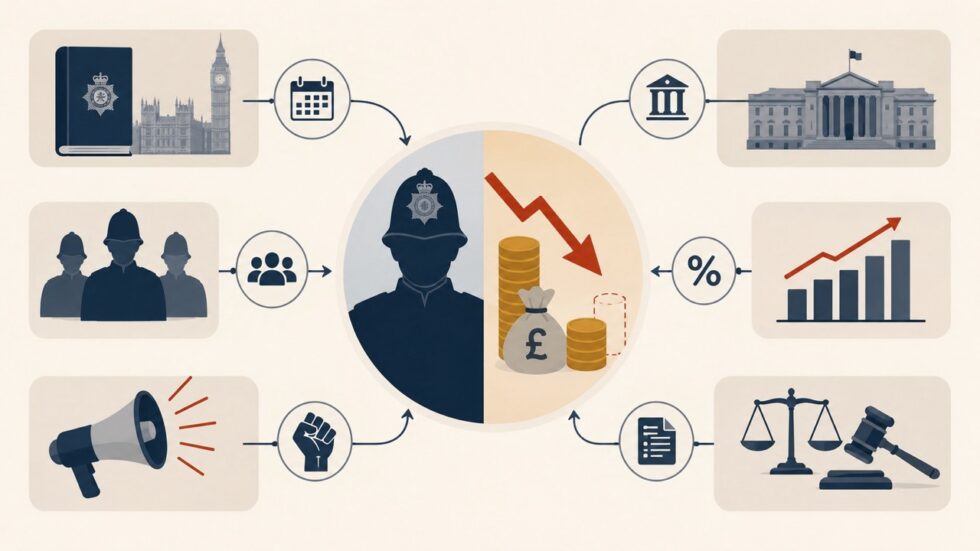
1987 Police Pension Scheme changes have triggered immediate financial consequences for retiring officers across England and Wales after the UK Treasury raised the SCAPE discount rate, reducing lump sum payouts for those leaving service from 21 May 2026. Officers who had already planned retirement based on recent pension forecasts are now facing losses of around five per cent in cash benefits, with no transitional period or prior warning, The WP Times reports.
The abrupt implementation of revised commutation factors means officers exchanging part of their annual pension for a lump sum now receive significantly less than colleagues who retired just days earlier, raising concerns over fairness, legal exposure and the integrity of public sector pension planning.
What are the 1987 Police Pension Scheme changes and why do they matter
The 1987 Police Pension Scheme remains one of the key legacy pension structures for long-serving officers in the UK. While core pension entitlements remain protected, the current controversy centres on commutation factors — the mechanism used to convert annual pension into a one-off lump sum at retirement. This week’s change was driven by a Treasury decision to increase the SCAPE (Superannuation Contributions Adjusted for Past Experience) discount rate to CPI plus two per cent. This technical adjustment has direct real-world consequences: it reduces the amount of cash officers receive when opting for a lump sum.

In practical terms, officers retiring from 21 May 2026 onward will receive approximately 5% less for the same pension exchange compared to those who retired before the change. For many, this equates to losses of several thousand pounds at a critical financial moment. The impact is particularly acute because many officers had already received official pension illustrations under the previous system — and made financial commitments based on those figures.
How much money are officers losing under the new rules
The financial effect of the 1987 Police Pension Scheme changes can be illustrated through standard retirement scenarios. Guidance circulated to pension administrators shows clear reductions in lump sum outcomes.
| Scenario | Before Change | After Change | Difference |
|---|---|---|---|
| Officer retiring at 50 | £174,850 | £166,075 | -£8,775 |
| Typical reduction | — | — | ~5% lower |
| Affected group | Pre-2015 legacy scheme members | Same | Immediate |
These figures demonstrate that even modest percentage adjustments translate into significant real cash losses for individuals.Importantly, the change does not reduce the annual pension itself — only the optional lump sum conversion. However, for many officers, the lump sum is essential for clearing mortgages, supporting family transitions or funding retirement plans.
Why the timing of the change has caused backlash
The strongest reaction has not come from the scale of the reduction alone, but from the speed, timing and lack of warning. The revised commutation factors were issued and applied with immediate effect, meaning officers retiring from 21 May 2026 were placed under a different calculation from colleagues who retired only days earlier. This creates a sharp practical problem: some officers had already received pension quotations or benefit illustrations based on the old factors. Those figures may have influenced decisions on mortgages, debt repayment, family support, relocation or the exact date of retirement. This means that:
- Officers retiring days apart may receive materially different lump sums
- Recent financial planning may no longer match the final pension payment
- No adjustment window appears to have been offered to affected members
- Pension administrators must apply the new factors immediately
- Officers with imminent retirement dates may have little time to reassess their plans
The Police Federation of England and Wales argues that the implementation could now raise legal questions, especially for officers who relied on official projections before retiring. The issue is therefore not only actuarial. It is also about trust, notice and whether public servants were given a fair chance to plan around a major financial change.
“Picking the pockets”: reactions from police leaders and critics
The response from police representatives has been immediate and sharply critical. Federation figures say the change damages confidence in long-term public service pension promises because it alters the cash outcome at the very point officers are leaving the service.
“After decades of service, the ‘thanks’ retiring officers get is this: government quietly shaving cash off a hard-earned retirement overnight.” (John Partington, National Secretary, Police Federation, UK, May 2026)
“Officers who are due to retire imminently… have had the rug pulled from underneath them suffering substantial losses.” (Katie Clements, Chair, Devon and Cornwall Police Federation, UK, May 2026)
The Federation has confirmed it is seeking independent actuarial and legal advice. That review is expected to examine the scale of the reduction, the justification for the new factors and whether officers who received recent quotations may have grounds to challenge the decision because of financial detriment.
However, the criticism is not universal. Lee Broadbent, co-founder of the National Police Association, argued that pension schemes are regularly revalued and that changes to SCAPE rates or contribution assumptions are not unusual. His criticism focuses less on the calculation itself and more on whether representative bodies communicated the issue early enough. That split shows the core dispute: whether this is a normal technical update, badly communicated, or an unfair overnight cut imposed without proper notice.
What exactly is the SCAPE rate and why does it affect pensions
The SCAPE rate is a government discount rate used in public service pension calculations. It helps determine the value today of pension payments that will be made in the future. When the SCAPE rate rises, the calculated present value of future pension payments falls. That matters because commutation factors are based on actuarial assumptions about the value of giving up part of an annual pension in exchange for a lump sum.
In simple terms, the higher rate means the same amount of pension surrendered now converts into a smaller cash payment. That is why officers under the 1987 Police Pension Scheme may receive around five per cent less lump sum than they would have received under the previous factors.
Key implications of the higher SCAPE rate include:
- Lower lump sums for the same pension given up
- Immediate changes to retirement calculations
- Reduced value of commutation for affected members
- Potential effects across other legacy public service pension schemes
- Greater pressure on officers to review retirement timing and financial plans
The technical nature of the SCAPE rate does not make the change abstract. For retiring officers, it translates directly into thousands of pounds less in expected cash.
What happens next for officers and other public sector schemes
The fallout from the 1987 Police Pension Scheme changes is likely to continue because the Federation has already moved toward legal and actuarial review. The key question will be whether the Government had the right to apply the new factors immediately, and whether officers who relied on recent official figures suffered a legally relevant financial detriment. Other legacy public sector schemes may also be affected by similar recalculations. Firefighters’ pensions have already been mentioned as one possible area where comparable changes could follow.
In the short term, the focus is likely to fall on:
- Legal advice for officers with recent retirement quotations
- Actuarial scrutiny of the new commutation factors
- Pressure on the Treasury and pension boards over notice periods
- Calls for clearer communication to members close to retirement
- Possible political pressure over fairness and timing
For officers approaching retirement, the practical advice is clear: they should not rely on older estimates without checking updated figures. The most exposed group is likely to be officers who were close to retirement and had already made decisions based on previous pension illustrations.
In the longer term, the case highlights a wider problem in public sector pensions: technical adjustments can be financially lawful but still feel unfair when they arrive without warning. For officers who served for decades, the controversy is not only about a percentage cut. It is about whether retirement promises can be trusted when the rules change at the final stage.
Key Questions and Answers — 1987 Police Pension Scheme Changes UK
The sudden shift in commutation factors has left many officers, advisers and pension administrators seeking clarity on what the changes mean in practice. Below are the most important questions currently being raised across the UK policing and pensions landscape.
Q: What exactly has changed in the 1987 Police Pension Scheme?
A: The core pension entitlement has not changed. What has changed are the commutation factors, which determine how much lump sum an officer receives when exchanging part of their annual pension. These factors were revised following the increase in the SCAPE discount rate.
Q: When did the new rules take effect?
A: The new commutation factors were applied immediately from 21 May 2026, with no transition period. This means officers retiring from that date are subject to the new, lower lump sum calculations.
Q: How much less will officers receive?
A: On average, officers may receive around 5% less in lump sum for the same pension given up. In real terms, this can mean a reduction of several thousand pounds depending on rank and service length.
Q: Does this affect the annual pension payments?
A: No. The annual pension remains unchanged. The impact is limited to the optional conversion into a lump sum at retirement.
Q: Why has the SCAPE rate increase caused this reduction?
A: A higher SCAPE rate reduces the present value of future pension income. As a result, the amount of cash offered upfront in exchange for that income is lower under actuarial calculations.
Q: Can officers challenge the change legally?
A: The Police Federation is currently seeking legal advice. Challenges may arise particularly in cases where officers relied on recent official pension projections and suffered financial detriment.
Q: Are other public sector pensions affected?
A: Yes, similar adjustments may affect other legacy schemes, including firefighters’ pensions, as they are also linked to Treasury discount rate assumptions.
Read about the life of Westminster and Pimlico district, London and the world. 24/7 news with fresh and useful updates on culture, business, technology and city life: Plan to exempt state pensioners from tax will help just 700,000 – why UK pension tax threshold hits 13 million retirees