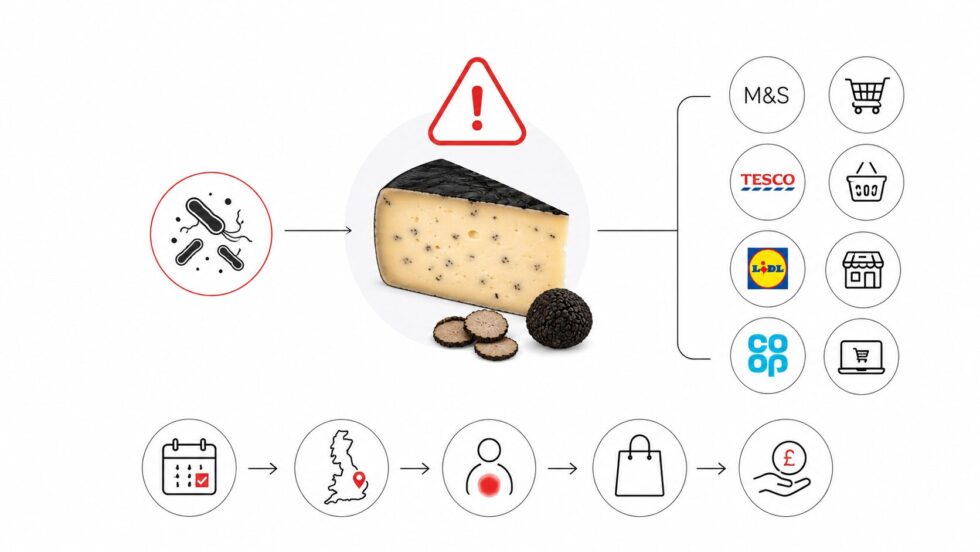
M&S has told customers not to eat a specific batch of its Food Truffle Gouda after Listeria monocytogenes was found in the cheese, adding another urgent warning to a series of supermarket recalls involving Tesco, Lidl, Co-op, Ocado and other major retailers. The M&S action applies specifically to Northern Ireland and covers 150g packs carrying product code 29424887 and a use-by date of 9 October 2026; shoppers should return the cheese for a full refund rather than consume it, The WP Times reports after examining the latest notices issued by the Food Standards Agency and the Food Safety Authority of Ireland.
The wider recall picture is more complicated than some supermarket round-ups suggest because the products are not all affected by the same hazard and the warnings do not all apply across the whole United Kingdom. The M&S cheese alert concerns confirmed Listeria and Northern Ireland; selected Tesco Finest, Lidl Deluxe and Brady Family ham products were recalled in the Republic of Ireland over the possible presence of the same bacterium; a Capsicana salsa sold through Co-op contains undeclared barley and mustard; and Minton & Donello Organic White Orzo, stocked by retailers including Tesco and Ocado, contains undeclared wheat. Customers therefore need to check the exact product name, batch code, date and geographical scope rather than assume that every pack sold under a familiar supermarket name is affected.
Why M&S has recalled Truffle Gouda over a Listeria risk
The central M&S recall concerns M&S Food Truffle Gouda, a 150g cheese product sold in Northern Ireland. According to the Food Standards Agency alert issued on 8 July 2026, the affected pack carries product code 29424887 and a use-by date of 9 October 2026. M&S is removing the product from sale and displaying notices in shops that stocked it, while customers who already bought the cheese are being instructed not to eat it.
The FSA notice states that Listeria monocytogenes is present in the affected product. Symptoms can resemble influenza and may include a high temperature, muscle pain, chills, nausea, vomiting or diarrhoea. In rare cases, listeriosis can lead to serious complications including meningitis. The people considered most vulnerable include:
- adults aged over 65;
- pregnant women and their unborn babies;
- babies younger than one month;
- people whose immune systems are weakened.
The warning does not apply to every M&S cheese or every Truffle Gouda pack. It covers only the specified 150g product with the stated code and date. The FSA says consumers should return it to the retailer for a full refund, while M&S has said that no other products are affected by this particular notice.
The same cheese was also included in an Irish recall covering M&S Food Truffle Gouda with a best-before date of 9 October 2026. The Food Safety Authority of Ireland separately listed Horgans Truffle Gouda sold through Tesco Ireland, with best-before dates of 2 October, 9 October and 24 October 2026. This is important because the Irish alert includes an additional brand and retailer not named in the Northern Ireland FSA notice.
M&S Truffle Gouda details customers should check
| Product | Pack size | Product code | Date | Recall area | Reason |
|---|---|---|---|---|---|
| M&S Food Truffle Gouda | 150g | 29424887 | Use by 9 October 2026 | Northern Ireland | Listeria monocytogenes |
| M&S Food Truffle Gouda | 150g | Check retailer notice | Best before 9 October 2026 | Republic of Ireland | Listeria monocytogenes |
Customers should not rely only on the appearance of the packaging. The identifying code and date are the decisive details. Anyone who has already discarded the outer wrapper and cannot verify the code should contact the retailer before eating the cheese, particularly where the product was bought in Northern Ireland or the Republic of Ireland.
Which Tesco and Lidl ham products have been recalled
Separate warnings involving Tesco and Lidl relate to cooked ham sold in the Republic of Ireland. The Food Safety Authority of Ireland announced on 30 June that five product lines made under the Brady Family, Tesco Finest and Lidl Deluxe brands were being recalled because of the possible presence of Listeria monocytogenes. All of the affected packs carry a use-by date of 16 July 2026.
The products are:
| Product | Pack size | Batch code | Use-by date |
| Brady Family Wood Smoked Real Irish Ham, six slices | 80g | 235417 | 16 July 2026 |
| Brady Family Hand Crumbed Real Irish Ham, six slices | 80g | 235880 or 235765 | 16 July 2026 |
| Lidl Deluxe Triple Oak Smoked Carved Irish Ham, five slices | 130g | 235461 | 16 July 2026 |
| Lidl Deluxe Honey Roast Carved Irish Ham, five slices | 130g | 235473 | 16 July 2026 |
| Tesco Finest Crumbed Shaved Ham, 16 slices | 120g | 235412 | 16 July 2026 |
The FSAI instructed retailers to remove the batches and display recall notices at the point of sale. Consumers were advised not to eat the products.
These ham recalls should not be described as a general UK-wide withdrawal without qualification. The official notice was issued by the Irish authority and applies to the products identified in Ireland. A Tesco or Lidl customer in Britain should therefore check the retailer’s local recall pages or the UK FSA register before assuming that an apparently similar pack purchased in England, Scotland or Wales is included.
The distinction is also important because “possible presence” does not mean that every individual pack has tested positive. A precautionary recall can cover an entire batch where contamination may have occurred during manufacturing, slicing, packing or distribution. The public instruction nevertheless remains the same: do not taste the product to determine whether it is safe.
Why chilled cheese and cooked ham can still carry Listeria
Listeria monocytogenes presents a particular problem in chilled, ready-to-eat foods because refrigeration does not necessarily eliminate it. A contaminated product may look, smell and taste normal, meaning sensory checks cannot establish whether it is safe. For most healthy adults, infection may produce mild flu-like or gastrointestinal symptoms. However, the consequences can be substantially more serious for pregnant women, newborn babies, older people and those with reduced immunity. The Irish food authority says the incubation period averages around three weeks but may range from three to 70 days, so illness may not appear immediately after the contaminated food has been eaten.
Consumers who believe they have eaten one of the affected products should not panic, but they should pay attention to symptoms and seek medical advice when appropriate, particularly if they belong to a higher-risk group. The recall instruction is designed to prevent exposure, not to suggest that every purchaser will become ill.
What Co-op customers need to know about the Capsicana salsa recall
The Co-op-linked recall concerns Capsicana Easy Going Mild Salsa, but the hazard is undeclared allergens rather than bacteria. Capsicana recalled the 285g product after it was found to contain barley, which includes gluten, and mustard that were not declared on the label. The affected salsa has:
- a pack size of 285g;
- batch code 6091;
- a best-before date of May 2027.
The FSA alert is specific to England and Wales. The product may pose a health risk to people with a mustard allergy, an allergy or intolerance to barley or gluten, or coeliac disease. Shoppers affected by those conditions should not eat the salsa and should return it to the shop for a full refund. The official notice states that no receipt is required.
For consumers without the specified allergies or intolerances, the problem is not comparable to the M&S Listeria recall. Undeclared allergens create a potentially serious risk for a defined group of consumers because the packaging does not provide the information needed to avoid an ingredient. The product is recalled because those shoppers may reasonably believe it is suitable for them when it is not. The retailer name also requires careful presentation. Capsicana is the company recalling the salsa, while the product was distributed through Co-op stores. The recall should therefore not be interpreted as evidence of a wider safety problem affecting unrelated Co-op food ranges.
Which Ocado and Tesco shoppers should check Minton & Donello Orzo
A further allergy recall covers Minton & Donello Organic White Orzo, a rice-shaped pasta product that contains wheat and gluten despite those ingredients not being declared on the label or in the ingredients list. Dundeis UK Ltd issued the recall in England and Wales, and the affected product has been reported as stocked through Tesco, Ocado, Amazon and Planet Organic. The recalled packs are 500g and carry batch code 78850. Three best-before dates are affected:
- 31 January 2027;
- 2 May 2027;
- 24 May 2027.
People with an allergy or intolerance to wheat or gluten, or those with coeliac disease, should not eat the orzo. The FSA advises them to return it to the retailer for a full refund.
The product name may cause confusion because “orzo” can be mistaken for rice. In conventional Italian food terminology, however, orzo is normally pasta shaped to resemble a grain. In this case, the safety issue is not that pasta unexpectedly contains wheat in itself, but that wheat was missing from the legally required labelling and ingredients information. Ocado customers should check both products still stored at home and recent delivery records. Online shoppers may be less likely to notice a shelf notice than customers visiting a physical supermarket, so the batch code and best-before date become particularly important.
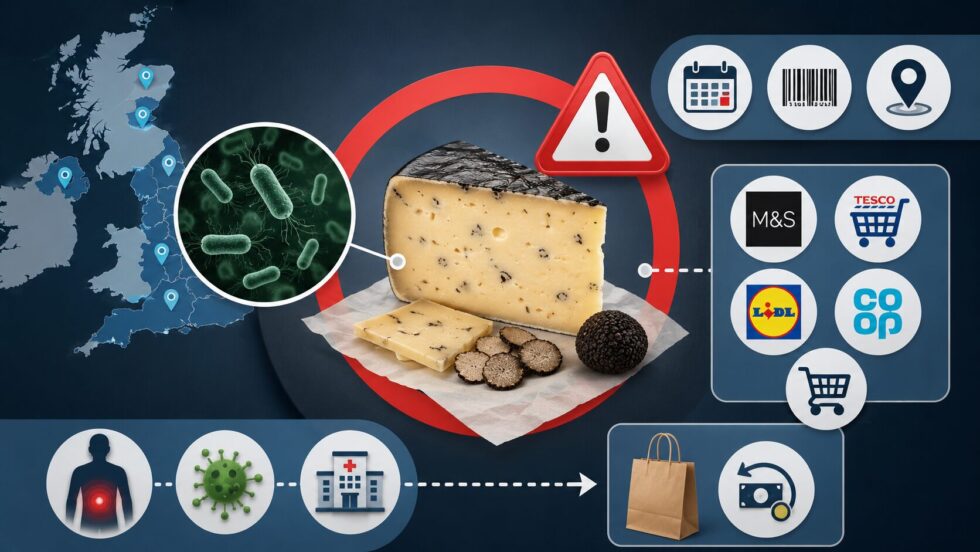
What shoppers should do after a supermarket food recall
A food withdrawal and a food recall are related but different actions. A withdrawal normally removes a product from the supply chain or shelves before it reaches more customers. A recall goes further by asking people who have already bought the product to stop using it and return or dispose of it. The FSA publishes Product Recall Information Notices and allergy alerts so that consumers, retailers and local authorities know what action is required.
Customers checking a recall should follow five steps:
- Match the full product name. Similar products from the same brand may not be affected.
- Check the pack size. A recall may apply to a 150g or 500g pack but not another format.
- Find the batch or product code. This is often the most precise identifier.
- Compare the use-by or best-before date. The recall normally applies only to specified dates.
- Confirm the country or region. Northern Ireland, Great Britain and the Republic of Ireland may be covered by different regulators and supply chains.
Consumers should not eat a recalled product merely because it looks normal or because they have previously consumed part of the pack without becoming ill. They should also avoid giving the product to another person, donating it or using it as an ingredient in cooked food unless the official notice explicitly says that cooking removes the risk.
Where the recall concerns allergens, only consumers affected by the specified allergy or intolerance may face the stated medical risk, but the labelling failure still requires the product to be removed. Where the recall concerns bacteria such as Listeria, the instruction applies to all purchasers of the affected batch.
The full recall position for M&S, Tesco, Lidl, Co-op and Ocado
The latest warnings do not amount to one connected contamination incident across five supermarket groups. They comprise separate regulatory actions involving different manufacturers, products, hazards and markets.
M&S: Truffle Gouda recalled in Northern Ireland because of Listeria monocytogenes; a related Irish alert also covers M&S cheese and Horgans Truffle Gouda.
Tesco and Lidl: specified cooked ham batches recalled in the Republic of Ireland because Listeria may be present.
Co-op: Capsicana Mild Salsa recalled in England and Wales because barley, gluten and mustard were omitted from the label.
Ocado, Tesco, Amazon and Planet Organic: Minton & Donello Organic White Orzo recalled in England and Wales because wheat and gluten were not declared.
The immediate priority is therefore not to clear every product from a household fridge or cupboard, but to identify the exact pack named by the regulator. Customers who match the product, code and date should follow the “do not eat” instruction and return the item through the retailer’s refund process.
Materials used: Food Standards Agency, Food Safety Authority of Ireland, M&S customer recall notice, FSA allergy alerts.
Read about the life of Westminster and Pimlico district, London and the world. 24/7 news with fresh and useful updates on culture, business, technology and city life: The Hidden Labour Market Keeping London's Grandest