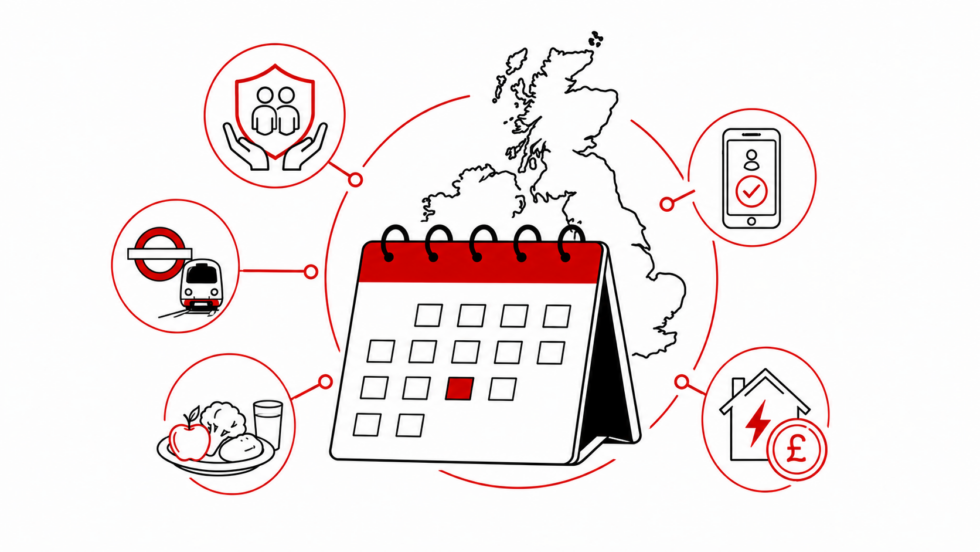
September 2026 brings a series of practical changes across the UK, although not all of them apply in exactly the same way in England, Scotland, Wales and Northern Ireland. From 1 September, safeguarding rules change for people who regularly work or volunteer with children; new statutory guidance takes effect in English schools and colleges; a new framework for digital right-to-work and right-to-rent checks becomes capable of entering into force; and London starts the 2026/27 school year with another £99.4 million allocated to universal free primary school meals. Transport works continue across the capital, while September is also the final month of the current Ofgem energy price cap before new rates take effect on 1 October.
The WP Times reports that the most important UK changes September 2026 are concentrated around schools, employment checks, household costs and London services rather than one single nationwide reform. For households, the practical questions are straightforward: who now needs a stronger DBS check, what parents should know at the start of the school year, how London transport is affected, what happens to energy bills after September and which identity checks employers and landlords may increasingly perform digitally.
The dates to watch are 1 September for safeguarding and school guidance, 10 September for a major London cultural change, 26 September for an Elizabeth line closure at Acton Main Line, and 30 September as the final day of the current energy price-cap period.
Safeguarding rules change from 1 September
One of the clearest legal changes this month concerns adults working or volunteering with children. From 1 September 2026, the supervision exemption is removed from the definition of regulated activity with children. Until now, some unpaid activities such as teaching, training, instructing, caring for or supervising children were not treated as regulated activity when the volunteer was sufficiently supervised by another person. That exemption now disappears. The practical effect is significant for schools, colleges, childcare providers, sports organisations and other settings that regularly use volunteers.
A volunteer will generally fall within regulated activity when the relevant work is carried out frequently or meets the statutory period condition, including activity on more than three days within a 30-day period or overnight. People carrying out such regulated activity will require an enhanced Disclosure and Barring Service check including children’s barred-list information. The main group affected is volunteers who were previously outside regulated activity because their work was supervised. The change applies in England and Wales, with corresponding changes also being made in Northern Ireland. It is therefore more precise to describe it as a major safeguarding reform rather than a single uniform UK-wide administrative rule.
New school safeguarding rules take effect from 1 September
From 1 September 2026, schools and colleges in England must follow the new edition of Keeping Children Safe in Education 2026. It replaces the 2025 guidance and changes both staff safeguarding duties and the way schools deal with volunteers.
The most visible change is the removal of Annex A, the shorter safeguarding summary previously used for staff who did not work directly with children. From September, all staff are expected to read Part One of the guidance, including administrative, support and other employees without regular classroom contact. A separate quick-reference overview remains available, but it does not replace Part One. Schools and colleges will now need to make sure that staff:
- know who the Designated Safeguarding Lead and deputies are;
- understand how and where to report concerns about a child;
- recognise signs of abuse, neglect, exploitation and online harm;
- record safeguarding concerns, decisions and actions properly;
- share information where necessary to protect a child;
- understand procedures for concerns or allegations involving staff.
A separate legal change also starts on 1 September. The supervision exemption for regulated activity with children is removed in England and Wales, with corresponding changes in Northern Ireland. Volunteers who regularly teach, train, instruct, care for or supervise children can therefore fall within regulated activity even when another member of staff is supervising them. This is particularly relevant to reading helpers, assistant sports coaches, youth-group volunteers and people working in outdoor activity centres. Where the activity is carried out frequently, on more than three days in a 30-day period, or overnight, the organisation may need an Enhanced DBS check including Children’s Barred List information.
For parents, there is no new form or application process: the September changes mainly affect how schools, colleges and childcare organisations vet adults, train staff and respond to safeguarding concerns.
London keeps universal free school meals
For London families, the start of the academic year brings continuity on one of the capital’s largest cost-of-living programmes. The Mayor of London has approved spending of up to £99.4 million to continue universal free school meals during the 2026/27 academic year. The funding covers Key Stage 2 pupils in eligible state-funded primary schools across London, including academies, all-through schools, special schools and alternative provision.
City Hall estimates the scheme can save families approximately £500 per child over the school year. Of the total budget, £95.3 million is allocated to core funding, with up to £4.1 million available for additional costs including kosher meals, exceptional costs in special schools and higher-than-expected take-up.
| London school-meal funding | 2026/27 |
|---|---|
| Maximum programme budget | £99.4 million |
| Core allocations | £95.3 million |
| Additional funding | Up to £4.1 million |
| Estimated family saving | About £500 per child |
| Academic year | September 2026–July 2027 |
For London September 2026, this is one of the most tangible household measures because it begins with the new school year rather than on a tax-year or calendar-year date.
London transport works continue through September
London’s September transport picture is defined less by a new fare policy and more by targeted engineering works that can disrupt individual journeys. TfL is continuing major upgrade programmes, including work on the Piccadilly line, while road users are still affected by the long-running A23 Streatham Hill scheme, which is scheduled to continue into spring 2027. The practical impact will vary by route and date. One confirmed change falls on Saturday 26 September, when Elizabeth line trains will not stop at Acton Main Line after 22:00. Passengers travelling through west London that evening may need to use nearby stations or alternative TfL services.
For commuters, the main September risk is not a network-wide shutdown but a patchwork of closures, late-evening changes and engineering diversions.
TfL advises passengers to check the latest status before travelling, particularly for evening and weekend journeys, and to allow extra time where replacement routes or station changes are in place.
Digital right-to-work and right-to-rent checks move to a new framework
Another technical but important September development concerns digital identity verification. On 1 September the government published version 1.1 of the supplementary code for digital right-to-work checks. The code sets rules for digital verification services used by employers that choose to carry out identity-based right-to-work checks. A corresponding version was also published for digital right-to-rent checks used by landlords. The date needs careful wording. These rules do not automatically become fully operational for every employer and landlord on 1 September. They can come into force when the first conformity assessment body is accredited to certify services under the framework, and the government states that this cannot happen before 1 September 2026.
One practical change in the right-to-work code is that certified digital checks can support processes involving expired passports in circumstances permitted by Home Office regulations. The framework also introduces rules for services used to confirm that the person presenting for work is the same person whose right to work has been checked. For employers, landlords and verification providers, this is among the more technical new rules in the UK this autumn, but it could ultimately make more identity checks digital rather than document-based.
September is the last month under the current energy price cap
Household energy prices do not receive a new cap on 1 September, but the month is financially important because the current Ofgem period ends on 30 September. For a standard variable tariff paid by Direct Debit, the average capped rate from 1 July to 30 September is 26.11p per kWh for electricity with a 57.19p daily standing charge. Gas is capped at an average 7.33p per kWh with a 29.04p daily standing charge. The exact figure varies by region, payment method and meter type. From 1 October, electricity rises slightly to an average 26.32p per kWh while its standing charge falls to 54.83p. Gas rises more clearly to 7.97p per kWh, with a 29.68p daily standing charge. Ofgem also notes a tax change affecting comparison with earlier periods: electricity carries no VAT from 1 October 2026 to 31 March 2027. For anyone following UK energy prices, September is therefore the month to check whether a fixed tariff or the new October cap is likely to be cheaper for their actual consumption.
London gets a new Fourth Plinth artwork on 10 September
Not every September change is regulatory. On 10 September, Tschabalala Self’s Lady in Blue is due to be unveiled on the Fourth Plinth in Trafalgar Square. It becomes the 16th commission in the programme since 1998 and replaces Teresa Margolles’ Mil Veces un Instante. The bronze sculpture depicts a contemporary metropolitan woman and will be finished in a lapis-lazuli blue patina. City Hall describes the work as a representation of an everyday London figure rather than a historical monument. The capital is also consulting on its next London Plan, covering housing, transport, the environment and economic development over roughly the next 20 to 25 years. An in-person consultation event is scheduled at City Hall on 22 September.
What matters most in September 2026
The biggest September changes are unusually concentrated around schools and identity checks. From 1 September, organisations working with children face a broader regulated-activity definition, English schools move to updated safeguarding guidance, and the statutory architecture for certified digital right-to-work and right-to-rent checks can begin to operate. London adds its own layer: universal free primary school meals continue for the 2026/27 academic year, TfL engineering works affect selected journeys, and a new Fourth Plinth commission arrives in Trafalgar Square on 10 September. For households across Great Britain, 30 September is also the final day of the current Ofgem price-cap period before October energy rates take effect.
Sources used: GOV.UK, Transport for London, London City Hall and Ofgem.
Read about the life of Westminster and Pimlico district, London and the world. 24/7 news with fresh and useful updates on culture, business, technology and city life: London events October 2026: the rescued Chopin monument returns to life at the National Liberal Club