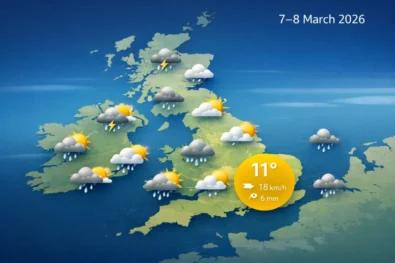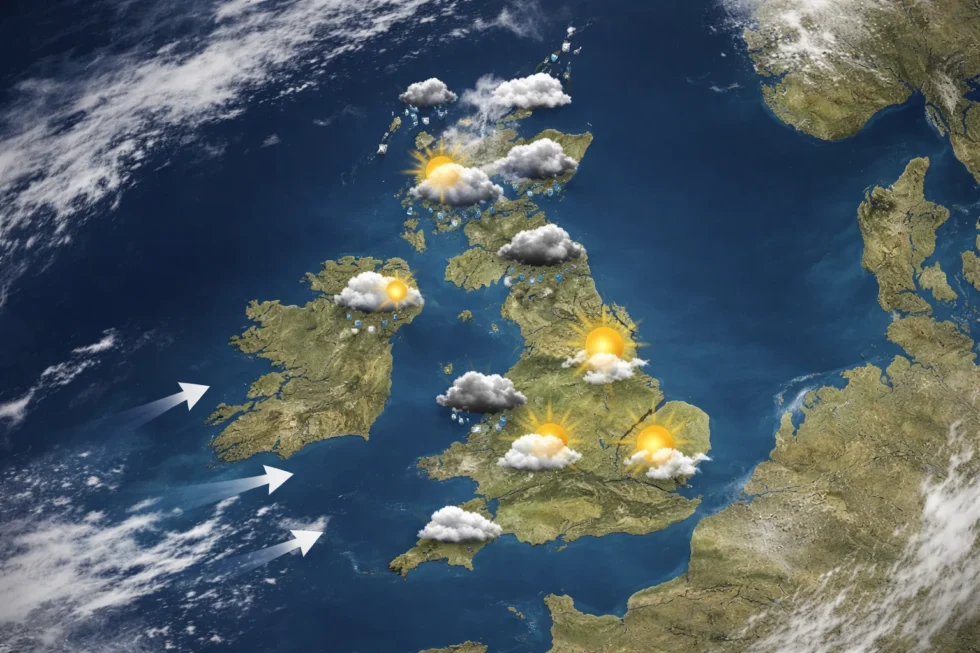
UK weather tomorrow 7 April remains under the influence of post-storm instability following Storm Dave, with London weather tomorrow 7 April conditions and wider weather tomorrow patterns across Britain transitioning into a complex structure of blustery showers, uneven wind fields and short-lived clear spells, reports The WP Times, as forecasters from the Met Office indicate that the country is entering a classic Atlantic-driven recovery phase rather than a stable spring pattern, with heightened attention on London weather, weather Glasgow, Edinburgh weather and ongoing storm warning dynamics affecting regional forecasts.
Synoptic situation: what is driving UK weather tomorrow 7 April
UK weather tomorrow 7 April is not governed by a single фронт or a defined storm centre, but by a multi-layered atmospheric structure that sustains instability across Britain, reports Renewz, with the Met Office pointing to a transitional phase in which improving surface conditions conceal deeper atmospheric volatility. At synoptic scale, the UK is positioned between two competing features:
- a departing low-pressure system tracking into the North Sea
- a weak ridge building tentatively from the southwest
This in-between positioning prevents the atmosphere from settling. Instead, it generates a fragmented and reactive weather pattern driven by three key mechanisms:
- cold polar maritime air advecting across the country
- residual jet stream energy maintaining inconsistent wind fields
- daytime surface heating triggering convective shower development
From a British forecasting perspective, this setup is highly characteristic of post-storm environments. It produces weather that appears calmer on first observation but behaves unpredictably over short timeframes. Crucially, the pattern is non-linear:
→ calmer intervals are repeatedly disrupted by sharp, fast-moving showers and sudden gusts
→ regional contrasts intensify, with the north and west remaining more exposed than the south and east The result is a classic post-storm instability regime — a phase where the headline storm has passed, but the atmosphere has not yet re-established balance.
Regional Breakdown: London, Scotland and Ireland on 7 April — Synoptic Assessment
The UK weather pattern on 7 April is governed by a post-frontal polar maritime regime, following the eastward displacement of a mature Atlantic low into the North Sea. In its wake, the British Isles sit within a weakly cyclonic westerly flow, while a transient ridge attempts — but fails — to stabilise the atmosphere from the southwest. This results in a conditionally unstable environment, where the same air mass expresses itself differently across regions depending on three controlling factors:
— proximity to the jet stream
— vertical thermal gradients (lapse rates)
— degree of exposure to Atlantic moisture advection
The outcome is not uniform recovery, but a fragmented, dynamically evolving pattern.
London: Peripheral instability under weak ridging
London occupies a marginal synoptic position, located on the southern flank of the polar maritime flow and partially influenced by weak ridging. This introduces periodic subsidence, limiting vertical development and suppressing organised convection.
Forecast parameters:
Temperature: 10–14°C
Wind: W–NW 15–25 kt, gusts up to 25 kt (≈30–45 km/h)
Precipitation: isolated, short-lived convective showers
Cloud: broken stratocumulus with intermittent clear intervals
Dynamical interpretation:
— Boundary-layer mixing is present but shallow
— CAPE remains low to marginal → insufficient for sustained convection
— Subsidence interrupts vertical growth cycles, reducing organisation
Operational implications:
— No structural disruption expected across transport or aviation
— Variability is mesoscale (minutes to ~1 hour), not system-driven
→ London sits on the decaying edge of instability, not within a stable air mass
Scotland: Core post-frontal instability with jet support
Scotland remains fully embedded within the cold sector circulation, directly coupled to the trailing dynamics of the departing low and aligned with the jet stream corridor.
Forecast parameters:
Temperature: 5–10°C
Wind: W–NW 25–40 kt, gusts 40–45 kt (≈60–80 km/h)
Precipitation: frequent, locally heavy convective showers
Additional: hail; sleet over higher ground
Dynamical interpretation:
— Steep lapse rates driven by cold air aloft → strong vertical instability
— Jet-induced divergence sustains uplift and convective regeneration
— Orographic forcing over the Highlands enhances intensity
Convective structures evolve into bands and clusters, not isolated cells — indicating a more organised regime.
Operational implications:
— Wind constraints on exposed infrastructure (bridges, coastal routes)
— Rail sensitivity to debris and wind thresholds
— Marine conditions: rough seas, elevated wave energy
→ Scotland represents the active instability core, not a recovery phase
Ireland: Atlantic inflow and moisture-driven convection
Ireland functions as the upstream sector of the system, directly exposed to a persistent Atlantic westerly flow.
Forecast parameters:
Temperature: 8–12°C
Wind: W 20–35 kt, gusts up to 35 kt (≈50–70 km/h)
Precipitation: repeated bands of showers moving eastward
Visibility: variable, locally reduced in heavier bursts
Dynamical interpretation:
— Continuous Atlantic inflow supplies moisture and energy
— Shower bands are more linear and coherent than over Britain
— Higher humidity increases precipitation efficiency
Instability here is less explosive than in Scotland, but more persistent and moisture-driven.
Operational implications:
— Aviation: crosswind components and sequencing delays (notably Dublin)
— Maritime: ferry operations sensitive to combined wind–wave forcing
— Downstream effects: delays propagating into UK airspace
→ Ireland acts as the feeder zone, not just an affected region
Comparative synoptic structure
| Region | Air Mass Position | Instability Type | Wind Regime | Precipitation Mode | Operational Risk |
|---|---|---|---|---|---|
| London | Peripheral / subsident | Weak, shallow | Moderate, gusty | Isolated convection | Low |
| Scotland | Core cold sector | Deep, organised | Strong, sustained | Frequent heavy showers | Moderate–High |
| Ireland | Atlantic inflow (upstream) | Moisture-driven, persistent | Strong, uniform | Repeated frontal bands | Moderate |
Key synoptic conclusion
The UK on 7 April is governed by a single polar maritime air mass, but its behaviour is regionally asymmetric due to dynamical positioning:
— London: subsidence-modified peripheral zone
— Scotland: fully developed instability under jet influence
— Ireland: continuous Atlantic moisture inflow
This is not a stabilised spring regime. It is a transitional phase with incomplete atmospheric recovery, where:
→ instability decays southward, not uniformly
→ local exposure overrides national trend
→ operational impacts are driven by mesoscale variability, not headline conditions
Weather Sensitivity Advice for 7 April 2026

The atmospheric pattern across the UK today is characterised by a post-frontal polar maritime air mass, fluctuating pressure and gusty westerly winds. This combination does not create extreme weather, but it produces physiological instability, particularly for weather-sensitive individuals. The main effect is not severity, but variability — rapid shifts in light, wind exposure and pressure that the body must continuously adapt to. In practical terms, this can lead to headaches, reduced concentration, fatigue and a general sense of internal imbalance. Today should not be treated as a high-performance day. It is a stabilisation window, where managing energy is more effective than pushing output. Key practical guidance:
- Start the day gradually rather than abruptly, avoiding immediate stress or overload in the first hours after waking
- Maintain consistent hydration, preferably with mineral water, as wind and cool air increase fluid loss
- Structure work in focused intervals, as attention span is more vulnerable under fluctuating conditions
- Protect against wind exposure, particularly around the neck and head, to reduce physical stress on the body
- Prioritise warm, balanced meals with protein and avoid sharp sugar spikes that destabilise energy levels
- Limit stimulants such as caffeine on an empty stomach, and avoid alcohol, which amplifies vascular sensitivity
- Reduce unnecessary decisions, especially financial or high-impact ones, as perception and judgement may be less stable
Overall, the most effective strategy today is not intensity but control. Slower pacing, environmental awareness and deliberate choices will produce better outcomes than forcing productivity under unstable atmospheric conditions.
Read about the life of Westminster and Pimlico district, London and the world. 24/7 news with fresh and useful updates on culture, business, technology and city life: Horoscope Today 7 April 2026: Money, Magnetic Storm And Financial Control